Why would you work your ass off trying to do this for a likely meager raise and a pat on the back? No thanks, I’ll take my sanity instead. Keep this energy for your own projects. Do NOT use it to make someone else rich.
I know I’ll get some whataboutisms of people who work for places that give good raises for good work. Great for you but you’re in the minority.
When they start moving away from API calls to third parties to their own embeddings or AI they’re in for a bad time.
What’s going to end up happening is they’ll then create another backend for AI stuff that uses python and then have to deal with multiple backend languages.
They should have just bit the bullet and learned proper async in FastAPI like they mentioned.
I always read blogs of this type and immediately try and find what the author has actually built. Usually it’s either absolutely nothing or a simple blog generator. Nothing wrong with that, but if you want to build stuff you eventually need to stop config twiddling and do it. Hope it works out for her.
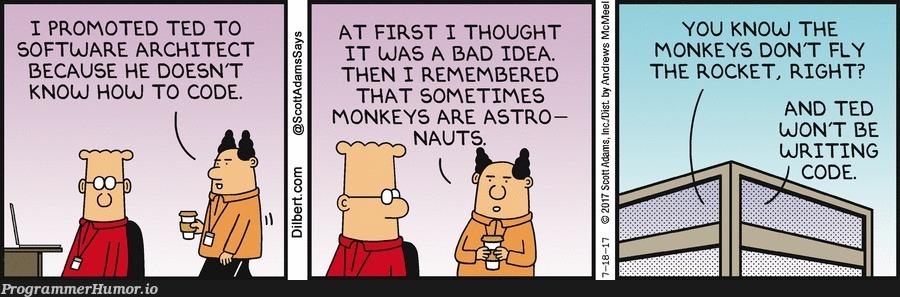
The subtle disdain I hear from these types of super elite principal distinguished architects about actually writing code amuses me. Of course actually writing code is far too lowly of an activity, they’re more of an “ideas guy”. Fred Brooks had a good laugh about these types decades ago.
I have one of those jobs, and I don't contribute a lot of code at work anymore (sometimes, when it makes a difference or I can help save a lot of time).
I still write code almost daily however, e.g. for personal projects or in FOSS. For one, I love it as an activity - writing code is stress-relief for me. If I don't do it for some time I really feel deprived. I also think it's necessary to keep the first-hand knowledge of stacks and tools alive and well, e.g. for effectively communicating with engineers in a way both sides will enjoy.
I also do still make a point to e.g. do a MR regularly at work, partly to make sure I know the processes and their pain points, also so I can use my clout to complain if we make engineers waste time with stupid stuff, as processes also tend to accumulate cruft over time.
And obviously I don't think of writing code as a "lowly activity". Quality and skill matter on every level.
For that matter, you can also encounter quite a lot of "the architects don't know how to code"* stereotypes, so the subtle-disdain thing can go both ways (your comment may be exemplary). I try to prove them wrong by having written more and more different stuff than most :-)
It’s not necessarily disdain, it’s the fact that writing code is necessary but not sufficient to make a successful software project. To have the most positive impact, sometimes you have to focus on the parts that everyone else finds difficult or uninteresting, yet are still important.
What’s the real problem here? The front end looks really bad and it’s causing us to lose potential customers.
Why is that? Maybe we have a shortage of frontend devs. Maybe the frontend code is a mess and people are just hacking in small changes here and there to minimize the time they spend with it. (Maybe both.)
What do you do about it? Fix the alignment now to stop the bleeding. Through that exercise, understand what’s wrong with the front end architecture, get engineering buy-in on an easier approach, and train devs and/or refactor code (efficiently, prioritizing and allocating effort commensurate with the problem), pairing with some devs who have been suffering from the pain and are interested in finally being able to fix it. Advise management on whether we’ll need more frontend talent even after we fix the alignment issue. If so, suggest who might be a good candidate to transition to more frontend work, or else work with sales to lobby for hiring more front end devs even though we have zero headcount budget.
Why would they build their own browser from scratch? That would be dumb without a significantly compelling reason. The author of this post reminds me of one of those guys who writes an entirely new game engine instead of using an off the shelf product and ends up never completing the game..
Good grief. Developers who use Unity/Unreal/Game Maker/ whatever don’t announce their game as being a revolutionary new tech.
The problem isn’t that they made yet another chromium based browser with their garbage on top. The problem is that they’re positioning it as this exciting and radical new thing when it’s just chromium with their garbage on top.
In a scenario where what we're doing is describing and assigning work to someone, having them paste that into an LLM, sending the LLM changes to me to review, me reviewing the LLM output, them pasting that back into the LLM and sending the results for me to review...
What value is that person adding? I can fire up claude code/cursor/whatever myself and get the same result with less overhead. It's not a matter of "is AI valuable", it's a matter of "is this person adding value to the process". In the above case... no, none at all.
Because we know what the value is without AI. I’ve been in the industry for about ten years and others have been in it longer than I have. Folks have enough experience to know what good looks like and to know what bad looks like.
The Stanford study showed mixed results, and you can stratify the data to show that AI failures are driven by process differences as much as circumstantial differences.
The MIT study just has a whole host of problems, but ultimately it boils down to: giving your engineers cursor and telling them to be 10x doesn't work. Beyond each individual engineer being skilled at using AI, you have to adjust your process for it. Code review is a perfect example; until you optimize the review process to reduce human friction, AI tools are going to be massively bottlenecked.
The evil in this world would love to peddle the idea that having any free time, not living in a shitty apartment with four other people, or not dying of hunger or treatable disease is a “luxury”.
Seems like no matter how positive the headline about the technology is, there is invariably someone in the comments pointing out a worst case hypothetical. Is there a name for this phenomenon?
Not believing everything you read on the internet? Being jaded from constant fluff and lies? Not having gell-mann amnesia?
I get your sentiment of "why you gotta bring down this good thing" but the answer to your actual question is battle scars from the constant barrage of hostile lies and whitewashing we are subject to. It's kind of absurd (and mildly irresponsible) to think "THIS time will be the time things only go well and nobody uses the new thing for something I don't want".
Same. We've all fooled ourselves into believing that an LLM / stochastic process was finally solved based on a good result. But the sample size is always to low to be meaningful.
even if it works as described, I'm assuming it's extremely model dependent (eg book prerequisites), so you'd have to re-run this for every model you use, this is basically poor man's finetuning;
maybe explicit support from providers would make it feasible?


I know I’ll get some whataboutisms of people who work for places that give good raises for good work. Great for you but you’re in the minority.