I wonder what part of these failed sales is due to GDRP requirements in the IT enterprise industry. I have my own european view, and it seems our governments are treating the matter very seriously. How do you ensure an AI agent won't leak anything? It just so happened that it wiped entire database or cleared a disk and later being very "sorry" about it. Is the risk worth it?
Having worked with this stuff a lot, privacy isn't the biggest problem (though it is a problem). This shit just doesn't work. Wide-eyed investors might be willing to overlook the 20% failure rates, but ordinary people won't, especially when a single mistake can cost you millions of dollars. In most places I've seen AI shoved - especially Copilot - it takes more time to read and dismiss its crappy suggestions than it does to just do the work without it. But the really insidious case is when you don't realize it is making shit up and then you act on it. If you are lucky you embarrass yourself in front of a customer. If you are unlucky you unintentionally wipe out the production database. That's much more of an overt and immediate concern than leaking some PII.
Some time ago I was through a stage of depression, anxiety attacks and I couldn't eat a thing, my brain was simply refusing to accept a food. I lost a lot of weight then... But this is the worst way of losing weight IMHO. Every now and then I read about intermittent fasting and it reminds me of those days. When simply not eating lead to losing weight.
Education was pretty good there comparing to USA. However, what is more important, are chances after education. Where are you gonna end? In USSR, only in some national soviet office, wasting all your talent...
TBH that’s not exactly true. For entrepreneurs possibilities were indeed limited (it was not impossible, but very hard to enrich yourself), for everyone else the career ladder did exist and you could make considerable impact by your work. SU was running a space program, there was a lot of scientific research and engineering. It raised several generations of dreamers, who now miss that time dearly, when they could just work on what they liked, whether it’s science or city planning, get a free apartment from state, go to parental leave without worries for the future etc. It was empire of evil for sure, but it does not mean people could not use their education for something meaningful.
> for everyone else the career ladder did exist and you could make considerable impact by your work.
This is simply not true and is main reason that superior education in USSR did not materialize in economical and technological prosperity.
Your career advancement in USSR was affected by many factors with your actual performance being near the bottom. Being Jewish was a huge handicap, not being member of the party was another one. Coming from peasants/laborers family was a plus, for there were quotas for advancement of the "hegemony" classes. Bribes as well as your network (or your relatives') could land you better job much easier than hard productive work that nobody values.
Existence in USSR was dull, many talented people drunk themselves to death (drugs were hard to get by). These distinct bright spots like superior education did not change the overall picture.
>now miss that time dearly, when they could just work on what they liked, whether it’s science or city planning, get a free apartment from state, go to parental leave without worries for the future etc.
The problem is, such an utopic system where everyone works on whatever they want and gets free housing from the state was economically unsustainable long term. Which is why it collapsed and most of those people working in science immediately packed their bags and move to the US when it happened because talented people working on interesting things don't like living with shortages in a strict oppressive environment where you had to constantly watch your mouth or risk having your career or life ended swiftly.
It was only sustainable back then due to the massive natural resources the SU had, while enduring shortages and exploiting the forced/slave labor the SU had access to. Not something replicatable or desired in free societies today, though plenty of modern slave labor practices exists in rich western nations today where some industries only survive due to access to cheap labour willing to work below market rate and live in worse conditions than the locals.
Yes and no, it’s more complicated than that. SU style welfare state wasn’t really unsustainable economically — in fact it was rather cheap, it collapsed from different reasons (too much spending on military industrial complex and heavy industry at cost of everything else, no market feedback loop despite having quasi-market relationships between consumers and producers). Basically their economic models at strategic level had wrong KPIs, but incentive system for middle management and workers was ok. In late USSR it wasn’t really a slave labor.
There isn't anything unsustainable in free housing. If everyone is working for the state and state is also everybody's landlord, it's not free, it's just part of compensation. And the housing was really basic anyway, as you can't choose.
Unsustainable part of USSR was military spending, not free housing.
>There isn't anything unsustainable in free housing.
I meant it's unsustainable in capitalistic "free" market economy where it's an appreciating asset. But yes, the free housing in the communist times was actually one of the best things.
Looking what housing it was... I wouldn't be so sure. Today's cashier on a minimum wage lives in a much nicer apartment than average soviet citizen. Who was likely to spend his 20s and 30s in housing with shared amenities. With many people living their whole lives without ever getting a proper apartment.
That also depends.
Capitalistic free market always has some welfare baseline, below which state intervenes and may use money collected via taxes to level the playing field. Free housing can be part of that baseline. It distorts the property market, but like with the opioids market we have to ask if it should be completely free or regulated to death. It’s not like economy will suffer, there will still be construction industry etc, but the incentives will shift and the money buried in property bubbles will go elsewhere.
> It raised several generations of dreamers, who now miss that time dearly, when they could just work on what they liked, whether it’s science or city planning, get a free apartment from state, go to parental leave without worries for the future etc.
In reality that was more a queue for basically anything including apartments, all the high position jobs were taken by party members where you had no chances hence why nobody misses that.
I will not dispute that there was scarcity of basic things, but within that system things were perceived very differently by people and what I said remains true. Nostalgia about those times does exist, so “nobody” is a strong and incorrect word here.
On the nostalgia subject, the main country where people are having nostalgia is Russia and it's not exactly because of the opportunities but because the soviet union was basically also the last colonial empire in anything but by name and some people still haven't moved past the power that goes with it.
No, that's not true. There s word for it in German, "Ostalgia", so it's safe to say that some former East Germans feel it, too.
It was also the wealthiest eastern bloc country, and the one with most "economic freedom" relatively speaking. And despite the infamous totalitarian surveillance system, there was a lot more open, civic defiance like conscientious objection to military service, than there was in Russia.
I do think there's a lot more longing for the empire than for the planned economy in Russia today - but that's not so different from the nationalist movements in Hungary, Poland and Ukraine. They just have other ideas of past greatness.
It is normal to feel nostalgia about good old times when we were younger, yet you assume the motivation is a “colonial empire” (SU was very different from British or Spanish empire in that sense, I’m not sure “colonial” even applies to it economically — this is a political narrative of former republics, which were colonies of Russian empire).
It is a stretch. Majority of Russian population couldn’t care less about the statehood of the former Soviet republics and nostalgia for SU is not the base of the current regime (ideology of which is a conservative nationalism very similar to MAGA). This nostalgia existed in 1990s too and has same nature and features as in Germany.
Given that party membership was ~10% of the adult population, restricting the best jobs to party members didn't mean much. Ambitious people usually became party members, unless something in their background prevented that. Many people were discriminated against for various reasons, but otherwise the lack of party membership signaled lack of ambition.
Lmao, belonging to the party is not the same as working for the party. Would you say third of americans belong to the democratic __establishment__ and another third - to the republican? So, two thirds of americans are the establishment.
And belonging to the party in soviet era didn't mean working in party structure.
You want to raise beyond certain level in engineering or management? You gotta sign up to the party. But signing the paper may be your only activity in the party.
Party membership means different things in different systems.
Soviet/Chinese style communist parties were vanguard parties. Party membership was a privilege you had to earn, and it generally meant that you were a reputable person and potentially a member of the elite. In some sense, it had the same kind of signaling function as having a college degree or passing a leetcode interview.
American Democratic/Republican parties are kind of like semiofficial branches of the government. They have little control over their membership (or their candidates), and membership in itself means very little.
European political parties (at least in the countries I'm familiar with) are private organizations. Party membership tends to be lower than in the Soviet/American systems and signals some nontrivial commitment to the party.
Yes. To this day Cuba is famous for having much better doctors, and even a pharmaceutical industry, than their poverty would suggest. I think it's fairly obvious that when the avenues for social status through entrepreneurship and initiative are limited, the avenues that remain do well - and medicine has been a high-status profession for a long time now.
Likewise, the fields people don't go into for money, like scientific research or performing arts, seem to have been fiercely competitive and high quality in the planned economy countries.
I grew up in the GDR (East Germany). During the standard ten year "polytechnical secondary school" (https://en.wikipedia.org/wiki/Polytechnic_Secondary_School) when it came to deciding what I wanted to become I chose... officer in the East German army, specifically, engineering, airplane maintenance. It never came to that because the wall came down and I switched target to computer science and the civilian sector - for the exact same reason why I wanted to go to the army: A civilian engineering job seemed quite useless.
During school we had lots of contact with real world jobs. Apart from summer jobs, where I usually ended up in some food production factory (brewery, chocolate, sausages - everything was very clean and sanitary, not a single bad anecdote here in any of them), we had "lessons" where we went to the factory and did some limited production of household goods ourselves, learning factory life, processes and various machines. It was a lot of fun and an unambiguously good experience by the way.
Anyway, during my time in the (huge, extremely run-down chemical fiber) factory I saw engineers with shovels digging. That was the last straw, for good pay, good advancement, good social standing and better job satisfaction than the pretty much non-existent one one of an engineer in the GDR (as far as I could witness) the army was the only real option. Ironically, for the exact same selfish reason I switched to desiring a company job immediately after reunification, to the dissatisfaction of the guy in the recruitment office who still hadn't realized how everything had changed around him including his own citizenship.
(2)
The German equivalent of "Business Week", which is called "Wirtschaftswoche", even before the actual reunification had a thick special edition for students about to leave high-school, for the first time issued for both East and West Germany. It included some really big test that one could fill out to get some free advice for oneself based on the result.
It was popular enough that tens of thousands of results were available from both West and now also from East Germany, I had submitted one of them (by letter). It had taken a whole afternoon to fill out.
The result was that overall the East Germans were better than the West Germans in the STEM fields, worse in languages (East German language education sucked, mostly rote learning - even though I had had not just Russian but English too) and in text interpretation.
The Soviet Union was a vast and diverse territory with a wide range of cultural and educational systems. However, the reality for many in the scientific community was one of forced labor and control by the politburo. Fundamental rights such as freedom of speech and academic freedom were suppressed and non-existent.
Modern people must remember that they were told what to work on, when, and how much they would get paid. There wasn't the concept of Sundays or vacations as we have today. There were no choices, only the government's choice.
I can attest that in the Eastern Block (not USSR) where I lived, this was indeed true.
Things could've been different in the USSR which was the conquering country while the Eastern Block their vassals. Many goods produced went straight to the benefit of Russian occupiers while lacking in the Eastern European countries.
So you can attest something different than life of middle class of SU. How is this relevant?
I lived in middle class family in SU and I see it differently.
Just look at the evidence: scientists fleed USSR as soon as they had the chance and not the reverse, scientists invading USSR begging to be in the science paradise the propapaganda sells. If you go to Cuba to learn medicine, you will realise everything is so outdated that cannot be treated seriously. Same happened in USSR, but the propaganda aparatus still works trying to sell the idea of the science paradise, all I've seen traveling to ex USSR, and some communist-socialist places is quite the opposite.
This is certainly not true. I do not know where you get it from, but real brain drain started after transition to a presumably better capitalist democratic system and it happened due to economic reasons. The funding simply went down by orders of magnitude, which made scientific work impossible.
Your personal tourist impressions are not making you closer to understanding of such a big country with such complicated history. Try reading some books if you are really interested.
I have read books, of course. But brain drainage for sure were prior the dissolution. You can read for example about the Operation Osoaviakhim, where 2500 scientists (and their families) were forced to go the soviet union as war reparations. Or the book The Murder of Nikolai Vavilov: The Story of the Persecution of One of the Great Scientists, were you can read how beautiful was science in the soviet union.
The real brain drain started when people were finally allowed to flee the paradise and what was left of it. It wasn't their fault your apparatchiks and yesterday's party members, the real owners of everything, started to carve up their posessions calling themselves capitalists this time. Before the fall only establishment members could flee (illegally) and jews (since the 1970s).
This was true for a very short time though. That’s like painting whole USSR in the spirit of NEP or the corn experiment or Holodomor.
On the other hand, all of that is a good example how experimental and far-reaching the totalitarian regime was. Which is a frequently overlooked feature of this „progressive“ mindset. Every societal change comes with a cost, frequently unexpected.
Forced labor in science? Probably you are referring to “sharashka” — research labs using work of prisoners, but they existed only in Stalin era. There was no forced labor in scientific work before 1928 or after 1953-55. So what exactly is completely true in that fiction?
2) After graduation, you'd get an assignment for your first workplace. Technically you could choose, but in reality the choice was limited and it was more like companies headhunting students. There was no option to refuse all assignments and go on your own.
A partial opt-outs was to get married while in university. If your partner already has a job, then you'll probably get an assignment in same city. Although sometimes they'd just get your partner to move too :)
3) Hiring even for unskilled jobs was highly political. E.g. political prisoners of Stalin era, after returning, would have very hard time to get even a cleaner's job. If somebody had a specific position for you in mind, they had all tools to make it happen.
4) Changing jobs was pretty difficult. You couldn't just leave, move to another city and then look for another job. You couldn't get registration in another city without employment. You'd have to find a company that will agree to hire you first. And if you were needed at your current job... They could easily talk to that company to not hire you (after all both managers were members of the party). Unless that other company really wanted you and the manager had enough political weight to make it happen.
All in all, was it forced labor at gunpoint? No. But free will to pick employment was very limited to say the least.
(1) Yes
(2) Yes, but that was only for university graduates, it was time-bound and came with additional job security guarantees and often with guaranteed accommodation. Not sure if it’s really different from some modern contracts.
(3) I suggest to stop referencing Stalin era as something that is characteristic for the entire history of SU. It was not the longest period and it was indeed special. In other periods being forced to do a particular job was a rare thing.
(4) There were restrictions on the process of changing the job, but compare that to modern world: large notice periods on contracts, non-compete agreements, visas - is it the world of forced labor or sometimes employers have stronger negotiation power than you?
> (2) Yes, but that was only for university graduates, it was time-bound
Time-bound forced work is still forced work.
> and came with additional job security guarantees and often with guaranteed accommodation
Serfdom and slavery also comes with job security and accommodation. It's still forced labor though.
> Not sure if it’s really different from some modern contracts.
You're free to not sign up a modern contract.
> (3) I suggest to stop referencing Stalin era as something that is characteristic for the entire history of SU. It was not the longest period and it was indeed special. In other periods being forced to do a particular job was a rare thing.
Specific example was about post-Stalin era. Many political prisoners and their kids were released from gulags after Stalin's death. Coming back home, even to full-of-anti-soviet-resistance Lithuania, was not easy. A distant relative had to live in Kazakhstan for decades since he couldn't get a registration closer to home. We're talking „lax“ Chruschiov era.
> (4) There were restrictions on the process of changing the job
And there was a lot of unwritten rules were special persons would just fall in a never ending quagmire.
> but compare that to modern world: large notice periods on contracts, non-compete agreements
Non-compete is illegal in many jurisdictions. Few weeks notice seems fair to both sides TBH. Dropping a job on the spot is not nice.
> visas
That doesn't apply to 99.9% of people. If you work in foreign country and don't have permanent residence there, it's up to you. But when you need visa equivalent to move to a city from a village in your native whereabouts...
You mean like negotiating their pay, changing their employer or even the city they lived in? Those simple things were completely impossible under communism: the only employer was The State and you needed papers to move.
Of course things were different if you were part of the nomenklatura (leading party) or the secret police. You were a winner in communism then.
Of course it was, but I am not talking about possibilities, but more on the probabilities side, just to point out:
In a socialist regime, job assignments are made by the state. The state controls most industries and companies, and is responsible for assigning jobs to citizens. However, there may be corruption in the system where individuals in positions of power use their influence to give jobs and favors. It's important to note that the reality of socialist systems can vary significantly depending on the country or region in question and may have different characteristics than described.
But the basics of the corruption system is the same. In fact, low level officials traded jobs, cigarettes, food, for sex if it was a woman who wanted a favor or a job, and rubles if they were males, there are accounts of men giving their wives in order to obtain promotions, jobs, or moving to a another city.
In Venezuela as an example, or Cuba, it happens the same. Citizens don't deal with the State, they deal with low level officials who have the veto power. Basically you become a slave.
> In a socialist regime, job assignments are made by the state.
In a socialist system, the workers exercise control of the means of production, and, as a consequence, of industry.
There are models of socialism where this control is exercised centrally through the state, but it is controversial within socialism. It is widely known because a branch of socialist theory that attempted to adapt Marxist theory (itself one particular corner of socialism) to avoid capitalist development as a prerequisite was influential with groups that haf some success establishing control of various states and implemented it, but it is not the only model of socialism.
So, yes, in the USSR this is a (gross simplification of) the system, but it is not general to “socialism”.
> In a socialist regime, job assignments are made by the state
This is a generic and oversimplified statement that does not apply to Soviet Union. Its history is divided into several periods in some of which mobility of workforce was severely restricted (1940—1956), but not most of the time. You only had to have work, but moving to a different job or different city was certainly possible with 2 weeks notice period (in modern Germany typical contract requires 3 months notice). Some HR departments in manufacturing even had to solve the retention problem due to high churn.
If you want to study history, do not go to nearby book store, read real historians instead.
It is not the same. In capitalists countries, you have options, and new options come out each time someone wants to control the wage, and it's not a problem of the capitalist system but the goverments setting up mininum wage and other controls that kills free market. In socialists regimes there is no options and no chance to even discuss raises with your employers. If you got to Cuba, NK or any other similar country you will see how well prepared people is working on mundane jobs, by force, I've been there and I've been taken from my hotel to airport by a driver in Cuba that he was a doctor. Tell me how these systems will be pro-science if you cannot have access to the best of the technology, market, literature, etc.
Ask your average min wage service worker how much freedom they actually feel they have
Communism sucking does not magically make USA style capitalism a magical utopian paradise where everyone has a private yacht. Sure between the two i'd definitely pick usa - hands down, but lets not pretend that the average worker in usa can just dictate what their wages will be.
He doesn't have any option because the market is regulated. In unregulated market he can move to a better paying position, it always happens like this. Just look the IT market, the moment you're feeling you're not well paid you find out someone else who will pay you more, until you reach a line.
They had options in the East Bloc countries too, it was just that they were limited by who you knew rather than how rich you were.
And I totally agree that being at the mercy of someone you have to ask permission, can be every inch as dispiriting being at the mercy of a person who can set a price.
Oh no. It doesn't even compare. The current "price" is set by the free market and it can be met, negotiated or worked for. It's clear and it's fair even if sometimes steep.
But asking for permission was dehumanizing. You ass belonged to them afterwards. Like asking for a favor from the mob. You were a slave. They were the aristocracy and you were less than dirt.
A lot of this culture still exists today in the post communist countries. Romania has a poor education system that fails most average people who don't go to the handful of elite schools in its wealthiest cities, but leads Europe in medals won at STEM olympiads versus Finland which has the best school system in EU but doesn't win any olympiad medals. This system creates and endemic educational inequality in Romania where few students are very well educated, above western standards, and the vast majority of students are poorly educated and will be stuck in a circle of poverty and sometimes crime and alcohol abuse in the countryside.
It's a relic from the past where the eastern socialist block was very preoccupied with projecting an image of power superiority over the "dumber" and "weaker" west, so investing massive resources in prepping a few younglings in STEM olympiads, along with sports olympics and chess were a way to assert that superiority over the west. As such, back then, if you studied hard and got into a good STEM university you were set for an easy and stable carrier in a big city where the government would provide you with a nice apartment and great school for your future kids. It's how my dad managed to escape one of the poorest villages in the country and move to a big city with a nice job, until everything collapsed in '89 that is and everyone was now broke.
Now it's a pointless endevour as those olympiad medal winners immediately go to ivy league universities, propping up the US economy instead, who doesn't need to invest much in its lower education system as it gets the best students from abroad anyway.
>It doesn't matter if a few elite students win the olympiad.
It matters in the way that it projects an image abroad that the Romanian education system must be really good if so many grads from there win medals and go to ivy league universities. Even though this ads absolutely no value for Romania.
Yes, the image abroad is fine, but the reality in the country is a disaster with kids dropping out of school and rampant functional illiteracy. Needless to say about plagiarism cases among politicians with PhDs. Even the PM is fighting plagiarism accusations in an ongoing court case.
As someone who lived in the Eastern Block (not USSR though), I can tell you: struggle and no hope.
Struggle to get the basics for life: heat, food, clothing, books, disposables. It all took queues, friends, relatives, and black markets.
No hope for the future: no matter what you did, how hard you tried, there was no way to improve your lot in life. It was all outside your influence, all controlled by The Party.
The only dream we had was to somehow escape to the Free West. It was dangerous and you could lose your (or your loved one's) life in the process, but for many it was worth it.
Middle class in a big city on Urals, late USSR (1970-1980s):
My grandfather was repressed (forced labor) in Stalin times, but later became a worker at very large steel mill and made very good money there, even traveling to Egypt as a consultant. He had a good car — Volga (white, the black ones were reserved for party VIPs), moved to a new apartment couple times. We spent enjoyable weekends on dacha (a small plot of land with a house and a garden) or went to a nearby lake to swim or to fish. Spending a week or two in sanatorium in the mountain area was also possible (I think this was sponsored by trade union — still a thing in some large companies in Russia).
My parents were engineers back then, they also had a good job, separate apartment (no morgage, no expensive payments) and dacha. Travel abroad wasn’t really accessible (my father was in Hungary once), but within the country it was a normal thing, flights were relatively cheap.
This was the lifestyle of many our family members and their friends. Of course, there were many people which lived much worse, but for sure life in SU was not eternal suffering of everyone and you did not have to be a party member to live well.
Congrats, your grandfather was part of nomenklatura (establishment), that's 2% of the population. They "repressed" each other, no surprises here. It had nothing to do with the "middle class" (in an alegedly "classless" society, lol).
If you are truly interested and not just negative, I don't know how it was in the USSR apart from anecdotes, but I was born in the GDR in 1972 and lived there until the wall came down, and for that Eastern country I can speak.
Some countries like Rumania had rulers that were the typical tyrants, enriching themselves in the process. But that was not so in all Eastern countries. YES, the party members and governing people did have it better - but the gap between them and the rest was waayyyyy lower than that in Western countries.
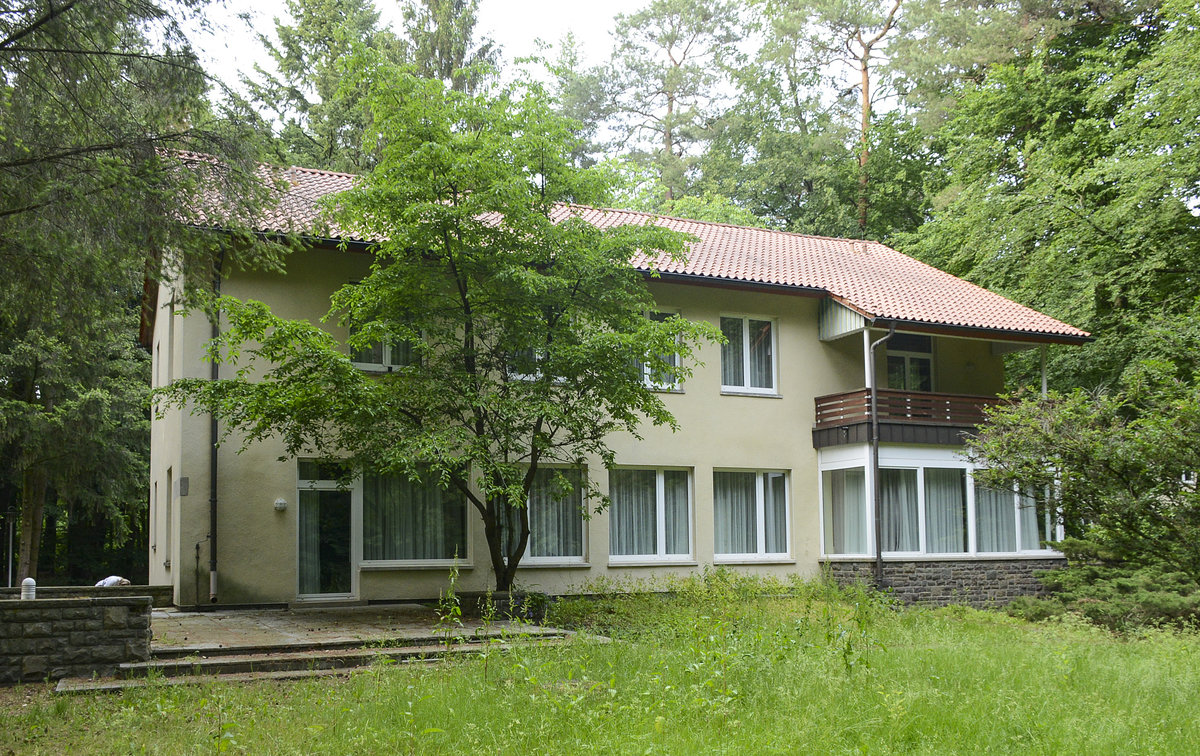
Here are two pictures of Erich Honeckers house, the leader of the GDR, in the protected area where several of the leaders lived, front and back:
He explicitly states in that text that every well working and connected GDR craftsman, movie actor or pub owner would have laughed about the size and everything in there, and that after being the first journalist to tour the place his sense of justice was not triggered at all while seeing it all from the PoV of a regular GDR citizen. Which is exactly the same impression I myself had too when I saw the pictures on TV.
The had a pool! I'm sure every American is very impressed knowing that. They had a better food selection, like the famous bananas that GDR people were always longing for, but it's not like the rest of the country was starving. I remember 40% bad food at school and later in the factory (especially pasta, it was really bad), but at home it was always really good. Only more exotic imports were hard to get, like said bananas, or oranges (other than the terrible Cuban ones).
Honecker did have some privileges, like a hunting ground, but that really is not much, hunters in Germany all have theirs too.
I heard that in Russia it was somewhat similar: While the nomenklatura were better off, e.g. they had Volga cars, but in the end all their advantages pale to anything some middle class person in the west has, never mind the truly rich. The "Getting rich and become a billionaire" thing only started with the economic chaos of the 1990s.
I was one of those in the rallies leading to the fall of the wall (I was 17), and I had always known the fortified GDR borders were keeping us in, and not the Westerners out. But I have to admit the leadership was NOT doing it for their economic benefit. It was truly political and ideological. And it was truly meant to be for the benefit of the "working class". They did care a lot about everyone especially worker and farmer children to get the same good education (well, always plus "political education", but they really believed what they taught, unlike Putin and his cronies today who I think know they are lying to their people and behave more like Mexican cartel bosses) - see my other comment.
They had the ultimate privilege: unlimited power over their fellow human beings. They were much closer to royalty in that respect than to today's billionaire.
What you call "small" advantages: car, pool, VCRs, bananas - put them so far about their average citizen that it was like having a private jet and yacht today.
They justified that amazing power to themselves by saying they did their duty to us... the people. But make no mistake, they were never elected and they didn't give up their power willingly.
> What you call "small" advantages: car, pool, VCRs, bananas - put them so far about their average citizen that it was like having a private jet and yacht today.
At this point at the very latest, if not your first sentence already it is clear that you are nothing but a troll.
But tell someone who actually lived there, me, your nonsense - sure.
> and they didn't give up their power willingly.
They did. I lived there in 1989. Nothing happened. They could have given the order to fire, the troops were listening and obeying. They never did. You tell lies. What a twisted, biased, one-sided world view, on a site that's supposed to have open-minded discussions. Truly disgusting, and I say that especially because this was my live, right then, right there, and you do speak nonsense, which sounds not less ideologically blinded than the worst I heard in the GDR, sometimes personally (to me, a teacher, 1989: "Sie schwimmen im Fahrwasser des Klassenfeinds!").
I too was alive in those times and I remember them very well. I remember a doctor visit meant a pack of Kent or a bag of coffee beans. How a kind's school year meant a deodorizer or some soap for the teacher. How a promotion or advancement meant joining the Party or ratting on your coworkers to the Secret Police.
Just in a different EE country, not in GDR - I must specify. Here we were starving. And they did gave the order to fire - the troops obeyed.
I must also admit that we are extremely skeptical of anything coming out of the ex-GDR around here. We know it was thoroughly infiltrated by the KGB and Stasi controlled everything in the country. We also watched Merkel making the whole Germany dependent on Russian energy, practically delivering it in Putin's hands - who was in KGB in GDR...
That's still not the norm in Russia. Instead, there are agreements between the schools and the nearby public swimming pools that their instructors will teach school children at a certain predefined time of the week. E.g., "between 10am and 11:30 am, the first three lanes in this pool are reserved for school number 42".
Yes if we talk about most of ex-USSR countries during the transition to 11-grade system. Some switched to 12, Lithuania switched back to 10 so grade comparison is a mess. To add some, that switch back in 1990 was done via extending elementary school, so actual 5th grade was equal in both 10- or 11-year program.
Is that that different to the Western model: I have a masters degree in physics. I either have to give up on having a family and buying a house and do research / teach. Or I can go work at a bank doing something with no real social value and have an Ok life.
Even down to "if my parents were rich and connected I would have more options" our system mirror the soviet one in actual opportunities and outcomes. We just have better marketing...
Lol, what do you think you'd do in the soviet system? That'd depend on your parents. If they are party members with connections, you'd get some prestigious (by soviet standards) job. The coolest were to do with production of food, distribution (because then you can "distribute" some to your pockets), embassies (you can go to work in GDR, almost "капстрана", and smuggle some jeans/parfume or something), party apparatus (you're the highest class: you've got your own shops with stuff that isn't available for laymen since 1917, hospitals with western drugs, vip rooms in stations and airports, special reserved train cars and hotel rooms just in case you show up, and gourmet food at prices fixed in 1939). If your parents aren't important after graduation you'd be sent to some remote Shitville in the middle of nowhere, say as a physics teacher's assistant, to redeem your "free" education, no choice, you're "allocated" to "uplift the province", off you go.
That's sort of my point: It's about the same as our current system here in the west because your "choices" are very limited and the outcomes you get primarily depend on your parents' positions...
It doesn't actually matter what system you are stuck with. It matters whether that system offers you actual opportunities and choices. Both can do that. Both can fail to do that. Right now, we in the west are failing.
Seriously? Do you stay in 1hr lines every morning to buy bread and milk? Do you need a year savings and connections to buy furniture or tableware? Can you visit a neighbouring city without asking permission of officials? Do you need a registration of your address at the police, do you need a permission of your employer for it, would you be detained by the first police patrol without it? Can you resign and live off your savings without being arrested? Can you go somewhere during work hours and not being detained? Does your employer uses you as free labor for gathering veggies in the fields? Are you forced to take part in marches and clean up events during your weekends? Are you forced to spend 2 years of your life in the army, can you be sent to Afganistan? Can you leave the country for a personal purpose of yours and without testifying before the commission of homeland security, do you need to pass an ideology exam for that, do you need references and impeccable biography? Can you buy a car, do you need to wait for 5-10 years for that, do you need to prove the sources of income and your __necessity__ (why you need it) to the officials? Do your dentists spend 5-15 minutes per patient, do they have to serve at least 40 people per shift? The list of qustions is endless.
I think you've missed my point here. I am absolutely NOT advocating for communism. I am advocating for opportunity. Right now, we provide very very little of that.
We also ignore our own system's similarities to the failing parts of communism. Take for instance your own question:
>Do you stay in 1hr lines every morning to buy bread and milk? Do you need a year savings and connections to buy furniture or tableware
Of course I don't. Wasting an hour a day for essentials would be terrible right?
Instead, as a rich western capitalist, I waste 2 hours a day commuting to and from a job because our free market has totally failed to provide affordable housing for working people.
It would be madness to have a system where people wasted an hour a day getting bread. So how is it so sensible that the same people waste 2 hours because of crippling housing shortages?
You can do the same comparison with 101 other things like education. I am not required to work for the state to repay my communist state education on pain of arrest. Instead I am required to work for private companies to pay my student loan on pain of homelessness and starvation. But neither system has much opportunity right?
In Soviet Union you were expected to do both and for lousy pay. The joke about women was that they were expected to with in male fields and be there traditional housekeeper at the same time.
The great success of the soviets was getting people from farms to factories (big gain in income and opportunities). The great failure was not getting them any further. It's sort of interesting looking at the stats from Stalin's time. He took the USSR from a feudal society to industrial society. I think this is an under appreciated ability of communism (the same thing has happened in China, Vietnam, Cuba etc). The problem is communism cannot get you any further than that (or so it seems). Hence countries stating "communist" and embracing private industry and free markets (Vietnam and China).
It makes me wonder what we will do next. Is the service economy the final form? Will we need different political/economic models to move to whatever the next form is?
> The great success of the soviets was getting people from farms to factories
People working at farms ("колхоз") got their passports in the 70s. You have no right to leave without a passport, that's a criminal offence. Not to mention you must be registered at a specific address ("прописка", "регистрация") or you'd be detained by the first police patrol. And they got their first salaries in the 50s. Farmers in the USSR were effectively serfs for the most part of history. Slogans aside, no one got them anywhere.
> He took the USSR from a feudal society to industrial society.
Thanks, american taxpayers and spiness commie sympathizing administrations for sponsoring and building the "soviet" industry.
The difference is you: you have choices, and they are your choices.
Under communism you'd just get told what to do, by others.
In capitalism, if the system is not providing you opportunities, you can go out and attempt to make your own opportunity. It's damn hard, near impossible, but nobody is stopping you try. Under communism, it was illegal and they would shoot you for it.
Not really though. My choice is to do what others say or go starve on the street. That's the exact same choice communism offered. Capitalism only actually offers choices when there is a lot of opportunity. But we have drained the opportunity out of the current system.
I don't think people actually really care about communism vs capitalism. They want opportunity. When communism provided that, it did great. When it stopped it fell (after a few shitty decades). Now capitalism has stopped actually giving people actual opportunities...
I think you are right, however prepositions are quite tricky for those whom English language is not mother tongue.
In Polish we could say "on": eg. "12,428 people have now died on COVID-19".
I don't think that was GP's point. "From" seems absolutely correct. Using "with" would mean that the number refers to people who died while having COVID-19; using "from" means COVID-19 was the cause of death.
There is another way. GMail allows to use compact interface. There is option to turn it on: click on 'gears' icon in top right on the top of table/list with e-mails and switch onto compact view.
You can also turn off those "Primary", "Promotions", etc. labels.
Those are options but definitely don’t come anywhere near what the author has achieved! I’m actually very impressed with the new interface.
I can’t believe it, but I’m actually at the point where I no longer enjoy using Gmail. I have an easier time using the Windows Mail application at this point... which is really telling I think.
Yeah it's really nice! :)
However i think there should be an option to disable showing sidewalks for pedestrians, so only roads for cars should be seen then. It would be nice to see where you can drive your car ;)
My two nuggets.
This reminded me of Ijon Tichy's saying after one of his voyages:
" Thus concluded one of the most unusual of my adventures and voyages. Notwithstanding all the hardship and pain it had occasioned me, I was glad of the outcome, since it restored my faith, shaken by corrupt cosmic officeholders, in the natural decency of electronic brains. Yes, it’s comforting to know, when you think about it, that only man can be a bastard. "