Doesn't France have fairly strong labor laws and high taxes?
I recall not long ago seeing headlines about "the rich fleeing France".
I wouldn't think that would be a big draw for finance types, especially when there are other markets in the EU that seem like they would be more tax friendly (Ireland, Luxembourg, Switzerland, Frankfurt), while still being close enough to other centers of power.
"In bank-based financial systems such as Germany and Japan, banks play a leading role in mobilizing savings, allocating capital, overseeing the investment decisions of corporate managers, and in providing risk management vehicles. In market-based financial systems such as England and the United States, securities markets share center stage with banks in terms of getting society’s savings to firms, exerting corporate control, and easing risk management." [1]
France is a bank-based economy. Britain is market based. London's financial dominance pre-dates the EU for good reasons.
"• In higher income countries, stock markets become more active and efficient relative to banks. There is some tendency for national financial systems to become more market oriented, as they become richer.
• Countries with a Common Law tradition, strong protection of shareholder rights, good accounting regulations, low levels of corruption, and no explicit deposit insurance tend to be more market-based.
• Countries with a French Civil Law tradition, poor protection of shareholder and creditor rights, poor contract enforcement, high levels of corruption, poor accounting standards, restrictive banking regulations, and high inflation tend to have underdeveloped financial systems." page 5
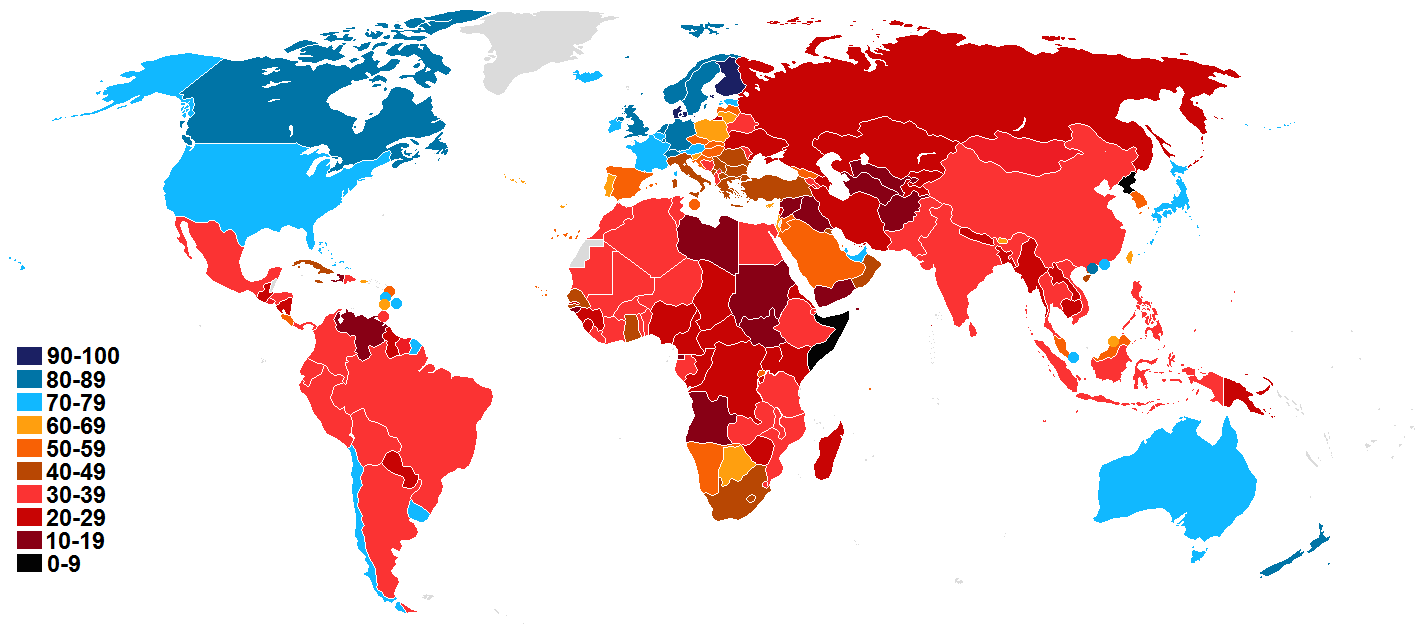
Not sure what you're implying. The US and UK have low levels of corruption; France, Germany, Benelux have high levels of corruption? ¯\_(ツ)_/¯
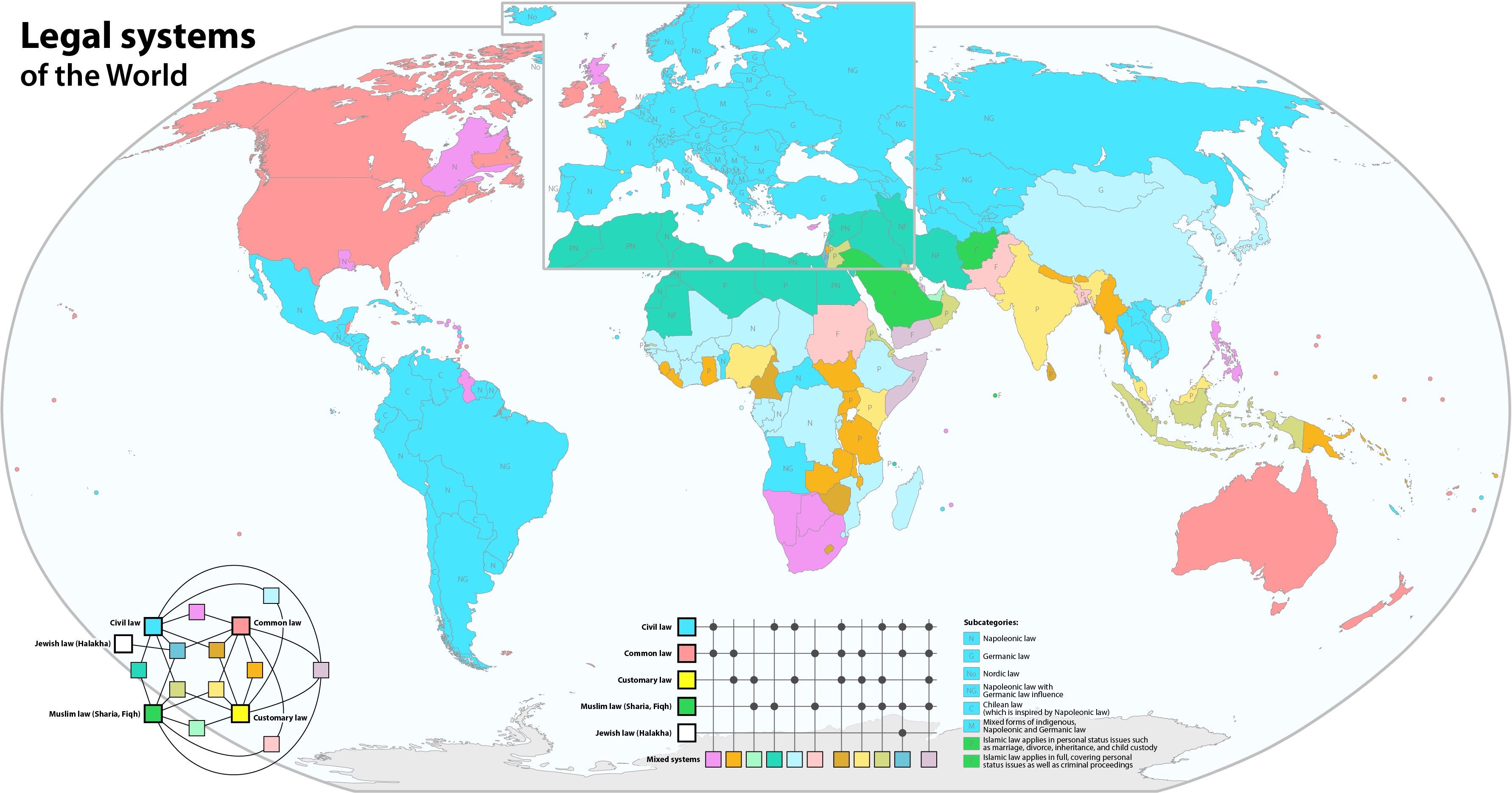
Lets first have a look where Common Law exists [1]. OK, that's pretty easy: It is FVEY plus some islands.
Now lets have a look at the Corruption Perception Index [2] (alternatively, just check the picture at [3]). The UK and US are at place 12 and 17 respectively. The top 10 is comprised of: Denmark, Finland, Sweden, New Zealand, Netherlands, Norway, Switzerland, Singapore, Canada, Germany. I count 2 common law (New Zealand, Canada), and at least 7 Civil Law (I'm not including Singapore because I don't know what kind of law system they have; the list is including that pesky Germany who according to your source have high corruption). I fail to see your pattern.
London bankers' skills are unlikely to efficiently translate to Paris. Moreover, Paris can support less financial activity for having a bank-based economy--banks can't process at the throughputs markets can.
> I fail to see your pattern
The paper considers more than ten European countries. I included the postscript because I found it interesting, not because it's particularly germane to the article topic.
> I included the postscript because I found it interesting
I replied because I saw your quote contained a possible inaccuracy. When I investigated that specific part, I found contradicting proof of a causal relationship between French Civil Law tradition and corruption. Which is what your quote was implying. I didn't attempt to verify anything else, but I'm highly skeptical.
Either that, or I read wrong and what is being implied with:
> Countries with a French Civil Law tradition, poor protection of shareholder and creditor rights, poor contract enforcement, high levels of corruption, poor accounting standards, restrictive banking regulations, and high inflation tend to have underdeveloped financial systems.
(Emphasis mine.)
is that these are all requirements due to and.
Which further is suggested by the quote hereunder that countries with high income such as France, Germany, and Benelux (all of which are original members of the EEC/EC) are not meant to be included in the list you mentioned.
> In higher income countries, stock markets become more active and efficient relative to banks. There is some tendency for national financial systems to become more market oriented, as they become richer.
But hey, if you want to prove your point feel free to prove -with sources- France, Germany, and Benelux each have:
* Poor protection of shareholder and creditor rights
> countries with high income such as France, Germany, and Benelux...are not meant to be included in the list you mentioned
The paper divides economies into three buckets: market-based, bank-based and underdeveloped. It does this by looking at economic factors. It then looks at what other factors, Y, are similar between countries in each bucket. This doesn't work going backwards.
By analogy, suppose I have circles, squares and triangles in blue, green and orange. It is meaningful to group by shape. It may also be meaningful to observe that 90% of the triangles are blue. It does not follow that a random blue shape is a triangle.
> The paper divides economies into three buckets: market-based, bank-based and underdeveloped. It does this by looking at economic factors. It then looks at what other factors, Y, are similar between countries in each bucket. This doesn't work going backwards.
I know it doesn't because the paper is linking certain properties it observes without proving the causation, and then tries mention them as if they're relevant while in reality there's no relevance shown.
(For example, an alternative plausible explanation could be a relation between corruption and wealth.)
> By analogy, suppose I have circles, squares and triangles in blue, green and orange. It is meaningful to group by shape. It may also be meaningful to observe that 90% of the triangles are blue. It does not follow that a random blue shape is a triangle.
Imagine shapes and colours can change, and there's no proof the change is related to the shapes or colours. Imagine the conclusion for the 'blue' is 'beautiful'. Does it then matter to mention that the blue ones happen to be 'beautiful' and 'mostly triangles'? Is it a relevant conclusion that the 'non-beautiful' are 'mostly not triangles' or 'that they are not beautiful because they're mostly not triangles'? The latter is what your quote implied, and its merely suggestive. You have no proof.
Because correlation is not causation. So why does the paper mention it? If you're not willing to prove the missing point, why do you quote it?
I'm not saying Paris isn't a financial centre. It's just in a different league compared to London, NYC, Singapore, Hong Kong or Tokyo.
> The physical location of the trading desks relative to the markets matters little
Making markets requires plugging into financial and political power structures. Due to home-country effects, buyers and sellers of a security tend to congregate around the issuer.
A Singapore desk will hand off to New York to execute an order by a Singaporean buyer and American seller. Note: we're not talking about hedge funds. We're talking about investment bankers, sales-traders and market makers--relationship-driven businesses.
> I'm not saying Paris isn't a financial centre. It's just in a different league compared to London, NYC, Singapore, Hong Kong or Tokyo.
That's true. But the point here is that a lot of London's banking depends on unfettered access to the EU markets, and so the question is not "which city", but "which city in the EU" will take over once the UK exits the EU.
> Making markets requires plugging into financial and political power structures. Due to home-country effects, buyers and sellers of a security tend to congregate around the issuer.
That matters for some roles, but certainly not all. But this same arguments also is part of the exact reason why the UK faces an onslaught post-Brexit.
Very interesting. I buy into your market vs. bank based economy argument. Would make sense out of many personal observations.
But how come (French) Civil Law is to be 'a bug'? To me Civil Law seems superior, because it tends to make law more codified and less informal. In return it seems to be more affordable for the masses. If you're considering where to locate your startup for example, the differential in litigation costs between UK and Germany is said to be 3 to 1. But really, I'd like to know what you think.
The paper divides economies into three buckets: market-based, bank-based and underdeveloped. French Civil Law is found in a disproportionate number of underdeveloped economies. I suspect this has to do with France's colonial traditions more than the merits of civil versus common law. (Based on what I've read, both legal systems have produced advanced, albeit structurally different, economies.)
Thanks! Africa seems to be a big contributor, but there are lots of mixed systems in the wild it seems [1][2]. Wonder how the paper draws the line there...
Zero chance Paris pulls a large percentage of these bankers. They do have a lot of bad labor laws and quite high taxes, both of which have contributed to France having a very stagnant economy (both in terms of innovation and growth) for decades. In real terms their economy hasn't expanded in nearly 25 years. The centers of power in Europe are still by far in Germany and the UK. French voters have noticed the problem, which is why their Socialist leader recently had a 4% approval rating and the far-right is making big gains. The same disastrous policies that have left them with a broken economy, will keep the London bankers away. There are half a dozen other major cities that will get a look before Paris.
Not to mention, France is increasingly an outlier in Europe with a punishing corporate income tax rate (33%). Most of their European competitors have been slashing that rate the past decade plus: Netherlands 25%, Spain 25%, Austria 25%, Sweden 22%, Denmark 22%, Portugal 21%, Finland 20%, UK 20%, Iceland 20%, Czech 19%, Poland 19%, Switzerland 17.9%, Ireland 12.5%. The average across Europe is about 20%. Why would an international bank want to be there, except for local French business purposes?
France has a large percentage of EU bankers already.
Only Frankfurt and London are at a similar level as Paris in the EU for banking today, and if London ceases to be a viable alternative (due to passporting etc. post brexit), then Paris will end up taking a lot of that business for the simple reason labour laws and taxes are not the only things the banks need to care about, but also where their employees are willing to live and work.
My ex works in HR at executive level at a major investment bank. French labour laws etc. never comes up when they consider where to staff up/down (and they do continuously). As for corporate taxes, no investment bank has a problem finding schemes to shift profits around.
> They do have a lot of bad labor laws and quite high taxes, both of which have contributed to France having a very stagnant economy (both in terms of innovation and growth) for decades.
Their GDP per capita is largely moving in lockstep with the UK and Germany, despite far fewer hours worked per year for the average French worker. As it turns out there's very little evidence that these "bad labour laws and quit high taxes" have much impact on growth.
> Not to mention, France is increasingly an outlier in Europe with a punishing corporate income tax rate (33%).
In line with Germany.
> The average across Europe is about 20%. Why would an international bank want to be there, except for local French business purposes?
They are already there for purposes other than "local French business purposes". Many international banks have similar numbers of staff in Paris as in London.
>> Not to mention, France is increasingly an outlier in Europe with a punishing corporate income tax rate (33%).
> In line with Germany.
The problem in France is not corporate income tax, as some huge companies do not pay that tax with creative but perfectly legal accounting.
The problems are with the "taxe professionelle" which is not based on revenues and the taxes on labour. If some employee receives 2000 euros, usually the company has to provision 3000 to 4000 euros. Most of those labor taxes go to the social security organism which has a budget as large as the state budget.
(Edited for grammar and clarity)
> If some employee receives 2000 euros, usually the company has to provision 3000 to 4000 euros. Most of those labor taxes go to the social security organism which has a budget as large as the state budget. (Edited for grammar and clarity)
This is similar in the UK with employers national insurance contributions.
Total tax wedge in France is higher than the UK and higher than the OECD average, but still in line with Germany according to the OECD [1], just as I stated. Note that the OECD tax wedge data covers total cost paid by both employees and employers.
The French consulate publishes inflated estimates without evidence for obvious self-serving reasons, but verifiable data from the ONS is singnificantly lower than that.
It really doesn't at all, please take the time to read it. UK stats (census and ONS numbers) put the number of French nationals between 66000 and 86000, which would make it the 44th biggest French city at best (taking the largest figure).
Le Monde's estimate, also given in the article and based on a comparable INSEE data would make it 23rd.
Repeating ad nauseam the unsubstantiated claim that it's the 7th largest French city when all evidence suggests it doesn't even make the top 20 is not a worthwhile contribution to this discussion.
The bank my ex works at has as many traders in Paris as in London, for example, and that's fairly common.
I don't doubt there are many French traders in London - these banks shifts staff and roles around as if they're commodities. But that doesn't change the fact that Paris has a large proportion of the EU financial industry. Not as large as London, but substantial enough for Paris to be a major financial centre.
The competition isn't between London and Paris. It is about which EU cities will take the most business from London due to potential limits on market access.
It's not a question if banks will move some portion of staff out of London, but how many and where they go.
London does have more than Paris, but Paris and Frankfurt are the only two other EU cities that consistently get listed amongst the top global financial centres.
What exactly that means in hard cash depends on what you want to count and how, and so the rankings vary greatly depending on who you ask.
This is simply not true. If you look at the report of the Cour des Comptes regarding the tax rates of the financial sector [1] you will see that France take less taxes on bank than pretty much all OECD countries, the only exceptions being Portugal, Spain, Finland and Austria. There are a lot of methods for banks or big company to lower taxes in France and it works well with both bank and France's interests.
This. Nitpick : it is not a left vs right problem, Sarkozy did next to nothing to make France a better country for entrepreneurship and Fillion who is said to be the next french president was prime minister at that time. France isn't a country for young innovative businesses, it's a country where basically a dozen of big corporations control the entire economy and the rest are just sub-contractors. Neither the left nor the right want to change that. French people will continue voting for high unemployment and stagnation.
I think he meant the labor laws are protecting more the employee than the employer, notably on the firing part. So, as far as some theories go, if it is hard to fire employees, employers will be more reluctant to hire, reducing worker mobility.
But I only have a small experience of the consequence of our current labor laws (which are very hard to change, the current gov tried last year and got massive protests for their trouble).
Edit: Also the employment taxes (the one paid by employers) are very high in France (half of the salary +/-).
In Sweden, which I image has similar laws, managers (ie. employees with responsibility for other employees, not "team leads") usually have no specified working hours at all. They're trusted and expected to work as much or as little as they need. Most still work ~40 hours/week however.
Yep, we have this status, it's called "Cadre" in France, and you don't even have to be a manager, you just need to have a certain autonomy on your work, which basically apply to everyone that work in an office.
20K bankers to shortly find themselves working in a regional office and wishing they could relocate back.
Passporting doesn't require moving your employees wholesale, you just setup a subsidiary within Europe and trade with that legal entity for European trades. A skeleton office is all that is required.
I was thinking that. Nearly all the big banks must have European branches already and presumably someone at Barclays London can log into the systems of Barclays Paris and do a trade there for instance if it has to be done that way.
Given most of global trading in London is USD debt anway, can't happen, won't happen, Thinking in London, doing in Dublin, the manual part that is necessary anyway today.
Well, those X,000 bankers pay their taxes (to some degree), pay rent, buy food in restaurants..
So their absence is disruptive to the local economy, considering how much money their earned.
Comments by people in the English banking ecosystem: France is completely delusional about being able to attract English financial ecosystem. They are only hesitating between Amsterdam and Frankfurt.
France already has a large portion of the EU financial ecosystem. Large banks are constantly adjusting their staffing balance between their various countries, and Paris is high on the list of countries for them to hire in.
Source: an ex that is currently processing staffing numbers across EMEA for a major international investment bank.
Frankfurt is too small to subsume most of this business because of a difficulty getting staff that is willing to work there, and Amsterdam has a different focus. Likely they'll all get part of the pie, but that some of it goes to Paris is pretty much guaranteed.
It is to some. But it's not considered metropolitan enough to many. It's not that no banks will move there - clearly they will, there are plenty there aready. It's that Paris is a better brand for a large portion of employees. For staff with ties to London, it's also near-commutable. I've worked with people in London doing weekend-commuting far longer (in travel time) that Paris.
But most major banks have desks both in Frankfurt and Paris already, not just to handle local business but because it's hard enough getting top people to London (my ex even regularly tells me of her frustrations of dealing with offices in certain countries that exists solely because a single hotshot trader prefers a certain city over one of their big centres and brings in enough business for it to be worth a whole support staff to keep them happy) and so most of these banks needs presences in lots of places to be attractive.
If you don't have a presence in Paris and your competitor does, you're going to lose a sufficient portion of high-value traders to competitors over it for it to be an issue.
I'd like to point out two things regarding the size of Frankfurt.
Frankfurt is no London and no Paris, this is clear. However, that's also related to the way in which Germany as a whole functions. The individual cities aren't all that big, but they are clustered in metropolitan areas.
If you live in the vicinity of Frankfurt, you can just drive to Heidelberg for a Saturday night out (about an hour). Or, if you're more interested in food, theater or classical music, you have a large selection from Mainz to Aschaffenburg, all of which is easily reachable from Frankfurt.
Equally, the pool of support staff you can draw from isn't recruited from the minuscule population of Frankfurt (700k), but from the whole metro region (5.5 million). I myself live at the outermost boundary of the metro region and know many people who commute to Frankfurt.
The second point is that the relatively small size of the city of Frankfurt is an asset in one critical regard: Frankfurt is first and foremost a banking city (and secondly an airport city). If banks want to exert some influence over policy there, they have all the leverage they could want. This is not the case in Paris.
Personally, I'd be surprised if there was anything other than a somewhat even split of relocations between Frankfurt and Paris. And I'm fairly certain that the TGV service between Frankfurt and Paris will also be extended beyond what exists today.
Frankfurt has very good train connections as well. Specifically to Cologne which is via the hi-speed tracks, but also to Amsterdam and Vienna.
One big advantage of Frankfurt is that Germans are much more open to speaking English than the French, and this is an advantage that should not be underestimated. If you don't speak German, but do speak English it's possible to live in Frankfurt. To live in Paris, you have to speak French.
Only Amsterdam (which has English as its official language next to Dutch) is better in that regard. In Amsterdam you don't even have to ask if someone speaks English (that's considered an insult, on the same level of asking someone whether they can read and write).
The language point you touch on cannot be stressed enough. I have first hand experience with this as I travel to Germany on a regular basis and find Germans much more accommodating language wise than the French.
I also have had first hand experience of staff at establishments in Paris simply refusing to speak English. All in all if I had to choose as a Londoner I would prefer to move to Frankfurt or Amsterdam over Paris any day of the week.
> If you don't speak German, but do speak English it's possible to live in Frankfurt. To live in Paris, you have to speak French.
I speak French, but not that well. First time I went to Paris ('94) it was indeed close to what you suggest, but my French-teacher was right about one thing: As long as you got the pronunciation right and tried people would fall over themselves to try to help you.
Last times I've been in Paris, on the other hand, people would impatiently interrupt me when I tried to practice my French, and switch to English. It was outright annoying, as it made it hard to improve.
The most inconvenienced I've ever been was in some little village in Provence a couple of decades ago, when a shopkeeper didn't understand my French. But he proceeded to stop random passers-by until he found one that was willing and able to translate.
> The individual cities aren't all that big, but they are clustered in metropolitan areas.
That's the same everywhere. London is a cluster. My suburb of London itself has about a dozen town centres.
> Frankfurt is first and foremost a banking city (and secondly an airport city)
That's great for employers, awful for employees.
> If you live in the vicinity of Frankfurt, you can just drive to Heidelberg for a Saturday night out (about an hour)
Driving for an hour is not attractive for going out whe working long hours. This is why you see bankers paying millions of pounds for small flats in London Docklands so they are close to both work and nightlife. People who are used to walking distance or a few minutes on the underground to get to work and the same to get to restaurants and nightclubs are not going to be impressed by an hour to get someone interesting.
> Equally, the pool of support staff you can draw from isn't recruited from the minuscule population of Frankfurt (700k), but from the whole metro region (5.5 million).
Nobody cares about the support staff. They're easy to hire and cheap. The banks cares about the traders they pay a million plus in base salary and similar levels in bonuses. If they are willing to move to Frankfurt, the banks will go there. If they say "no, I'll just go to bank Y instead - they have an office in Paris," the banks will go to Paris.
As I've mentioned elsewhere, the bank my ex works for maintains several offices because of individual traders that insist on living in specific places and who bring enough business to justify it.
> If banks want to exert some influence over policy there, they have all the leverage they could want. This is not the case in Paris.
Banks have plenty of leverage in London, which is much larger than both Paris and Frankfurt combined. If anything they will have more leverage in Paris because Frankfurt is real competition for Paris in a way neither Paris or Frankfurt has been for London.
I wonder why these elite traders don't want to come to Berlin, which has plenty of culture/nightlife/etc within short walking/subway distance of many central spots? Certainly more interesting than Frankfurt.
It currently doesn't have the infrastructure. I just spoke with some Americans working in London, and while they'd generally prefer Frankfurt over Dublin, there are apparently currently no spaces in the international schools in the area. Sounds like a small issue, but can be significant, especially if you have a lot of people on management level who would need spaces there.
But generally, Frankfurt is perceived very well. Less hostile towards non-French speakers than Paris (subjectively), less remote than Dublin. It's a very small city, but you're quickly in Munich/Berlin/Cologne, which helps.
> But generally, Frankfurt is perceived very well. Less hostile towards non-French speakers than Paris (subjectively), less remote than Dublin. It's a very small city, but you're quickly in Munich/Berlin/Cologne, which helps.
that's objective, germans generally are more keen to speak with foreigners in english than french, no matter their level
I always thought so, but my recent trips to Paris were very surprising that everyone was happy to speak English with me (even though I tried in basic French). Might be very different on the countryside, but then again, good luck speaking English on the German countryside.
>good luck speaking English on the German countryside.
It differs, in generally people either speak it there, and then do so reasonably, or they absolutely don't speak it, not a single word.
This is quite different in The Netherlands. In Amsterdam people in shops etc will often address you in English and are rather fluent, but even in the most remote villages of the Dutch countryside everyone speaks some amount of English. It may be with a very heavy accent and not fluent at all, but generally it's enough to at least have a basic conversation.
Dutch is also probably one of the easiest languages for a native English speaker to learn. It's one of the closest living related languages to English.
If I recall correctly, I believe Faroese might be the closest (depending on how you classify Scots).
> It's one of the closest living related languages to English.
One the closest indeed, although Frisian is technically even closer. If I'm not mistaken it's really quite close to old English, but a modern English speaker wouldn't be able to understand it at all ;)
That's important. The French tend to be happy to accommodate, but there's something about making it clear that communication is a mutual effort. If you try in French first, it indicates that you want to work with them rather than assuming that they should kowtow to your preferences.
Frankfurt does not exactly have a very appealing picture to workers in London. London is a big buzzing city and speaking to my colleagues and friends in the city they all rather quit their job than move to Frankfurt which they think of a boring/depressing small city (not my words, theirs).
City worker here: I'm guessing they haven't been. It's actually rather nice. Yeah, it's tiny, but it's fairly cosmpolitan, and the influx of 5000 city workers and their families would probably improve it further.
> They are only hesitating between Amsterdam and Frankfurt
At least in private equity and the related leveraged loan, structured product and similar work, New York is taking the lion's share of formerly British bankers' business.
In relation to Brexit? I don't think so. It will be much harder for most employees to move to NYC (visa) than Paris/Dublin/Amsterdam/Frankfurt. Also, apart from the Americans that are working here, convincing people to move 500 miles is much easier than to the US.
Banks operating in both countries can of course gradually shift more work towards the NYC office, but I don't think that many companies are looking to relocate whole departments there.
That's not what's happening. The top performers are moved, middle- and low-level staff in London released and new staff hired in New York. A handful of middle managers may be moved or hired in Paris or Frankfurt or Amsterdam, as a conduit, too.
Clients are also shifting. The amount of first-time business I am personally seeing from new European clients, who need a considerable amount of help adapting to New York's more direct banking culture, has us hiring frenetically (though locally).
Exactly, but even for well performing front-office staff it will not be easy to get a visa for everyone. Moving within Europe is easy as there's no visa process (right to work in the EU is already given).
I don't doubt that NYC will profit from Brexit, but I think it's more in an indirect way (as you describe) and the generally better economic environment in the US at the moment, not through relocation.
As a side note, some banks use the Brexit discussion to move back office functions to Eastern Europe, hoping that they can sell it as a Brexit consequence and not as offshoring.
Really? I always had the impression that getting a visa to work in the US can always lead to delays, even if you're a company with a good HR department. Wouldn't you have to first try to fill every job with someone in the US, or at least pretend to to so?
Certainly not a problem for the big banks. They do this literally all the time. They have the staff, the connections and resources to fast track any of that stuff when and where they need it.
The article is based only on a statement by the CEO of Morgan Stanley, who has an interest in concentrating more functions in NYC. I think most companies haven't even decided on a city yet. They'll have some cities short listed but will only decide once the terms become more clear. Until then it's pure speculation.
And while it's a natural move by an American bank to move jobs to the US, it's much less clear for the rest of the sector.
Unless you have data to prove that statement, NY isn't taking any lev fin nor PE business from Brexit.
Most London-based PE houses have offices in other European capitals (Paris, Milan, Munich, Madrid, Stockholm, etc). Just take a look at KKR, Cinven, PAI Partners, CVC, Apax, Carlyle, etc, offices location around Europe.
Additionaly, most active banks have lev fin / acquisition finance teams in other European cities other than London (e.g. SocGen in Paris, BNP Paribas in Paris, DB in Frankfurt, Unicredit in Milan, Santander in Madrid, BBVA in Madrid, etc).
Should London be worried? Yes. Is the threat coming from the US? No.
That was my idea too. So us Europeans really did a number on ourselves with this one. Constantly agitating against the British financial services dominated economy and their catering to it. Now that they exit the club the continental idea is of course to split the booty. Talking about cooperation.
Frankfurt and Amsterdam are nice cities, but why wouldn't talent prefer first-tier ones? Why not go to NYC, Singapore or HK?
Because the only reason anyone is talking about moving staff to inside the EU at all is because the EU can't attract them itself, so has to force those people to move through law.
It's a failing strategy, long term. Can the EU "attract" employers by making it illegal for them to sell without physically being there? Sure, but that's kind of the opposite of trade.
Passporting regulations are an innovation which made it easier for EU countries to do business with other [EU/EEA] countries, not harder.
Ultimately, if a branch of a company isn't in a jurisdiction which follows EU/US/Japanese law it can't expect to represent itself as a EU/US/Japanese branch and expect to do the same paperwork as an EU/US/Japanese branch. The innovation with passporting was entirely around assuming that your French or Estonian branch didn't need to do special Italian paperwork or set up an Italian subsidiary because they all sat under the same jurisdiction following the same regulations anyway. If you insist companies based on your territory should be free to not comply with EU regulations, you can't expect that same rule to continue applying
That is totally wrong. In fact the MiFiD II EU financial regulations that are coming into force in 2018 say that any country can essentially be passported into the block as long as they have an "equivalent" regulatory regime.
So your statement that such companies "can't expect" is wrong - in fact they can expect that, because the EU already committed to it.
This is posing a big problem for the EU right now because obviously on the day of exit the UK would still have an "equivalent" regime, so there'd be no grounds to force bankers to relocate. The details of MiFiD II were handled by technocrats whose brief was just to make trade easier, so such rules make sense: if the two regimes are close enough, why insist on EU membership?
Nobody realistically expects the EU to stick to their own rules though. The EU never lets written law trump political demands. Just look at the Euro bailouts if you doubt that.
The word "equivalent" is doing a lot of work when a country has left a bloc with the specific stated reason that it wishes to be able to implement legislative change without respecting EU guidelines or authorities. MiFiD II doesn't apply to retail customers and "third country" passporting isn't automatic and can be withdrawn at short notice, so even if Liam Fox stops believing that free trade is the result of government inaction for long enough to ensure appropriate reciprocal arrangements are actually made, some business units are still going to see relocation as a more attractive alternative.
It's the opposite actually. The specific activity that tends to be talked about here is Euro clearing. London clears transactions in currencies from all over the world, including US Dollar and Renminbi transactions. Nobody cares about this because it's just not a big deal. Except the EU, which has some weird hangup about having euro clearing be physically done in the eurozone.
Note that the EU has already tried to force this business out of the UK even before Brexit. The UK Government took the Commission to court and pointed out that their new regulations blatantly violated the EU's own commitments around discrimination, and won.
If your financial records and contracts are subject to a legal domain it's reasonable to require that they are present in that legal domain so that the law and legal requirements such as auditing and regulatory scrutiny can be enforced. This isn't some special new rule made up by the EU, the US and plenty of other countries have similar rules.
Probably the assumption that either Frexit won't happen, or if it does that means the EU is over anyway.
The EU is supposedly a union of equals. In reality it isn't. It's run by and for the benefit of the original founding countries, in particular, for France and Germany. That's why the UK leaving is not seen as a threat to the EU's existence but France leaving is, even though in many metrics they're comparable countries.
Of course Amsterdam has the same issue. The country's politics are in some ways more volatile than the UK. The most popular politician there strongly dislikes, maybe even hates, the EU. Whenever this comes up I tend to see Dutch people online saying things like "well it could never happen here because" followed by some explanation of how European moral superiority ensures that even if anti-EU candidates come first in elections nothing will ever change, as everyone else will unite in opposition, which isn't very convincing to put it mildly.
Also bear in mind that we're talking about the eurozone here. Some countries have populations flirting with the idea of exiting the euro but not the EU. I suspect if one tries it they will discover they are fully under the control of the EU and are simply told that their votes will be ignored. It happens all the time in Europe.
Since I can't edit anymore: nice of you guys to put me at -3, but Wilders has had multiple election cycles where he is high in the polls but always ends either low or middling. These are facts since one can simply look up past election results.
And polls never indicated the UK would vote out of the EU until it did. So sure, perhaps Wilders won't get anywhere once again. But he's not getting less popular.
Political pressure in Europe is building and there doesn't seem to be much of a release valve: in a well functioning democracy you would see other politicians react to a popular upstart by co-opting some of their policies, but that doesn't seem to be happening much (except maybe in France a little bit?).
I think the latest poll is at around 66% support in France for remaining in the EU.
Also, Marine Le Pen (FN) may make it to the final round in the April/May election, but I don't think any poll sees her winning that round (I know, polls, Trump... touch wood!)
As an Irish person I'd love to see us get some kind of benefit from Brexit, as we'll be the country most negatively affected by it (besides the UK itself of course).
However I really can't see the financial institutions of London choosing Dublin over somewhere like Frankfurt or Amsterdam.
I assume it'll do reasonably well in niches where financial services companies already have a substantial Dublin presence (generally related to tax advantages: aircraft leasing and services for MNCs headquartered in Dublin). I suspect it might be attractive to British fintech founders considering a move out of London for passporting reasons too.
Whether that's anywhere near enough to offset the net impact on the Irish economy is another question
The #1 reason bankers will shift will be due to 'passporting' issues - banks will require EU based personnel for legal reasons. In this case, I think it's easiest for London banks just to have staff in the easiest and most accessible place: Dublin.
Other than that - I don't see the reason why any jobs at all would go to Europe.
If they can do it from the UK, they will do that.
There is no growth in Europe, it's all in Asia.
Now - I believe the EU is trying to pull some Euro currency exchanges and clearing from London, in which case, there might to be another 'regulatory' reason to switch some people over.
But I think this is overblown. There's nothing pretty about banking in the EU.
London has not become more attractive because it's without EU regulatory limitations - and - they'll have considerable leverage with Theresa May etc. to win more concessions to make it even more competitive.
It's entirely plausible that there are even more banking jobs in London after this is all settled.
With google, facebook and apple all expanding in the U.K. are they hoping to collect the developers that are left out in the cold? Anyway this has all been mentioned before back in 2011 after the government went on a witch hunt in the U.K. but all the talk of moving amounted to nothing mainly due to the cultural difference that exist outside of London. http://www.londonlovesbusiness.com/business-news/finance/bou...
Un-coerced free trade is never zero-sum. If I choose to buy goods from you, it's because I value the goods more than the money I pay, and you value the money I pay more than the goods. Both of us are better off after the transaction.
Arguments about foreigners taking our jobs are obverblown. Take Britain as an example. Through tour historic trade networks, commonwealth links and EU membership we a major free trade powerhouse. So have all our jobs gone to China? No, our unemployment rate is near historic lows and our employment rate - the percentage of the population in work - is the highest it's ever been since it started being tracked in 1972. Compared to what life was like in my childhood in the 70s most Britains are fantastically better off. Our city centers and public facilities have been transformed. Foreign travel for leisure, once the preserve of the wealthy, is within reach of most of the population. My wife in Chinese, I've been going there since 2001 and that country is almost unrecognizably better off thanks to Globalization.
I've seen both sides of the globalization equation up close. It's the most powerful force for good the world has even seen, flooding our markets with cheap consumer goods and low cost luxuries (I'd never seen a Mango in my childhood, now you can buy a box of them for £2 in the London markets in season) while lifting millions of people out of grinding, abject poverty.
>If I choose to buy goods from you, it's because I value the goods more than the money I pay, and you value the money I pay more than the goods.
Uh... No? If I pay you, it's because you have something I need. I'm not giving you that money because I think it has less worth than what you're giving me in exchange, I'm doing it because that's the price.
As far as UK unemployment goes, a huge part of that low percentage is due to zero hours jobs. Just because people are not registered as seeking a job doesn't mean they're better off. It's exact same scheme as Germany, and while unemployment goes down, the percentage of people with a job yet under the poverty line grows almost proportionally.
Except I didn't start with money. I'm not working to get money, I'm working to be able to afford things. Money is just a convenient exchange tool. It doesn't have any utility to me aside from being pretty much the only way to trade.
It has the exact same utility to me. Unless somebody is running an operation to get total control of what I'm looking to buy, I'm pretty guaranteed to be able to get it if I have the money. It is nothing more than an convenient way of exchange
In a democracy, "the government" is a reflection of the will of society, however imperfectly expressed. Paying taxes is as social obligation with known consequences for failure to comply (in this case, the threat of confinement).
As a parallel example, perhaps I have a housemate who gets upset when he finds dirty dishes in the sink. So I take care to clean dishes when I use them-- perhaps not because I particularly care if there are dirty dishes in the sink, but because it upsets my housemate. Again, to prevent myself from accruing the negative utility that comes from failing to meet a social obligation.
Driven or been driven on any roads lately? Bought any goods transported on public infrastructure? Etc. I'm lost. I've no idea what you're really arguing at this point.
> country is almost unrecognizably better off thanks to Globalization
> is the highest it's ever been since it started being tracked in 1972
Can you prove that globalization is the cause of all the improvements? The fact you'd never seen a Mango before is probably due to transportation technology/infrastructure improvements, for example.
"low cost luxuries" aren't necessarily sustainable so, and seem to depend on labor-cost disparities.


.png)

I wouldn't think that would be a big draw for finance types, especially when there are other markets in the EU that seem like they would be more tax friendly (Ireland, Luxembourg, Switzerland, Frankfurt), while still being close enough to other centers of power.