This was clearly a joke. In an earlier press conference, Rick Perry remarked that the US would be shipping freedom to Europe again, this time in the form of natural gas rather than US soldiers. (This joke plays on the fact that Europe is currently dependent on Russia for natural gas.) A reporter in the press room then quipped something along the lines of “I guess you could call it freedom gas.” Rick Perry agreed. A couple of subsequent press releases then worked in the same concept. It’s an inside joke to the press covering the DoE. (The public doesn’t read press releases, journalists do.)
I dislike Rick Perry as much as the next guy. But this is an archetypal example of how the media manufactures outrage and manipulates people’s emotions. They take a joke that wasn’t offensive to anyone, a good natured rubbing of allies and trade partners, and spin it to make it seem like people are irrational and crazy. The climate change policy is crazy enough. You don’t need to resort to this.
>But this is an archetypal example of how the media manufactures outrage and manipulates people’s emotions.
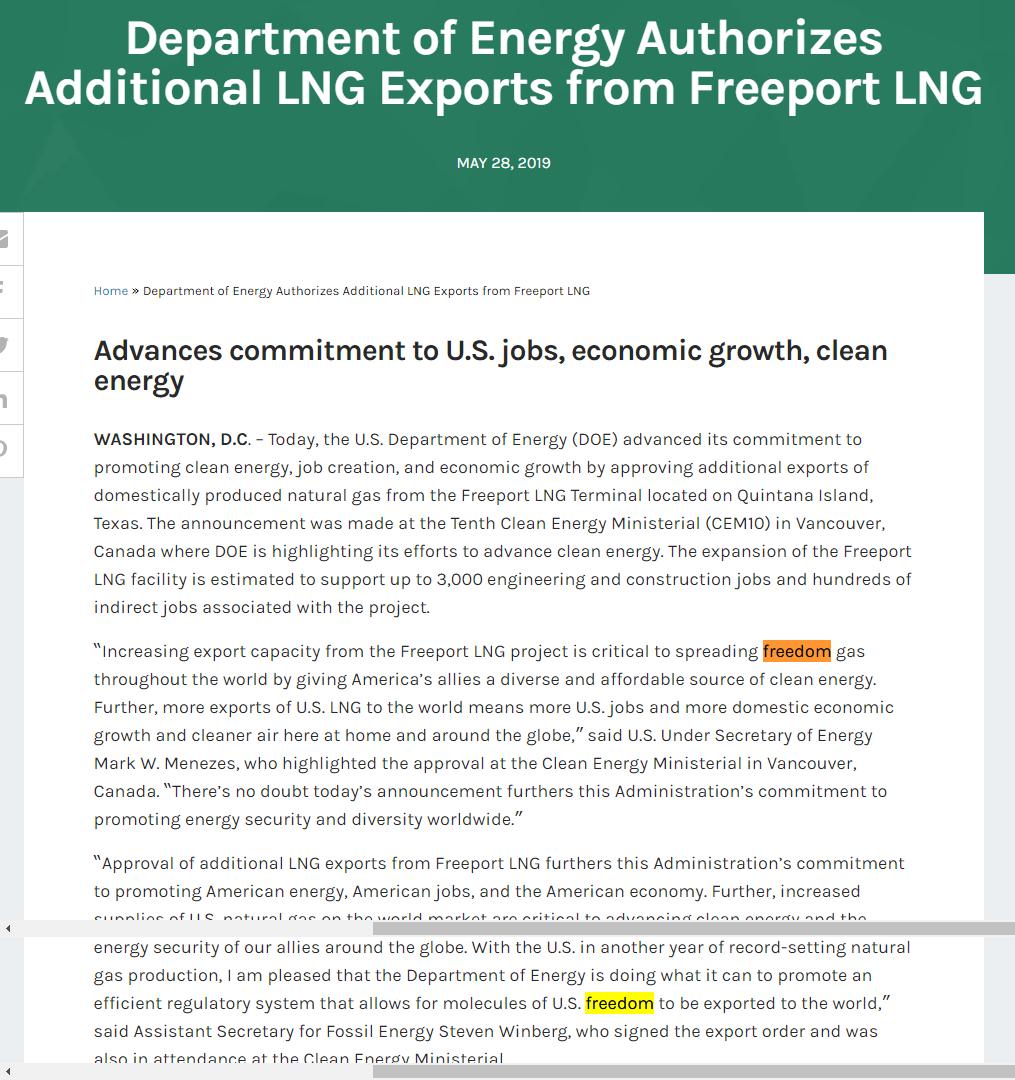
Why is this not the DoE manufacturing outrage? Are you suggesting that calling natural gas 'Molecules of US Freedom' in an official press release from the DoE is not newsworthy because the Department of Energy is just carping about and running a comedy act? If that is your position, isn't displaying such an utter lack of seriousness something that is newsworthy in and of itself?
edit - I like jokes, I can be one of the silliest bastards around when I want to be. However, if I was writing press releases for the DoE, I would do my level best to be serious, level headed and considerate of the issues. And I would expect to be fired should I do anything outside of that. If the energy department of the world's largest economy has decided to abandon seriousness in their public dealings, then that is a pretty dire situation to be in and not one that should be tolerated or swept under the carpet with a 'hey, chillout, they were just joking'.
People make jokes. Judges make jokes in court opinions all the time. They make jokes at trial in cases involving billions of dollars. And those are for general public consumption. Press releases are pretty much only ever read by reporters. People read them in the form of articles based on the press releases. Putting an Easter Egg in there, playing on a term created by a reporter, does not display an “utter lack of seriousness.”
I just had a read through the press release and the way this 'joke' is disseminated does not read at all in the same light as jokes I have read in court opinions. I find I am still in complete disagreement with you here. To not report this use of language would be a much greater issue and it is one indication, out of many, that there is a fundamental diconnect and utter lack of seriousness at the top.
edit - also, I regularly hunt out press releases after reading an article on a topic, I am sure that I am not the only person to do so.
> But this is an archetypal example of how the media manufactures outrage and manipulates people’s emotions.
No, this is a journalist just doing their job, letting people know what's going on so they know what the hell "freedom gas" means next time a politician brings up that "inside joke."
I know HN has a low opinion of people who didn't focus on STEM in college, but they're not all out to get you out of spite. I think you're manufacturing your own outrage about someone taking the time to inform us about what's going on in the global arena.
You can tell that the author is trying to manipulate rather than inform by the fact that the story is not in chronological order. The Rick Perry statement comes at the very end, and fails to mention that a reporter coined the term “freedom gas.” The ordering, plus the explicit commentary, makes it seem like Rick Perry is following some department policy established by the press releases. If you presented the story in chronological order, and include the relevant context, the tone changes completely.
It’s not a STEM thing. It’s a journalism thing. Presenting statements out of chronological order, a common journalistic technique, is inherently manipulative. People act and speak based on what happened before. When you reorder their statements you deceive the reader about the context in which statements were made or actions taken. Even in legal briefs, where lawyers are paid to argue for a side, you might see more or less emphasis on some facts, but people stick to a chronological presentation. (Because if judges feel manipulated, they’ll stop trusting you.)
I don’t think journalists are out to get anyone, it’s just that they are taught a writing style that is inherently bad and manipulative. Aside from playing with chronology, there’s the extensive reliance on hearsay, lack of citations, facts interwoven with emotional appeals, etc.
Here's a pic containing the relevant sections - https://pbs.twimg.com/media/D7vU3AvXoAIfvFH.jpg - If it was intended as a joke, then the joke intended is a practical joke from the fallout of putting it in the report in the first place.
Good thing everyone's memory seems so short. The joke references Freedom Fries from "Team America: World Police" but somehow the negative connotation has been erased.
Which is ironic since the US has been becoming increasingly less "free." Like state elections, the ways congressional districts are gerrymandered, and the enormous outsized voice capital has in the functioning of our government and elections: I'm not sure how much we have on other nominally less free countries sometimes.
And according to the heritage foundation the US isn't even in the top 10 most free economies, and that's the sort of thing people who are swayed by that particular jedi mind trick like.
I love the Guardian articles in general, but this time I'm a bit let down. Why didn't they bother to offer any explanation of why that term was used? Because in this case there actually is a very good reason (hint: several countries in Europe are dependent on gas from one not-so-democratic country that already used it as a trump card during a war conflict and hinted they would use it again).
So yes, in this case it's not as ridiculous as many other expressions with freedom and the US in them.
A public speech in which one says “we are effectively supporting the freedom of European states with this liquid natural gas export” may not be ridiculous, but once you strip context and just start calling it “freedom gas”, you’ve jumped the shark.
Yes, I agree that this particular figure of speech is ridiculous. But the underlying meaning is not. The energetic security, both long-term and short term (hot summer coming!) of several of these countries depends on Russia, in some cases in its entirety. This gas is actually of real help.
Is natural gas used to cool houses in Europe? I thought natural gas was mostly used for heating. In the UK at least many house lack air conditioning. I can't speak about the continent.
The article in question refers to Liquified Natural Gas - it has many uses but in this particular case it's used to generate electricity in power plants.
Natural gas was described in the DoE press release as “molecules of US freedom”. It is ridiculous no matter where else natural gas may come from for other countries.
it is entirely ridiculous as you would only be exchanging Russia for US. Russia is mroe easily contained than US so surely the Russian fuel has greater "freedom"
US doesn’t forcibly annex foreign countries. Don’t sponsor terrorists since at least cold war. American government doesn’t kill political opponents or journalists, neither abroad nor at home. Doesn’t use military chemical weapon against civilians.
Russian government does all that and more. Buying natural resources from them is ethically questionable, and has consequences.
I doubt it, if you had the exceptions you would write the exceptions, not the announcement.
Also, even if you think US is equally evil, there’s still a difference. US is #1 economy in the world. If tomorrow everyone will stop buying American gas, this might help American economy: will obviously hurt oil mining sector, but help everything else due to falling energy prices. Hollywood, software and internet companies won’t even notice.
Russian economy is very small, they’re smaller than Italy or Brazil, and they entirely depend on the export of their natural resources.
If your goal is to minimize global evil, and you must select from these 2, the pick is kinda obvious, doesn’t it?
" if you had the exceptions you would write the exceptions, not the announcement"
Why? All the obvious ones are well rehearsed, we all know the US isn't whiter than white. I don't think anyone's mind is going to be changed by the conversation, and haven't anything new or insightful to add so what's the point?
And I don't think the US is "equally evil". This isn't a superhero film where everyone is either a goody or baddie. There are shades of grey, and I wouldn't use 'evil' to describe any country.
So maybe we don't all know that the US isn't whiter than white, just like every other country.
Yet I see none in this thread. And I don’t know any recent cases either. Last time US forcibly annexed land was when, civil war?
> the US isn't whiter than white, just like every other country.
Just because no country is 100% evil doesn’t mean they are all equal. As a European consumer, I prefer renewables, but until the tech is here, I strongly prefer buying fossil fuel from US.
Americans have not started a war in Europe ever, Russia is still fighting with Ukraine for 5 years now, 1000 miles from here. They also tried to kill our prime minister, couple years ago: https://en.wikipedia.org/wiki/Montenegrin_coup_plot
Molecules of freedom has prompted me to consider the nature of freedom.
Can you get discrete packets of freedom, or is it a continuous range? Maybe its a binary value???
I suspect viewing it as binary just ends up being very absolutist. I struggle to think what a molecule of freedom actually looks like, or what atoms it would be made up of though.
This is a reminder that fossil fuels can be seen as both liberating and enslaving. It gives people the freedom to drive cars and generate cheap electricity, but when countries become completely dependent on it, the freedom is lost.


I dislike Rick Perry as much as the next guy. But this is an archetypal example of how the media manufactures outrage and manipulates people’s emotions. They take a joke that wasn’t offensive to anyone, a good natured rubbing of allies and trade partners, and spin it to make it seem like people are irrational and crazy. The climate change policy is crazy enough. You don’t need to resort to this.