I have had a fever for a week and difficulty breathing. I have asked my doctor about getting tested for Covid19 and they have declined to test me because I don't meet the critical criteria: age > 60, around large groups of people, etc.
I run in circles with someone that returned from Italy and has been confirmed to have Covid19. I'm assuming I have it.
The fever isn't so bad for me but there have been a few times where I thought I would die from not being able to breath. There is only one thing I did that helped with the breathing but it fits in the old wife's tales category so I wont post it here since I don't want to be mocked for it. We used to the same thing 10 years ago to get my Mother-in-law off the ventilator when they told us she would never get off.
Today is day 6 since the fever started and the fever is gone today, still feeling weak.
Some of the old-wives tales were descriptions of things that worked just like a lot of the herbal medicines. We didn't know why they worked so I agree it's hard to call them science. It's also possible it worked for you due to placebo effects, but you describe having a sample size of two! I hope we don't mock people for stating anecdotal evidence. I have seen mocking for statements that clearly contradict evidence (cough-cough flat-earth cough) or when people clearly have confused anecdotal evidence with fact.
I'm curious now what you meant ... maybe it would work for others and if it falls into the category of "can't hurt", why not share it.
NOTE: the coughing above is not a self-diagnosis on my part.
> We didn't know why they worked so I agree it's hard to call them science.
Science doesn't always tell us why something works, but it may tell us "whether". The theory of whether something works is much easier to understand and test than the theory of why or how.
It may not be rigorous science with good experimental design, that's all.
One could argue that science is about falsifying hypothesis - and terby narrowing in on not just if something works, but how.
But an important part of that process is trying to determine if something works or not.
I'd say doing that well is difficult without at least some theory and hypothesis of how - because of the need to determine significant factors.
To take a silly example, you could take a group of diarrhea patients and serve some copious amounts of green tea, and another group a limited amount of water; you'd probably observere severe dehydration in the group that is served water. But it does not follow that green tea is better than water for treating diarrhea - sufficient hydration is.
What you've described with green tee and water is science, it's just that your conclusions aren't well supported by the evidence.
> One could argue that science is about falsifying hypothesis - and terby narrowing in on not just if something works, but how.
To clarify, are YOU arguing that? Because if you're not arguing that, if you're just playing devil's advocate, then I'm unhappy with the way the conversation is going.
Testing "how" is not a requirement for science. There's been a lot of work on the philosophy of science over the past few centuries which I'm not going to try and summarize here (tl;dr: the idea of "falsifiability" is a bit outdated), but I'm going to copy and paste the first sentence of Wikipedia:
> Science is a systematic enterprise that builds and organizes knowledge in the form of testable explanations and predictions about the universe.
There's no requirement in science that we understand a mechanism of action.
Your quote literally includes the phrase "testable explanations"?
My point about tea vs water is exactly that having: "a systematic enterprise that builds and organizes knowledge" helps with controlling for other factors when setting up and evaluating experiments?
Ed: hm, we may be talking past each other here:
> Testing "how" is not a requirement for science
Indeed, 'testing "how"' isn't really possible, only testing "if". But testing "if" with no idea of "how" is very difficult? (because without an idea of "how" it's hard to even define the "what")
> Your quote literally includes the phrase "testable explanations"?
It says "and predictions". That is, both "testable explanations" and "testable predictions" are a part of science.
> Indeed, 'testing "how"' isn't really possible, only testing "if".
This argument is a dead end. If you construct your epistemology in such a fragile way that testing "how" is not possible, then take a closer look at the world you've constructed, you'll find that testing "if" is not possible either.
Any modern philosophy of science has to reconcile with modern epistemology. If you try to construct a good definition for science but use your intuition about what "knowledge" is, then you're only going to discover that you need to go back and refine your understanding of epistemology.
I claim that we can, in fact, test "how".
Testing "how" and testing "whether" are both scientific endeavors.
> You read that as saying that we can only test how, not if. Now you read my comments as saying we can only test if not how.
The original sentence, "One could argue that..." is poorly worded and confusing. Maybe you could take this opportunity to clarify what you meant.
I'm not really interested in litigating who said what. I'd rather understand what you actually mean, rather than try and attack the wording that you happened to use.
To clarify what I'm saying: Testing "whether" can be science, without testing "how", and vice versa.
> One could argue that science is about falsifying hypothesis - and terby narrowing in on not just if something works, but how.
Testing the "if" is science - but difficult without a framework helping understand "how". Testing only if, in a vacuum, isn't enough - and it is a tool on the path to understanding "how". This allows such things as using statistical models (if one has an idea of distribution, for example) to help refine the "if" tests, and narrow down exactly what your "if" experiment tested.
I don't think you can have science without both, and I think defining a body of theory is the more important aspect.
Honestly there is so much that I disagree with in this comment that I can't write a short reply. Sorry.
I get in discussions about philosophy of science all the time because I am passionate about it. But I am very disappointed because it turns out that other people who are passionate about science and the philosophy of science haven't really done the reading. This discussion is a prime example.
It makes me feel like nothing more than a conduit, copying arguments out of old books and pasting them on the internet.
I met skepticism on HN when I said that mega-doses of vitamin C were helping with my hay fever symptoms and was literally insulted on YouTube when I advised to keep water in your mouth while cutting onions to avoid crying.
Why would I care that these 2 things are not peer reviewed by some high level scientists ?
I know it won't be a popular opinion here but there's too much emphasis placed on science nowadays. While science is perfect, scientists aren't, they can make mistakes, they can be bought, and more importantly there's not enough budget to prove everything.
So I'm a pragmatist : if the thing makes sense to me and isn't costly or dangerous to try, I try it.
In fact I whish the placebo effect was much more prevalent. Imagine if you could cure everything with a few drops of fresh squeezed lemon juice in warm water ?
> was literally insulted on YouTube when I advised to keep water in your mouth while cutting onions to avoid crying
The reaction is unsurprising. Anyone who has ever cut onions gained an understanding that irritating gas (http://enwp.org/Syn-Propanethial-S-oxide) wafts up into the eyes. The hypothesis that water in the mouth is supposed to help runs counter to intuition.
It affords testing. Devise an experiment and let us know the result.
I'm always interested in learning what works for others. People need to understand we're all different so what works for one group of people may not work for other groups of people. Modern medicine has only recently begun to realize there may be several things for which a one cure fits all approach doesn't exist.
“ There is only one thing I did that helped with the breathing but it fits in the old wife's tales category so I wont post it here since I don't want to be mocked for it. ”
Hearing this makes me both mad and sad that you think it will get you downvoted. And who cares if it gets you downvoted? Hearing personal health experiences is extremely valuable. It’s what I missed the most about the internet these days with most conversations moving away from forums and message boards.
Tell me yours and I’ll tell you mine? Old wives tales usually have some science behind them that hasn’t been tested yet. No one is saying they have the magic cure-all.
I make a mixture of turmeric, horseradish, ginger, garlic, habanero, hot onion, and apple cider vinegar. Chop finely or blend and let steep and ferment for as long as you want. Doesn’t go bad. I take shots of it when sick. Actually really good to put in stir fry and stews too.
All of those ingredients have proven health benefits. Doesn’t replace antibiotics or medical treatment but can’t hurt. I’ve noticed it reduces the time I’m sick.
On this note about old wives tales, I'm a woman. I've tried every medicine, multiple birth controls, diets, workout and stretch routines to help with period cramps and pain, and I get to try a method and then take what I think helps and adapt for a better test every month until I run out of eggs and here is the bottom line for me at 30 having optimised alot.
Yes drinking water, stretching/really being flexible and fit helps and at the very least needs to start a few days before...
Salmon avocado, iron like steak help with body recovery.
Epsom salt baths help with the cramps as a natural muscle relaxant so does ibuprofen...
It's actually ginger juice, that makes 90% of the pain go away. I bought a $99 breville juicer 8 years ago and lasted me as long. Just got a new one. Three days before I juice ginger with other things
Maybe apple, celery, lemon to help it go down.
Every time I go to the store to get it the cashier's comment they have never seen anyone buy so much ginger in their life, and if it's a woman I tell them my secret. I buy pounds of it and drink probably a quarter gallon the week before.
If you are a woman or have a loved one who suffers from severe period pain, this does amazing things.
That being said, have no idea about respiratory stuff.
An actual Coronavirus story:
I did hear the scientists looking into this said bodies are overreacting into respiratory failure, so maybe it is like many others illnesses potentially about suppressing an extreme over reactionaey autoimmune response.
Someone in my industry got it. 45yr old smoker had to be induced into a coma to avoid acute respiratory failure a couple of weeks ago, after being diagnosed with Coronavirus.
I think the public needs to stress more vulnerable smokers are regardless of age to Coronavirus. Smoking is much more common in China and Italy.
Since you mentioned steak, have you tried a vegan diet? Dairy and meat contain hormones that might affect you. Neil Barnard has written about that, if you're interested.
Last time I tried apple cider vinegar the pH was so low it gave me a chemical burn in the back of my throat. It definitely can hurt, so be careful with that stuff.
I would appreciate the advice about the old wives tale, even if I don't after all use it. I promise to upvote every supportive comment and downvote every mocking comment!
We forgot about it until I was gasping for air and then my wife remembered and we had some laying around. I could breath again in about 20 minutes. My chest and lungs still hurt until today.
Note this user has basically zero HN history and is shilling an expensive product in a classic scammer way. I mean, maybe it's totally innocent! Doesn't look innocent!
I'm from the region where this plant originates and it's very popular to treat various health conditions. The fruits are consumed in stews and leaves used to make specialized tea to help with things like blood pressure.
The price point on amazon is ridiculous though...makes me want to get in the business of packaging and selling this product in the future (not specific to covid).
There aren't very good studies for basically anything in medicine (let alone outside of medicine). Triple/Double-blind large studies are expensive in the extreme. We don't have strong evidence for the majority of things we do.
Recent examples might be mamograms causing more cancer than it detects and stents, it turns out, are no better than a placebo.
Therefore, the lack of a decent studies isn't in itself that interesting. Neither is it illogical for people to turn to old wives tales for knowledge because the filter of history on the knowledge is more powerful than retail medicine in terms of anecdata.
You can buy moringa seeds/leaf for much, much less. There is some anecdotal evidence it helps with asthma but I agree you would want to see more studies
I'm really grateful you're getting better. I had a very strong flu two years ago, it was the toughest flu (or any diseases) i ever had. I fall apart and lost conscious three times, the cough was very strong that i wouldn't be able to breathe for a few seconds. It was really terrifying experience, and from what i read it is quite simialr to covid-19 symptoms.
For the throat issue, we use hibiscus (hot) with ginger. It really helps a lot to relief the pain and ease your breathing.
There can be wisdom in old wive’s tales or otherwise home remedies. As someone who knows very little about such things in relation to helping with breathing I would also be interested to hear what worked anecdotally for you.
Glad to hear that your Mother-in-law managed to get off the ventilator despite the odds.
Old wives tales can often be helpful. At the very least, they will probably be good at soothing symptoms.
The key is to (a) avoid stuff that could be dangerous (eating exotic stuff that may be potentially poisonous), (b) don’t use it as a replacement for actual proven treatments and what your doctor recommends.
The old wives tales I occasionally follow are stuff like having a ginger turmeric tea, something that would probably sell for $7/cup if a coffee shop put it on their menu.
And it takes 3-5 days for CDC results to come back. My whole family is in isolation due to potential exposure while we wait to find out if the sick person has cov-19.
Trump Inc gave up on CDC testing week and unleashed the more competent private sector. The first CDC portable test kit was defective making them [re]test at their central lab.
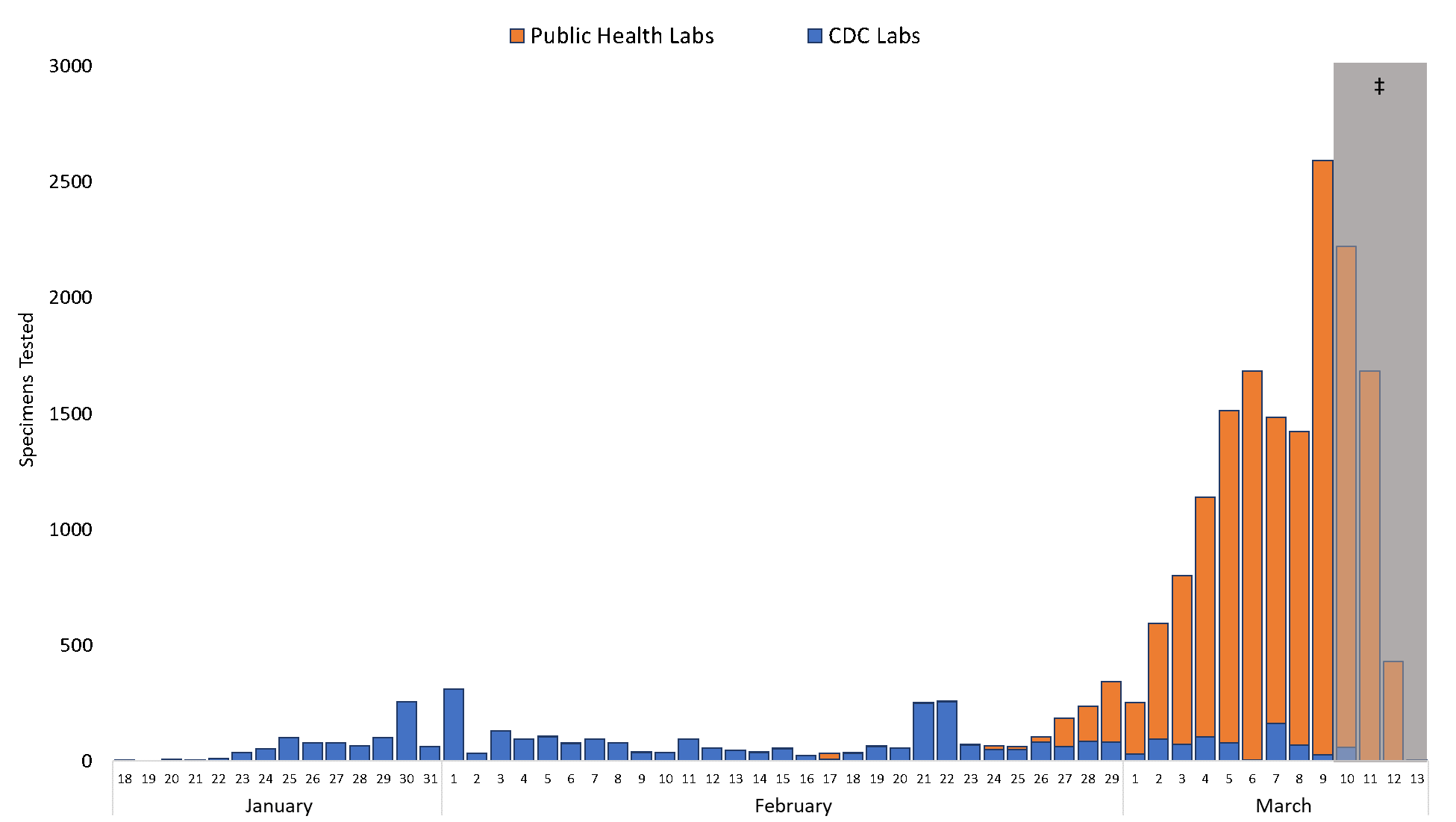
That meme is false and needs to die. Look at testing here [0], from the CDC website [1]. The CDC is just a part of this, and public labs are testing thousands per day right now. Expect this chart to keep going up.
In many cases testing shouldn't actually change the result, either. Suspected patients need to self-isolate, regardless of whether they actually are positive or not. Being positive doesn't necessarily require additional treatment and anyone who is sick enough to need hospitalization will need it whether they are positive or not. The main benefits I see of wider testing are a) better handle on spread of virus, b) despite the above, knowing one is positive could make the patient take self-isolation more seriously ("oh it's just a cold, I'll continue as normal" doesn't bode well).
I don't see much point in using limited resources just to satisfy the curiosity of people who are able to isolate themselves and recover unaided. In fact I had something with COVID-19 symptoms a week ago and I am certainly curious to know if I did have it or not. But I have since recovered and nobody I was with (so far) is sick so there's not a lot to gain by me being tested.
So if that is true, the testing capacity isn't going to be limited just by device approvals. Also need to establish the protocols for other reagents and so on.
This "community" can be quite toxic and is easily triggered by anything "anecdotal". Typical coping strategy is doing penance as an introduction to it, like "I'm probably going to be down voted for this". This sort of preemptive obedience seems to have a mildly soothing effect on a mob of nerds.
On the other hand ... Why would anybody care about HN karma.
Having said that, I'm also curious and promise I'll upvote him for it. No matter how superstitious it might be.
Watch out for cardiac symptoms. Some individuals who have been weaned off ventilators are suddenly dying from heart failure, probably from direct viral attack on the heart, and I don't see why someone with somewhat milder symptoms should be immune.
Please share what you did. You can preface it with it's an old wife's tale but you have anecdotal evidence of its working. This information could be invaluable to others. Anyone mocking you at that point is an asshole.


I run in circles with someone that returned from Italy and has been confirmed to have Covid19. I'm assuming I have it.
The fever isn't so bad for me but there have been a few times where I thought I would die from not being able to breath. There is only one thing I did that helped with the breathing but it fits in the old wife's tales category so I wont post it here since I don't want to be mocked for it. We used to the same thing 10 years ago to get my Mother-in-law off the ventilator when they told us she would never get off.
Today is day 6 since the fever started and the fever is gone today, still feeling weak.