Honestly it’s just a massive pain in the arse for any company that does business in the single market. Exporting and importing is now more expensive and wrapped in miles of red tape. It hurts small businesses in particular, who can’t exploit economies of scale in dealing with the bureaucracy.
Even trying to be somewhat objective about it, it is genuinely difficult to see where any concrete benefits are going to come from.
I used to live in the seaside town of Bournemouth and every summer thousands of teenage kids from all over Europe would come to study at the many language schools which are now suffering and tanking local economies thanks To Brexit.
This article is interesting, but it is the perspective of a single cheesemaker who was seriously harmed by Brexit. I would be really interested in a broader analysis of the overall effects of Brexit on the United Kingdom. I looked for this a week or two ago with disappointing results. Can anyone suggest such an article?
I think the discourse is still too politicized to get a clear view either way. Most outlets synthesizing data from multiple sources have a political axe to grind about Brexit, whether pro or anti, so your best bet is just to look at economic indicators and see how they're doing. Plus, it's difficult to separate Brexit effects from COVID effects.
Unemployment is very low compared to the last few decades. Government borrowing is obviously very high because of COVID measures. Houses prices are very high, which is good or bad depending on your perspective. GDP is growing and the UK is not in recession, but inflation is rising and that may cause significant problems next year.
It'll probably be a few years before we can definitively say whether the UK is going to turn into a basket case or not.
Also the benefit may not be directly measurable but still incredibly important.
For example what will be the cumulative impact over the next 100 years of having the people in the UK making the decisions, directly accountable to voters again.
If it's really "the biggest disaster that any government has ever negotiated", then they ought to be able to find a bit more evidence than one cheesemaker. I mean, I get that they want people to be able to relate to the alleged harm on a personal level. But they also need to demonstrate that the harm is pervasive. Failing to do so makes an emotional story, but an unconvincing one.
It’s just not possible yet - and be warned that any article which tries to say otherwise is likely pushing an agenda.
Brexit only really happened a year ago, in terms of rules actually changing - right in the middle of the pandemic, which will make it difficult to understand the effects for some time to come.
What's stopping them getting a visa if they need one? I don't understand this xenophobia point: post-Brexit, the evil xenophobic Tories changed the visa rules so that 3 million Hong Kong citizens were entitled to live here.
For a lot of EU countries they had no visa processes for UK citizens because no one had needed one for decades.
Then there is the difficulty of getting a visa. The expense, the time, the effort, the weird rules.
I looked at getting a German visa as I worked there on and off. But I can't because my German is meh. That was no problem for my employers, coworkers or people I knew there. But it is now.
So, German visa requirements are somehow the fault of the UK government? Nothing stops the German government from relaxing visa requirements if they choose to.
Yes, German visa requirements are the fault of the UK government. Because before the stupid fucking UK government made the UK leave the EU, there were no German visa requirements; that's totally caused by stupid fucking Brexit.
> Nothing stops the German government from relaxing visa requirements if they choose to.
The world would be such a better place if it weren't so that the less people know, the more sure of their supreme knowledge they are.
A) Yes, the EU Schengen agreement on internal and external borders stops the German government from relaxing visa requirements.
B) You know, the agreement that was one of the main reasons for Brexit, so all those horrible foreigners wouldn't come and take British plumbing (and lorry-driving!) jobs.
C) So Britain makes sure the foreigners are really "foreigners" and not "fellow Europeans" who are allowed in as a matter of course any more... But the German government is supposed to make sure Brits are still "fellow Europeans" who are allowed in as a matter of course and not really "foreigners"? Because a few posh British students are so much more important to Germany than a cheap labour force to fix Britain's clogged toilets, clean Britain's dirty floors, and give Britain's elderly their weekly sponge-bath were to Britain?
Can't you even hear how preposterously entitled (in addition to uninformed) you sound?
It's the UK governments fault since they choose to impose those requirements on us by brexiting (and not bothering to negotiate anything until a few days before exit day).
That's literally the UK governments job. It is not Germanys job to make Brexit work for British citizens.
I don't think that's the point. I think the point is that a lot of the rights many of us enjoyed for free were taken away as a result of the UK government's bargaining position during Brexit negotiations.
Brexit itself passed by a relatively narrow margin following an illegally run campaign from Vote Leave, and on the back of promises which have turned out to have been worth less than the buses they were written on.
However, the governments of Theresa May and Boris Johnson successively expected the EU to solve all of the UK's problems by accommodating their ridiculous red lines. The EU essentially held the same bargaining position from the beginning which was 'no single market access without freedom of movement', and the UK squandered an awful lot of time trying to convince the EU to change that position.
OP may have a different view, but although I don't blame the UK government for Germany's visa rules[0], I do blame the UK government for the fact that I am now subject to them, when I previously was not.
[0]: I'm not familiar with Germany's visa rules for British citizens. However, I do know that Russia (for example) operate broadly reciprocally - whatever hoops a Russian citizen has to jump through to get a visa for another country, citizens of that country have to jump though the same hoops to get a Russian visa.
The UK Government originally had an agreement with <Germany> that there were no visa rules for UK citizens visiting Germany. Just show your passport and you're good.
Then the UK Government rescinded that agreement, but said they might negotiate some new deal.
Ultimately they then decided to make No Deal.
Meanwhile the <German> government is just sitting there and staring and wondering what on earth is going on.
Ultimately it seems to me to be a British internal politics thing.
Yes, it was very much the UK government's decision, due to reciprocity.
There is no question that Germany would have reduced visa requirements for UK citizens, if the UK reduced visa requirements for EU citizens.
During Brexit negotiations, the EU offered UK freedom of movement, similar to how, for example, Switzerland is not a member of the EU but citizens have freedom of movement as if it was a member.
But not unilaterally. One of the duties of the EU is to support basic rights of EU citizens, and one of the mechanisms for doing so is to insist on reciprocity with countries outside the EU. If the UK will not grant EU citizens rights in the UK, then roughly speaking, UK citizens are not granted equivalent rights in the EU.
Naturally the UK turned that down, which closes the border to UK citizens going to the EU, just as much as EU citizens going to the UK.
Weaker, limited forms of freedom of movement were also offered. For example the Erasmus student exchange program, and visas for travelling performers.
All turned down by the UK. Thus the EU institutions and member countries are not minded to offer UK citizens rights, even limited, which the UK declines to offer to EU citizens.
As a Brit who has now lost their ability to work in the EU, and whose children will not have that wonderful opportunity to travel and work in a multitude of countries which all EU citizens enjoy (and many of them use), this is a profound loss.
It is not a surprising outcome, though. Politically, most speeches I heard by Theresa May during the negotiation period started with something like "on XXX date, freedom of movement will end".
The removal of freedom of movement was emphasised as a central, non-negotiable purpose of Brexit during such speeches.
So it is not surprising that it was stripped from us, because that freedom will not be removed in one direction only. And it's not surprising that the new visa requirements are the "hard default" which apply to countries that have declined to negotiate something better. Germany is unlikely to offer UK citizens preferential treatment so long as the UK holds an equivalently hard stance against German citizens.
Recently, I read that children from Germany no longer come to the UK on foreign exchange school trips, even if the purpose is to learn English. They have switched destinations to Ireland, Netherlands and elsewhere. That's because UK visas for such trips are now too difficult and expensive to obtain. Also, about 4% of children in Germany are non-EU citizens, and in practice those would have to stay at home while their classmates travel (before Brexit they could be part of a travelling school group). So the UK foreign exchange school trip industry for EU children has now collapsed, and the UK is no longer a place they'd think of visiting.
With that sort of abrupt change of rights affecting German citizens and residents, and the UK making it clear it doesn't want to make such things easier even for temporary stays, let alone working, of course Germany is not going to offer preferential work visa options to UK citizens.
Well, yes, ending freedom of movement was one of the reasons the UK population voted for Brexit in the referendum and then gave the Johnson government a massive majority in a general election in which ending freedom of movement was a key manifesto pledge. It wasn’t the Government; it was the people—that’s how democracy works.
I voted remain and made extensive use of freedom of movement, but the decision was made and there is no going back.
I'm not sure why you think I'm arguing against that. My GP comment was intended merely to address why the German visa situation for UK citizens is a near-inevitable consequence of the UK's decisions (as opposed to being entirely up to Germany as you suggested); my comment had little to say about why the UK made those decisions.
It really was down to decisions made on the UK side, not the German side. It seems irrelevant whether those UK side decisions were due to politicians, government as a whole, or the people.
That said, I looked up the last election's conservative manifesto, curious after you cited it, and ending freedom of movement for EU citizens isn't one of the key manifesto pledges. An "Australian-style points-based system to control immigration" is, but that is more about changing the worldwide immigration entry requirements.
I do not believe ending freedom of movement for themselves was what the minority who voted for Brexit had in mind - witness all the leave-voting holiday home owners who were distressed when they found out they can no longer visit their own Spain residence as much as they did before, for example.
Many surveys about people's views of Brexit have been done by now, and if there is one thing that stands out, it is that what people who voted leave voted for is lots of different things, many of whom now say "this is not the Brexit I voted for". Those I know personally did not even particularly want to end freedom of movement for EU citizens, although it's obvious they didn't think too hard about their reasons for voting. As for the 2019 election, there are only two things I would say with confidence based on what others have said: Many just wanted Brexit "done" and didn't really care how it was done, and many people found Boris more exciting as a "leader" than Jeremy. I think the conservatives would have won just as much of a majority if the "oven-ready" Brexit deal had been quite different.
In fact, the rules around importing whole milk products direct to the consumer have nothing to do with Brexit negotiations. It's a rule that was introduced by the EU in December 2019 and it applies to all third-party countries. It's unlikely in the extreme that the UK would ever have been given an exemption post-Brexit.
The Brexit addled PM essentially killed the UK toehold in the EU. They are now a pimple on an elephant. More and more EU buyers and sellers with both with the added paperwork for Customs and VAT and do not forget label and electrical standards are just not going to both and will not buy/sell to the UK.
Here in Canada we see many ebay sellers with "not shipped to Canada" for simple added postage/UPS/DHL procedures - which cost extra. UPS and USPS will ship to Canada - but it needs more labelling, a pro-forma customs invoice, and a different process to ship.
The UK is already ruing the day that they let Johnson and the Brexit RA-RA stampede them into leaving. Labor and manufacturing are already being hammered - which Brexit blames on Covid....after Covid...it will not be coming back.
> The Brexit addled PM essentially killed the UK toehold in the EU.
I'm sitting on the sidelines in the US, where we have our own problems, but this seems like the kind of unforced error that results in generations-long harm.
The UK gambled that their ball was so important that threatening to take it and go home would force concessions from everyone else in the EU. The EU, instead, has made it clear that the UK needs to EU, not the other way around.
This leaves the UK with no bargaining chips. The very best they can hope for is being able to come back to the table, hat in hand, asking to be readmitted. And even if the EU allows them to return, there will be no special considerations given to the UK this time around.
> The UK gambled that their ball was so important that threatening to take it and go home would force concessions from everyone else in the EU. The EU, instead, has made it clear that the UK needs to EU, not the other way around.
The UK overplayed their hand to the point where for the EU, Brexit was the better of bad choices, but it is wrong to think that we do not need the UK. Losing one of the largest economies in the world with one of the best militaries is certainly a major blow to the amount of power the EU can project abroad, and the new trade barriers have also negatively affected both our economic projections. Looking at percentage of world GDP, the EU's share (well, today's members) has been steadily declining since the early 90s, while the US stayed constant at around 25% of global GDP and developing countries, mostly China, has a much larger piece of the pie.
Long-term, the UK's idea of more closely alligning with its former colonies might actually not be so bad, as there were always strong limits on how much the UK could do within the EU, and how much it would be willing to take. Demographics and stagnant politics aren't really pointing towards a rosy future of most countries in the EU. On the other hand, with the UK gone, the EU has the chance to go ahead with a couple of projects, including federalization, that before would have had a strong vote against from the UK.
Overall, we are all worse off, and currently being in a long-distance relationship UK-Germany, I'm just really saddened and frustrated by the things happening.
"The very best they can hope for is being able to come back to the table, hat in hand, asking to be readmitted."
As far as I know both the UK and the EU, this is not going to happen. Not just out of pride; the UK and the Franco-German axis of the EU were never a good political match and after this divorce, they will drift even more apart, because they do not need to hammer out compromises anymore.
IMHO the UK was smart to avoid entering the Eurozone. The monetary union without fiscal union is a wobbly construction, papered over by extremely low interest rates and sovereign debt buying programs such as PEPP.
One of the important features of earlier EEC was convergence of the periphery with the center; it still works to some degree in Central and Eastern Europe, but it stopped working in the Mediterranean.
>threatening to take it and go home would force concessions
Trouble is the EU laws were agreements between 28 countries and can't easily be changed to suit one odd case. That was always the situation and the "we'll negotiate a good deal" thing was mostly lies for political purposes.
The UK is the third-biggest importer of goods from the EU after the US and China. It's an enormous market for EU goods which the EU most certainly needs. The UK is also the only nation in the geographic area except France with anything like a world-class military (although it doesn't compare to the US in that regard). It's also the second-biggest financial center in the world (and sometimes first depending on the relative position of New York and London).
It's not as though the UK will be holding out a begging bowl because the EU decides to be difficult. It will, however, have to develop new markets, which will take some time and cause some issues, including the cheese issue in this story. There will be ups and downs as the situation finds a new balance.
> The UK is the third-biggest importer of goods from the EU after the US and China. It's an enormous market for EU goods which the EU most certainly needs.
The point is that the UK needs the EU much more than the EU needs the UK.
I think you suffer from myopia. The 4th export target of the EU is... Switzerland. Do we need Switzerland ?
No, the fact the UK is geographically close to the EU and has no choice to import from us, does not make it as important as China, 20% of humanity, and the US, a giant economic power.
We need to find a way to redirect/enrich India, another 20% of humanity, to import from us before following the UK in whatever folly takes them over their nationalist cheese ambitions.
South America is too close to North America, but if we destabilize the India/China relationship enough while finding a way to move them forward in consumption, they could choose to import more than they do from the US... or the UK I guess ?
As for Africa, I'm not sure how their import are, but it's probably going to take a while before reaching Chinese levels :(
I suppose we'll have to wait and see how things shake out. The same arguments you've made about the EU finding new markets applies to the UK too.
> the UK in whatever folly takes them over their nationalist cheese ambitions
It's the EU's cheese ambitions that cause this problem. EU protectionism is why it's difficult for third countries to import certain goods without paying enormous tariffs.
I'm not familiar with the matter at all, but wouldn't there be a flip side, that his company has now a lot less competition from EU cheese makers in the UK?
The UK is too densely populated to be agriculturally self-sufficient, thus all major parties believe in free market principles when applied to food imports, because attempts at protectionism would lead to huge inflation and would doom any party that tried it.
The only debate is whether food should be imported from the US or from the EU.
I vaguely remember a story where, shortly after the Soviet Union collapsed, someone managed to take over a factory making erasers and made a fortune. Maybe it was the only functioning one and imports didn't work for some reason...
“Russian oligarchs” you hear about so often in the news are essentially gangsters that pilfered the valuable assets from the collapsed USSR. Many different types of factories were taken and profited from.
he deals with this question at the end of the interview, when he says marketing costs have gone through the roof as all other UK (ex)exporters now are forced to focus on (much smaller) domestic UK market
Also it's the guardian, may as well post a telegraph article that says the exact opposite.
My take on it: when money is involved, humans are excellent at optimising those systems.
Look at the lengths and success of people/companies go through to minimise paying tax.
What I'm trying to say is that we'll be fine once the existing systems are optimised for us not being in the EU. Obviously we're in the adjustment period, and I feel sorry for the people struggling with that.
There's nothing optimal or rational about international trade. It's full of the most vocal minorities screwing things up for everyone else (and sometimes themselves, see fishermen voting for Brexit). That's why trade agreements are usually negotiated in secret, to protect the parties from themselves.
In 20 years when the coalition of bigots and reactionaries and profiteers that gave us this mess have expired, we might be able to return to something resembling a rational arrangement. Or not, perhaps we will slip further and further into oblivion such as Russia did after the USSR.
UK fishermen voted for Brexit because it would directly lead to larger fishing quotas for themselves, the UK being an island surrounded by fish that was forced to give up most of its fishing rights over its own seas to (amongst others) the French and Spanish, who have plenty of coastline of their own and a reputation for aggression.
Given that fishermen weren't exactly ever migrating in droves to Berlin to become language teachers, that decision seems to be pretty much the epitome of rationality. The fact that you picked it as your best example of why people should live in a dictatorship in which they aren't even aware the rules are being made, let alone able to object, speaks volumes about the nature of EU ideology and why the UK was right to leave.
I was willing to listen to your argument up to this point. Throwing the "everyone who I disagree with is a bigot" around is very old hat at this point.
I definitely would not say that everyone who voted to leave the EU is a bigot, but it's fairly undeniable that a lot of bigots supported (and ran campaigns around) leaving the EU...
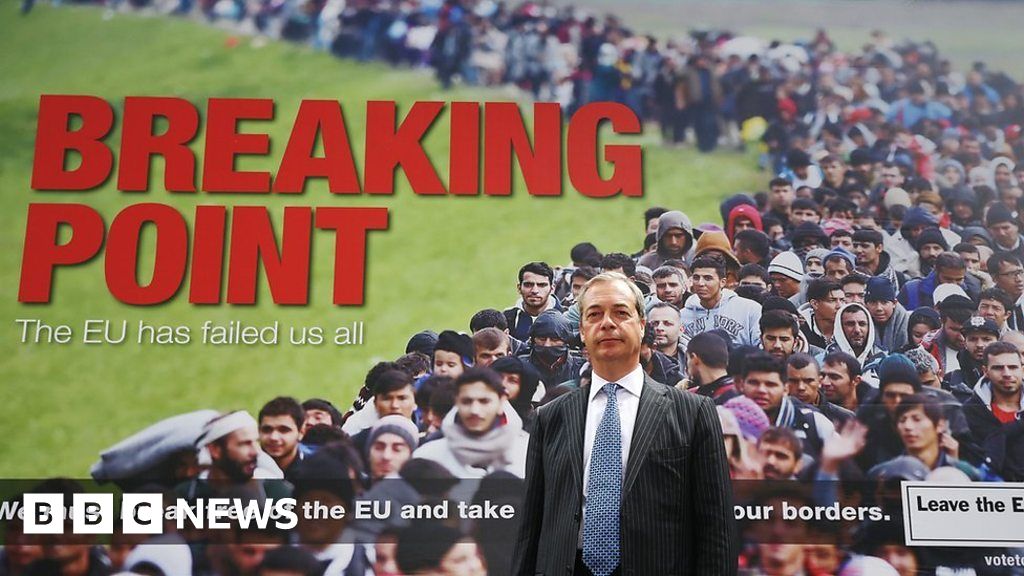
So the EU has a migrant problem. There are camps in France, Spain and probably other places not being reported. Poland is dealing with it as well in their own way without the eu. The EU hasn't come up with a solution to it. So I'm not sure which part of the image you posted is telling a lie or being misleading?
The truth hurts sometimes. Doesn't mean anyone is a bigot though.
Many of the migrants are in fact legitimate refugees from conflicts that the UK was intimately involved in the last 20 years (Afghanistan, Syria). Others are economic migrants from parts of the world that the British empire was directly responsible for fucking up. Most of the people of UK don't want to hear this, but we reap what we sew.
In any case, Brexit has made the problem worse because now not only does the UK have a problem with boat crossings, but we have strained our relations with the country that the boats are coming from (France). The boats are indeed leaving the EU.
In the absence of any logical reason to have a poster with a line of brown people and the text "Leave the EU" emblazoned on it, the only reason can be a bigoted one.
> Many of the migrants are in fact legitimate refugees from conflicts that the UK was intimately involved in the last 20 years (Afghanistan, Syria).
We were involved in Afghanistan, yes. Which brought about education for girls... Something not seen in that country for decades? We ultimately failed but not without trying to bring about a better world for those people. It's not like we were there to take the resources.
It's news to be that we were involved in the recent conflict in Syria?
> In any case, Brexit has made the problem worse because now not only does the UK have a problem with boat crossings, but we have strained our relations with the country that the boats are coming from (France). The boats are indeed leaving the EU.
Agreed. But we know who exactly we can name and blame for these failings (British MPs), and vote against them going forward.
>That's why trade agreements are usually negotiated in secret
The last deal I saw negotiated in secret and then leaked (TPP) ended up being a corporate wishlist that benefitted nobody except large companies.
The most absurd part was that it was more about extending copyright and setting up extra-judicial courts than dropping tarriffs yet they still called it a "free trade deal".
Fortunate that it was leaked otherwise this abortion of a deal would have passed.
Leaving the eu isn't really something you can adjust to. It's like losing a limb: you might learn to do without, but it's loss you work around not one that grows back...
Is it? The UK had a global empire before the EU existed. I'm not suggesting we go back to colonising far off lands, but clearly a nation can be successful outside the EU (there a plenty of examples of that). What an absurd idea.
A person can absolutely be successful after losing a limb. But it's a lot easier if they haven't lost the limb. And when you lose a limb because of serious systemic issues (like the UK has) the chances of going on to be successful are... Dire.
That's where the UK is. Success is entirely possible. And that's the faintest praise anyone can give isn't?
Many of the the (other) EU countries had global empires too. Fortunately or unfortunately the era of global colonialism has ended.
Since we're all unlikely to be able to conquer large swaths of far-away continents anymore, we're kind of better off working together instead. The alternative is that there's just a bunch of tiny rump-states rusting away in a corner of the globe, pining for our former glory.
But countries can work together without being in the EU. In fact the EU's refusal to work with countries geographically close to Europe unless they totally submit to the will of the Commission on everything, is one of the factors most damaging to European cooperation. The EU is ideologically incapable of compromise, structurally incapable of working together on some things and not on others. Once upon a time it could do those things, but not for many years now.
As far as I know there are many countries that cooperate with the EU but are not a part of it, based on many levels of compromise. (This video proposes we replace the european flag's stars with asterisks for all the exceptions and compromises! https://www.youtube.com/watch?v=O37yJBFRrfg )
In fact the UK took several of those types/levels of cooperation into consideration and rejected each. (Here's a quick video overview of that https://www.youtube.com/watch?v=agZ0xISi40E )
Many countries outside of Europe cooperate with it. Within Europe such non-EU controlled agreements are legacy and have been replaced over time with EU controlled institutions and agreements.
The UK tried many times to come up with some sort of compromise agreement or continued collaboration on various topics, but the EU never accepted them, always with some statement about "cherry picking" or how "Europe is not a la carte". In other words, totalitarianism: either you obey us in all respects, or we don't work together on anything.
In practice this was not a realistic policy position and the Commission has been forced into a series of reversals or dropping of its more extreme ideas especially around finance. But their position was clear at the time.
Even on the European continent there are many many asterisks. The UK themselves have had many many asterisks even while they were a member of the EU (eg: status of overseas territories, opt out of Schengen border control zone, opt out of Euro monetary union etc etc...) . If you look at it that way, you'd think that the average EU negotiator wouldn't even blink if someone requested an extra half dozen asterisks and a pound of cheese to go please.
Of course, I could be wrong. Can you give a specific example?
The thing to understand is that the EU has changed a lot over time. You're right to observe that the UK had many opt outs of various forms, but this comes with two extremely severe caveats:
1. They were all old. When the EU was smaller and the Commission less powerful, it was more willing to compromise. As it grew and took over more powers, its appetite for compromise lessened. It started to talk about competing approaches or partial cooperation derisively ("cherry picking") and refused to contemplate looser integrations.
2. They were getting unreliable. The UK secured an opt-out when the vague collection of principles called "human rights" was translated nearly directly into law - a bad move, constitutionally, and one the UK was wise to reject. The human rights were never written to be laws and could not function properly as such, so the UK insisted on an opt-out and got it along with Poland. The relevant bit of law is as clear as can be: UK and Poland are not subject to those laws. But as often the case with the EU the written word turned out to be utterly worthless. The ECJ simply ruled later that the opt-out was void. No actual real legal justification was provided - they just annulled it by fiat, and told the UK its opt-out was gone. And because EU membership means obeying the ECJ in all matters, that was that. No more opt out.
Now comes Brexit. Enormous numbers of proposals were tried by the UK to stay with closer alignment, a free trade deal, continuing in the Horizon research programme etc. All were rejected by the EU and we ended up with a relatively "hard" Brexit.
I did vote for Brexit and still support it strongly, partly because of things like this. The EU of 1992 is not the EU of 2022. It knows many populations don't want the level of control the EU currently has, and it feels like if it gives up even an inch the whole anti-democratic project will start to fall apart. Indeed one of the primary motivations of the EU negotiators during the Brexit talks was to not do anything that might encourage other countries to re-assert independence in any area, even if they didn't want to leave.
The UK is a non-example because that makes the argument circular.
So I'll forget you mentioned it.
Norway isn't successful?
Norway is an outlier case, for obvious reasons.
You could have also picked Albania, ex-Yugoslavia, Belarus, Ukraine in your list of proud EU dissenters but that wouldn't support your argument too well if you had, now would it?
Of course there are such examples
Just not "plenty" of them.
Dear God, aren't debates on HN about basic world facts outright silly.
You're the one who made the claim that there were no such examples, which is wrong. Now you're trying to come up with explanations for why those examples don't count or should be balanced against other countries.
You're also putting quote marks around the word "plenty" although you never said that, your statement was absolute.
I'm a little surprised such a histrionic headline is sticking for this one here. After living through the same dramatic statements every day from 2016-2020 here in the US about how the last administration was the biggest disaster ever, well, thanks to that "disaster" we had gas that was $1.50/gal cheaper, inflation was minimal, taxes were lower, we had far fewer illegal border crossings, a competent leader for getting us out of Afghanistan the right way, and so on. But, if you read the headlines daily, the world was coming to an end.
Today we have a more polite president, but far more expensive gas, crazy inflation, the Afghanistan situation was a mess, we have the most illegal border crossings in decades and decades, and double the deaths in the same period as the last administration. But if you read the headlines, things are heading in the right direction, well, because, totally unbiased of course. Bad things happen, but they're really not a big deal, and actually, Biden doesn't really have much to do with it. Here's Why.


Even trying to be somewhat objective about it, it is genuinely difficult to see where any concrete benefits are going to come from.