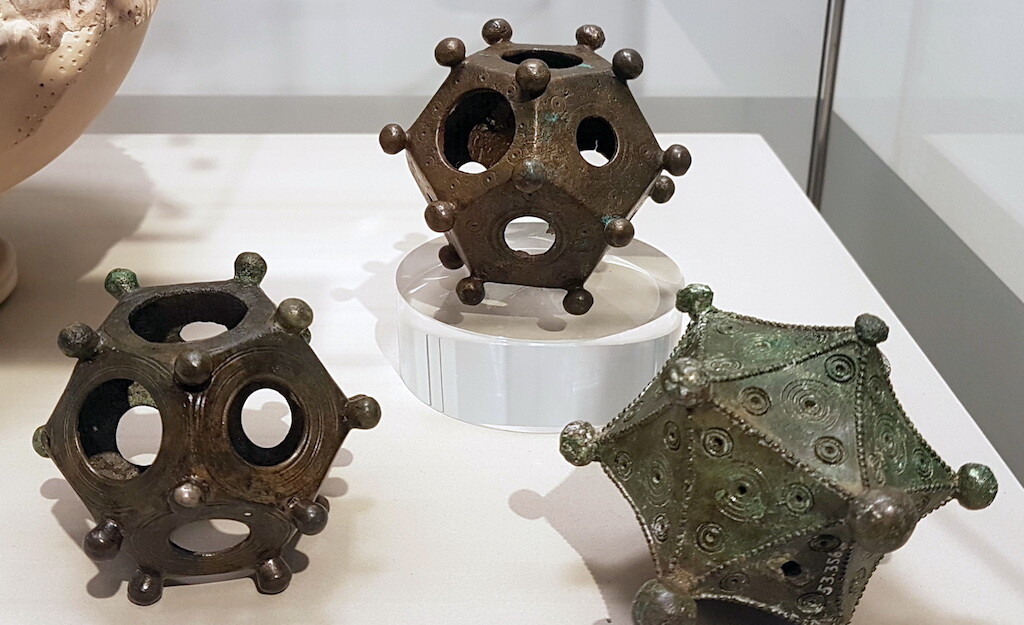
Of all the theories, this seems plausible. Has anyone done that to your knowledge? The easy way to test this is to take an assortment of Roman-era coins and see how well they match up to the holes and ring sizes. The pegs that protrude could easily help not only to stabilize the system but prevent coins from sliding off if placed in a stack.
they did mention they appear to be of widely varying sizes... I imagine if the holes were meant for specific coins they'd all have matching sizes...
I like the idea that the ratio between the incoming and outgoing holes allow you to get correct angles while looking through regardless of how the object is held (look through one of the smaller holes hold it far enough that the larger hole matches, and you have an exact angle viewer)