Yes, you wouldn't be building a steam engine with the tools of Greek artisans in antiquity, not even the ones who built the Antikythera mechanism. But we do know some things that would seem like crazy hacks to the ancients. For example, I know a simple trick. I can multiply numbers, of arbitrary size. And I can do it in a few seconds using just a stylus and tablet. This would have blown the minds of a learned Roman or Greek from that time.
For those who find the general idea enticing, there was a book written about 80 years ago on this idea. What if a time traveller got sent back to Ancient Rome? https://en.wikipedia.org/wiki/Lest_Darkness_Fall
A couple friends and I are big fans of the book, and premise. We always figured it was far too optimistic. Most likely you'd die of dysentery or be sold off into slavery. But assuming not, I figure the real path to power wouldn't be brandy, but strong acids and electroplating.
> I can multiply numbers, of arbitrary size. And I can do it in a few seconds using just a stylus and tablet.
So could a Roman or Greek. He'd just need a counting board and some stones. He could probably do it faster than you, as well. Anyone using an abacus today could perform almost exactly the same algorithms, with the added convenience of having beads on rods in a frame instead of an unwieldy counting board and stones. The algorithms are the same, and you can also do division and square roots with a counting board or abacus. When done deftly moving stones around on the counting board (and Aristotle makes clear that this goes so quickly that it's possible for the person calculating to cheat an onlooker, like in a con-man's shell game), one might choose to write the result down on a tablet, and he might just finish writing before you do.
> goes so quickly that it's possible for the person calculating to cheat an onlooker
Indeed, the biggest advantage of paper arithmetic is that it leaves a written record: each step in the algorithm can be checked for mistakes afterward. It is otherwise significantly slower and not inherently more accurate than a counting board.
The other advantage that paper arithmetic has is that it can be easily reproduced in printed books, making learning more advanced techniques more accessible / easier to spread to anyone literate, without requiring an expert teacher.
(And finally, paper arithmetic [eventually] has the advantage that it can be more conveniently extended and generalized to include more kinds of operations and structures, in a way that is easier to explain and teach than adding new kinds of counting board rules. Paper arithmetic is a more natural precursor for symbolic algebra than counting-board calculation.)
The big disadvantage of paper arithmetic is that it depends on widespread literacy and cheap access to paper (or similar material). In a context where paper is expensive or unavailable, written arithmetic is not very compelling.
Chalk (or charcoal) and slate (or other rewritable surfaces) were common before paper was cheap.
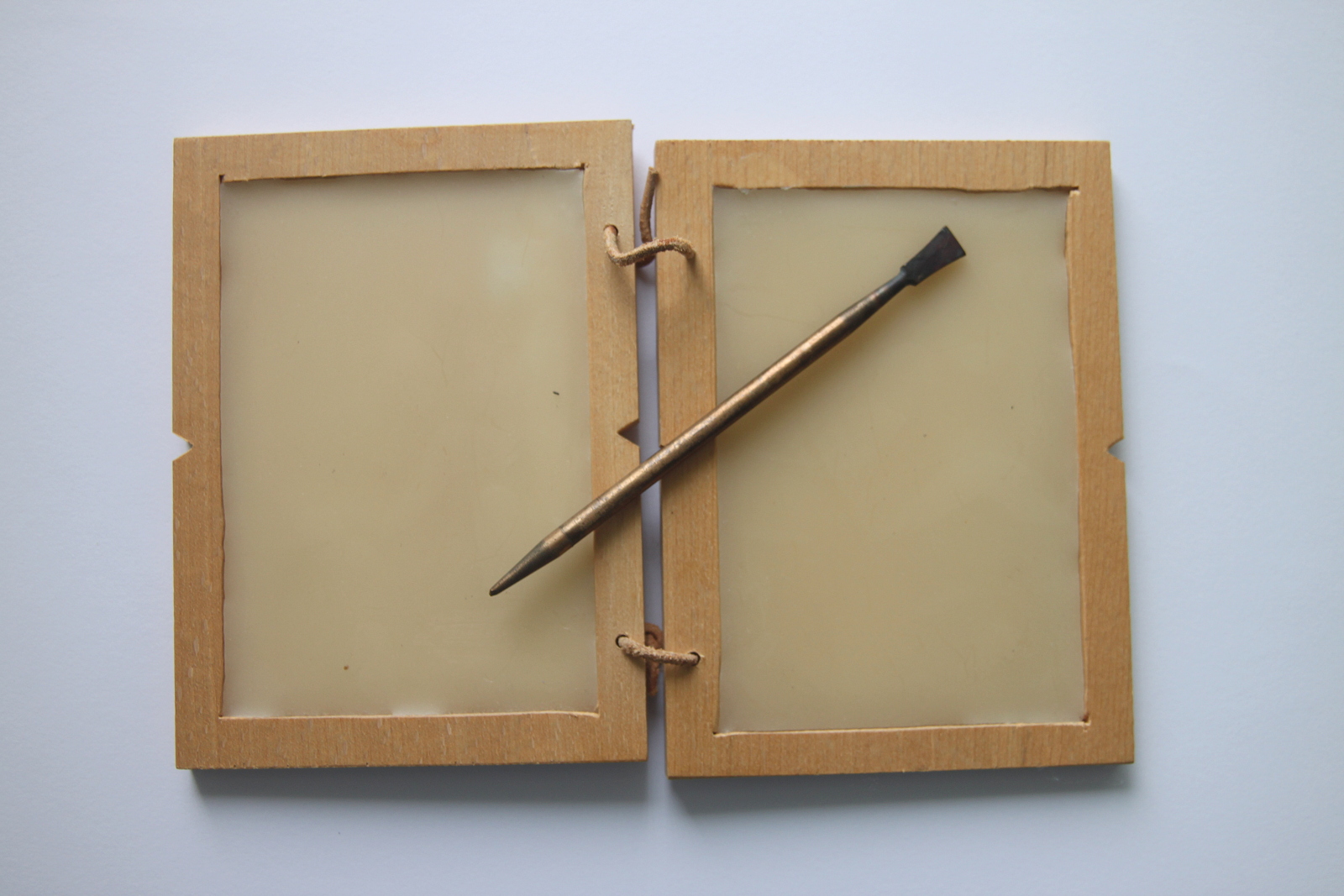
Greek and Roman students typically used wax-coated boards and scratched them with styli. The surface could be heated or rubbed to restore its unmarked form.
Yes that is true, but if you don’t have a permanent written record of the computation, that takes away a lot of the advantage of written arithmetic. You may as well just use your counting board.
Not permanent, but a record that could be shown as the computation was performed, and until the slate itself was erased. Obviously, where a permanent record is desired, permenent media would be used.
My point was that there were cheap alternatives to parchment and paper for quick work.
A wax or clay tablet or flat patch of dirt and a stick, piece of bark or wood and charcoal, etc. don’t have enough advantage for anyone to bother organizing their accounting or calculation system around them. They are on the whole inferior to the existing system. Trying to introduce them to people 2000+ years ago might have a chance, but it would be a tough sell.
The thing that really spread Hindu numbers around the world was access to paper.
My impression is that in India “Hindu” numerals and arithmetic were developed using some kind of erasable board, but among Arabic speakers (and later Europeans) the spread of Hindu numerals went along with paper as a prerequisite technology.
It's probably worth noting that Fra Luca Bartolomeo de Pacioli's dates are c. 1447 – 19 June 1517, shortly after Gutenberg and about 50--100 years after cheap papermaking (comparatively) first reached Europe.
It's hard to have double-entry bookkeeping without books.
I'm unsure if he used Arabic or Roman notation... Though the dedication page of Summa Mathematica in fact does include recognisable Hindu / Arabic numerals:
Wikipedia's article has several illustrations, but none of the actual bookkeeping notation itself, which is ... a curious oversight. Continued on the double-entry bookkeeping article as well FWIW.
Anyone with a counting board also has zeros, as empty places with no counters, and ancient people had no problem understanding and using the concept of zero in calculations (though most probably would not have considered zero a “number” per se). They just didn’t write explicit zeros in their permanent serialization format.
But there are certainly plenty of mathematical ideas and tools ancient people didn’t know about: they didn’t have a convenient method of manipulating algebraic expressions and equations; they had only the most rudimentary version of differential/integral calculus; they didn’t have group theory, linear algebra, complex analysis, etc.
Yeah Lest Darkness Fall the optimistic, knowledge from the future makes you powerful view of things - which really the hero was an academic who knew a lot about Rome of the period but also had lots of practical knowledge that he managed to make use of to improve his initial position of actually being made a slave.
Why not build a printing press? All you really need to do is carve some wood. As expensive as tunics were, books were much more so. Copying the bible would have taken several months (if not years) of labour. And the ability and control to spread such knowledge faster than others would not only be very lucrative but a source of great power.
The woodblock printing existed in Europe even before Gutenberg. Gutenberg's real contribution was the printing with movable metal types, which were themselves made by means of a hand mould he invented. So you had to carve a letter only once, produce one or several moulds from it and use them to cast identical metal types. This had not only the advantage that the types could faster be arranged into a text than cutting it all in wood. Their clear shapes were not only superior in appearance to any wood cut, but in one respect even to hand writen texts: all the types looked alike. Gutenberg's idea was not to make a cheap product for the masses (or at least for those who could read), but an extremly high-quality product for the top of the elite.[1] It is rather interesting to see that his intent and his actual impact were so far apart.
>Why not build a printing press? All you really need to do is carve some wood
The printing press seems to be far more complex than just "carve some wood". Otherwise I find it hard to believe that it took until 1400AD for people to figure out how to make large stamps.
Woodblock printing was invented in the 7th century in Tang China.
The prerequisite for economic printing is paper, and the tech tree for paper is reproducible from Roman conditions. The production of vellum is measured in years, scribes were barely the limiting factor on text production.
There is a lot of basic scientific knowledge that many/most modern people have (germ theory of disease, how the body works at some level, astronomy 101, etc.) But ancient people weren't stupid. They just didn't have advanced technology. Recreating a whole chain of technology to bring about the iron age maybe 1000 years early probably isn't happening. The fact is that they're mostly doing pretty well with building things that the technology more or less exists for.
Did the Romans not have paper of any sort? It seems odd that they only used animal skins for writing on.
My understanding is that while parchment (vellum in particular) was used in early printing press printings, such as the Gutenberg Bible, the use of paper was more common because it was so much cheaper, if less durable.
They did have papyrus but that is even less durable than paper, especially outside of very unique climates like Egypt (and the papyri that we do find there are very fragmentary). Parchment was known, but not widely used for obvious reasons.
Seems more like all this stuff is tied together in tricky ways. Why bother learning to read if the only supply of written text is people hand-writing it on fragile paper or parchment, so getting even a single page of written text is super-expensive? Why bother figuring out how to make cheap and durable paper when all text must be hand-written by the few who had time to learn how? Why bother making a way to write faster when paper is expensive and nobody knows how to read?
People need to solve all of those, and have some reason for solving each one independent of the others, before the written word can even start to proliferate widely.
A book on agricultural developments post-antiquity to the industrial revolution would be a far more immediate source of power. Less starving -> more surplus -> more specialization of labor and societal development -> goto(1).
> Yes, you wouldn't be building a steam engine with the tools of Greek artisans in antiquity, not even the ones who built the Antikythera mechanism.
Sure you could. The antikythera mechanism shows more than enough skill and precision to make a small one. It might only be a toy for the rich though. I'm not sure if you could afford enough metal to make one large enough to do useful work, and even if you could the fuel required might kill it (coal wasn't really available at the time, though knowing it is useful might be enough to find and use it). The metals of the time where not up to a modern high pressure (and thus efficient) steam engine, but a large low pressure steam engine is perfectly possible.
That said, water or wind power would be a much better invention to focus your efforts on. I'm not sure how much of that they had though.
No, you couldn't. It wasn't until Wilkinson had perfected his boring machine and Watt had a model of a steam engine that could not be be realized because he couldn't get a precise enough bore, that Wilkinson took it upon himself to bore the first steam engine cylinder that worked.
In order to get this, there are a lot of steps involved, including the ability to sand cast and bore iron of sufficient quality to take a reasonable amount of pressure.
If you got to that point, you might want to build a Stirling engine instead, it's far less likely to explode and kill people.
I have some knowledge of machining and how to create precision from nothing, though this isn't very common.
Lack of precision means worse efficiency, crude steam engines with careful handfitting can work well enough. Though this adds times, and as the other replies note it isn't clear if the Greeks had the fuel to run a modern steam engine if you gave them one with a boiler.
Watt's steam engines were vacuum engines, with power on the condensation stroke. High-pressure expansion engines didn't emerge until after Watt's patents expired in 1800. (I believe they may have been introduced a few years earlier in the United States where Watt's patents had no authority.)
> but a large low pressure steam engine is perfectly possible.
Irrespective of whether it was possible for the Greeks to make them, what would be the economic incentive for them to build large low pressure steam engines at scale? In our timeline, the only serious application of large low pressure steam engines was pumping water out of mines, from after 1720 or so. Even with the incentive of the industrial revolution, it took almost a century to get small high-powered engines, with the first public steam train in 1825.
Milling grain, hammering wrought iron, crushing ore etc. There were plenty of uses of mechanized power even in antiquity, and the ancients realized that through use of water wheels.
Are these actually feasible with a large low-pressure steam engine of the sort that the Greeks could have actually constructed? Remember that the early real steam engines were only just powerful enough to slowly lift buckets of water.
[Edit] - good answers below - thanks! But I think the question of economic viability still stands. As pointed out elsewhere, a waterwheel is easy to construct and doesn't have ongoing fuel costs. A steam engine requires a reasonably well developed iron/steel working industry (including skilled artisans), which in turn requires a fair amount of iron ore and fuel to support smelting. The finished steam engine would require a lot of wood as fuel, or coal, which wasn't widely available in ancient Greece, or easily transportable without a lot of effort. Ancient Greek metallurgy was definitely not sophisticated enough to build a steam train and as for for building a railway 1) they could barely build graded roads and 2) they would have needed a phenomenal amount of mass-produced steel for the tracks.
Water hammer is a big lever that has a hammer on one side and a big bucket of water on the other side. Bucket gets filed by a water stream, gets heavier than the hammer and lifts it, and then at the lowest point (of the bucket) it is mounted in such way that the water spills and the hammer drops, resetting the machine. No precision technology needed, they could do it in stone age.
You can do the same thing with fireplace and water and it's certainly doable with ancient technology, but I'm not sure it's worth it when you have more running water than industry needs anyway.
Another thing they could do is Heron's steam turbine geared in such a way that it does useful work. Also not sure if it's worth it.
This trick (using low power to lift the hammer slowly and dropping it quickly) can be adapted to use any inefficient power source - hamster powered mills are possible ;)
Yes, because that work had been done at the time by even more underpowered devices, that is, by actual humans. You’re lucky if you get half a horsepower from a good human, so replacing them with low HP steam engines might still be worthwhile.
I don't think the OP is saying that there wasn't a need for mechanized power, just that it wasn't profitable to get that power from steam.
Water wheels have no fuel costs, and very little ongoing maintenance costs. A steam engine that could be built in antiquity would be incredibly expensive in both respects. So even if the technology existed, there would be little economic incentive to use it over a water wheels, since transportation is cheaper than fuel and maintenance.
As recently as 1900, steam engines were so expensive that most farmers rented equipment by the day.
Some generals would likely find a mobile mill stone quite useful. When your centuria loot a conquered land they can now take raw grains in addition to processed flour without being tied down to the local stationary mills.
> Some generals would likely find a mobile mill stone quite useful. When your centuria loot a conquered land they can now take raw grains in addition to processed flour without being tied down to the local stationary mills.
Not in the slightest. The legion on the march has no use for a millstone because nobody's eating bread. They would never carry processed flour, because it spoils quickly. They carried raw grain and made porridge from it.
It was wrong. Turning up quick information makes it clear that hardtack was a core part of the military marching diet, and the soldiers could prepare their own bread, though they didn't carry flour.
Those both seem like decent writeups which cite to several classical sources. The first one mentions porridge (stating that bread was preferred); the second explicitly makes the assumption that all grain becomes bread. We can safely ignore that assumption.
More from that first writeup:
> The daily grain ration (wheat or barley)for one legionary was on average 830 grams and was in the form of unground grain; This was mainly due to the fact that grain spoiled slower than flour.
> The meals of the Roman legionaries were mainly based on wheat, from which two types of food were made:
> mash, called pulse. It was an easier-to-make food that required a mixture of cooked wheat grains, water, salt, fat, and olive oil or milk. Sometimes vegetables or spices were added.
> flatbread (pane). It was the more popular use of grain. The soldiers threshed out the grain, ground it with a device or stone, mixed it with water, salt and spices, and then roasted it over the fire.
So, what's true:
- The legion isn't going to carry a millstone. They're huge and there's no way to justify it.
- The legion isn't going to make itself dependent on the location of local mills. That would defeat the purpose of being a military force.
- The legion isn't going to carry flour, because it spoils. They carry raw grain.
- But they also carry hardtack, which is prepared so as not to spoil quickly.
- A foraging legion already takes raw grain. That's their primary foraging objective. They are not limited to robbing granaries; they're happy to harvest it directly from the field.
- Food preparation is done at a very low level - if the grain is going to be ground, it will be done in parallel by a large number of soldiers personally grinding small amounts of grain each, not by a mill.
- The soldiers often do eat bread. But if you're going to eat bread, you make it from raw grain the same day. This has to occur wherever you happen to be, so you'll be using something like a mortar and pestle.
- Despite the fact that bread is preferred to porridge, sometimes you make porridge anyway. It's much easier to make.
> it will be done in parallel by a large number of soldiers personally grinding small amounts of grain each, not by a mill
I'd had it in my head for some reason that a mill stone was the only reasonable way to turn grain into flour. This was the main factor I wasn't considering. The weight/effort to handle a portable mill certainly wouldn't beat hand tools. Even if to just help keep soldiers busy.
EDIT: I expect that if one were to analyze an army's flour requirement as some form of equipment weight + work-hours / grain-throughput * army size there would be a point at which it made sense to haul a portable mill. But it definitely would not make sense to power it with steam engine compared to having soldiers turn it by hand. I would also expect that a force large enough to utilize that efficiency would be unheard of in roman times.
Depends on if it is a practical self propelled engine or not. Our modern military (for any country with a modern military) is 90% about logistics, and all of that is possible because trucks and trains can carry so much food and other equipment overland (they had good enough ships for over water) that a military can supply itself from back home. This is a massive change to how a military operates and their generals would not be blind to that advantage. Siege defense worked in large part because the enemy ran out of food and had to leave (the food from harvest was stored in the city walls so the defenders had the advantage so long as they held the walls)
Of course practical over land transportation is a massive change, and a large part of why our civilization can advance so far. (without tractors 90% of us wouldn't be born because our grandparents would have starved, and the rest would be tillers of the ground - as in physically running a shovel)
It's just that slaves were vastly cheaper. In Britain early steam engines were price competitive with horses only at the coal mine for the first century of their operation.
An aeolipile is massively inefficient and it would have been almost impossible for ancient societies to extract useful work from it. By constantly releasing steam, an enormous amount of energy and matter is released from the engine that could otherwise be recycled. It's like trying to power a car with a rocket engine. The first steam engines that were used for practical work were low powered and very unreliable, but they did close the the steam cycle which allowed them to exploit the liquid -> gas phase transition while keeping (some or) the hot water around to reheat.
>An aeolipile is massively inefficient and it would have been almost impossible for ancient societies to extract useful work from it. By constantly releasing steam, an enormous amount of energy and matter is released from the engine that could otherwise be recycled. It's like trying to power a car with a rocket engine. The first steam engines that were used for practical work were low powered and very unreliable, but they did close the the steam cycle which allowed them to exploit the liquid -> gas phase transition while keeping (some or) the hot water around to reheat.
The first engines were atmospheric pressure, e.g. they used a vacuum to work. They were not closed cycle and they did not care about wasting water seeing as their purpose was to be a water pump. They didn't care about wasting coal as they worked at a coal mine. For the first century of their development they were stuck in the one niche where both the things they required were free.
An illustration that shows how they removed waste water from the piston. It was a century before high pressure engines were used, which were also open cycle and why steam trains released great plumes of steam when they moved.
The Aeolipile is exceedingly easy to reduce the steam outflow by having smaller nozzles. Given that they are basically a solid sphere made with four pipes sticking out they would have been the easiest form of high pressure engine to keep from exploding if there was a demand for mechanical work. They would however still explode, unlike the atmospheric engines.
I bet most STEM related people could work out how to produce lot or trig tables with a little thinking. I wonder if the ancient Greeks would appreciate those.
Edit: It turns out they could produce their own for trig functions and wouldn't have been all that impressed by the log table because they didn't have logs.
Slides rules, though. Although it'd be nontrivial to make them, and I'm not sure where the demand would come from. For some of the same practical engineering approximations they might use compass and straightedge instead.
I never had the chance to use a sliderule, unfortunately.
In general (I'm sure someone's dug incredibly deep on this topic and can tell me exactly why I'm wrong), the pre-digital/electronic-computer era of engineering seems to have been really focused on doing log based calculations, which makes sense -- a good design has tolerances such that you only have to be right in the order of magnitude, right? This seems like it would much more appropriate to share with ancient civilizations. No need to waste precision when the implementation is going to be done with an hammer and chisel.
I will only be useful if you can convince ancient Greek computers to go out to E-15, haha.
Yeah, a slide rule's supposed to be good to ~3 digits, and I was imagining maybe the crude ones you're hacking up are only good for 2. The one I picked up out of curiosity is a bit sticky in its action, alas, so I haven't been excited about getting into it.
I'd suck at "inventing" anything impressive & practical -- so it'd be hard to get heard about germs, etc., etc., which I do know.
Mark Twain’s A Connecticut Yankee in King Arthur’s Court is about this as well.
I thought it would be a silly story about a guy who get sent to the past but it is incredibly dark and pessimistic. The Yankee’s knowledge wows everyone, he’s put in charge of a war machine and creates an industrialized hell hole.
Do you recall the famous 'fan-fiction' fable of Prufrock on Reddit that was asked what happened if a modern military [Platoon?] was transported to ancient rome, and how would they fare against roman legions...
It was supoposed to have been opted for a movie... and then douchebagery ensues and it never made it to light...
This is reminiscent of the book series A Time Odyssey, by Stephen Baxter and Arthur C. Clarke, where a UN helicopter crew and a couple of cosmonauts from 2037, a late 19th century British force, the Mongol horde under Genghis Khan, Alexander the Great's army and a couple of early hominids happen to meet each other. I remember it as a quite interesting parallel to A Space Odyssey. Highly recommended.
An Ancient greek or Roman would have lacked paper. Using the available paper on arithmetic would have been seen as an inordinate waste of dies and paper.
For temporary purposes, they usually wrote on wax tablets with styluses, which could be easily melted and re-molded for reuse. They came in little boxes with a protective cover and were used for temporary records and drafts and personal letters: https://upload.wikimedia.org/wikipedia/commons/1/11/Table_wi...
And there's always sand! It's probably apocryphal but the legend is that Archimedes was slain by a Roman soldier during the taking of Syracuse when he objected -- "Don't disturb my circles!" -- to how the soldier marched through his trigonometry problems.


For those who find the general idea enticing, there was a book written about 80 years ago on this idea. What if a time traveller got sent back to Ancient Rome? https://en.wikipedia.org/wiki/Lest_Darkness_Fall
A couple friends and I are big fans of the book, and premise. We always figured it was far too optimistic. Most likely you'd die of dysentery or be sold off into slavery. But assuming not, I figure the real path to power wouldn't be brandy, but strong acids and electroplating.