My brother and I made a very similar road trip (Skiing holiday to Austria ~ 1000 km.)
I drove a 'normal' car and he drove a tesla Model 3. He left an hour earlier and arrived 30 minutes after me (with a relatively full battery to avoid the need of destination charging). He has the car for a little over a year so he probably optimized the charging schedule a bit better, but I still wonder why there was such a big difference between his and your experience (1.5 extra hours vs 4 extra hours for a single trip). He did not have to wait at the chargers, so that could account for some of it..
We only stopped for gas, toilet breaks, and took a 15 minute break for coffee and lunch.
1. I drove fast on the Autobahn. I'm usually cruising at 160kph+, and did the same with the Tesla. Doing some homework, this kills efficiency fast. I imagine your brother was driving slower. Probably more within the high efficiency band.
2. Temperature delta. It was -5C + wind chill for most of our trip, and much colder up the mountain.
3. I kept a healthy battery reserve when seeking chargers (10%+) Tesla owners seem to encourage letting the battery drop below even 5% as this means an even faster charge to 60%. I am told there is an optimal cadence to charging which I suppose one perfects over time.
4. I did not conserve heating, as I'm told many EV owners do on longer trips. My wife likes our car to be subtropical.
5. Our Tesla might have been abused, though I recall it having <20,000km.
6. 1,000km is 17% shorter than my trip, further compounding (reducing) these differences.
7. Maybe my regenerative braking was set to low. I didn't think or know to check.
8. My route took me to at least a few regular chargers instead of superchargers. Maybe if I had been smarter and spent more time planning I could have used only super chargers.
9. Perhaps you stopped for a lot of breaks, reducing the relative advantage you might have had in your car.
10. Perhaps he left more than an hour earlier than you.
11. Perhaps my charging lines were longer than his.
I'm sure there are many other factors I'm not considering.
You said motorway speeds, but then state you were on the Autobahn doing 100mph+. Most other jurisdictions/autoways this speed is illegal. I definitely see my battery going down massively at 80mph/130kph speeds+ on my non-Tesla EV.
In fact, going such speeds is probably massively inefficient for ICE cars as well, just that they're already incredibly inefficient already that you don't see much of a loss.
I dated an vehicle design engineer once. She told me that cars create drag at a logarithmic rate at basically for every mph over 80, most people design them to use nearly double the fuel consumption to maintain. You can get some aerodynamic cars that are designed for 90mph, but it’s pretty rare in the consumer space. This was also nearly 10 years ago and I could be remembering it wrong.
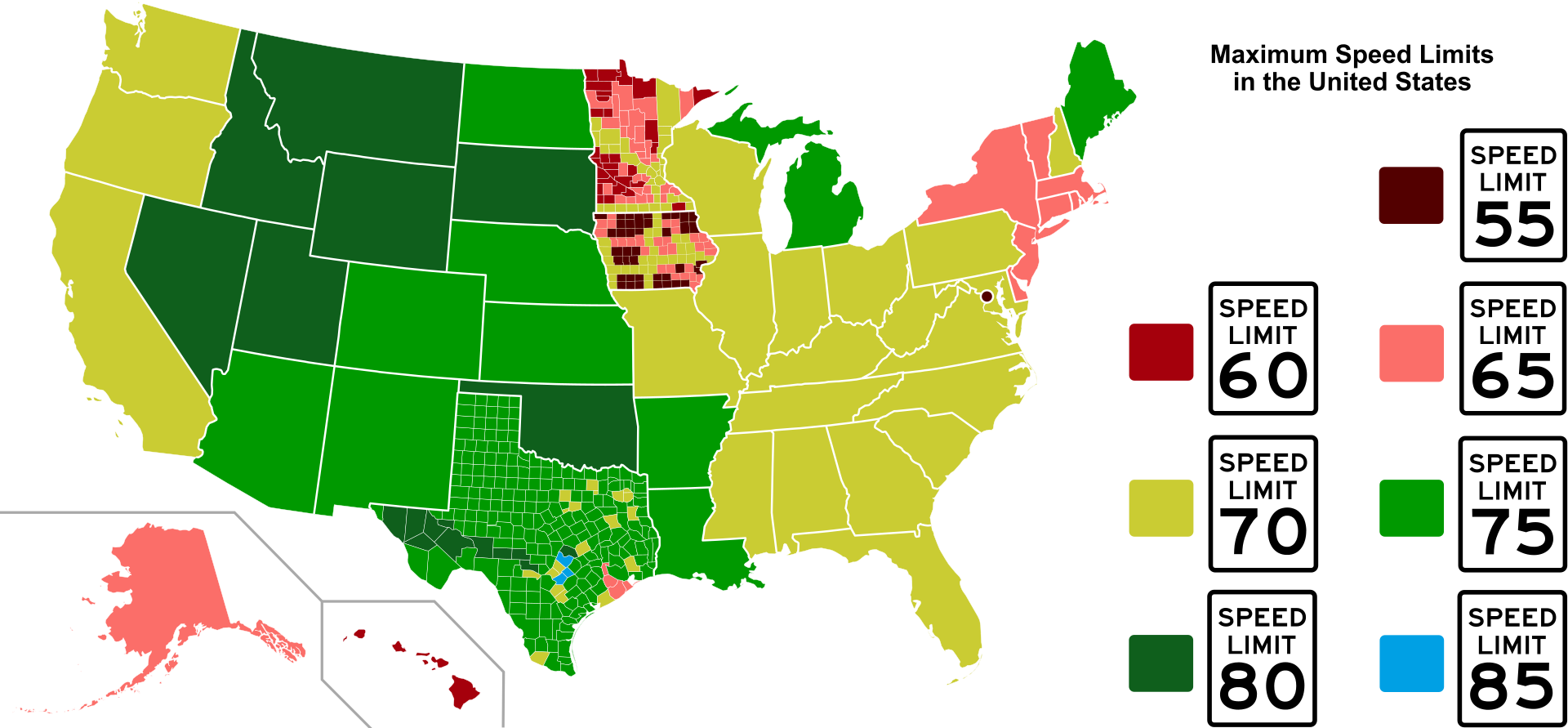
The US interstate speed limits are at most 120 kph (75 mph) and are 105 kph on average (65 mph), and can be as low as 90 kph (55 mph), so that's almost certainly what Tesla bases their "highway" estimates off of.
160 kph+ (100 mph+) is way past the efficiency sweet spot :)
US interstate speed limits have their roots in fuel conservation for WW2 (or noise control in wealthier spots), safety was just a side effect at least at first.
I've lived in a few different states across the US and I've yet to happen across one. (I am an American, yes we all learn metric in school, you can blame Reagan canning the attempt to switch in the 80s)
Wow, 160 kph! That's why. That extra drag really kills the battery. In the US I have never driven above about 130kph, anything higher is pretty much illegal everywhere.
It's a normal speed in Germany. And yes, driving that fast also drains a gas tank very quickly. Not sure why GP is surprised -- an ICE car will also perform much worse than advertised at those speeds.
But it's also pretty much only normal in Germany, and only on Autobahns. Almost everywhere in Europe the highway speed limit is 110 to 130 km/h, similar to the US.
Eastern Europe limit is usually about 140kph, and everybody frequently speeds a bit. With a waze app to check for cameras/policemen you can easily do 160kph in a dingy corolla.
People with expensive german cars usually go 220kph up to 280kph if they are pushing it. Doing 300kph on safe straight sections is not unheard of, but hard to pull off due to traffic.
So consumption increases about x1.5 from the "best case" to "autobahn speeds"? Sounds about right -- a 500km range would get reduced to ~340km. It's better than the 500km -> 300~250km claimed by GP, but it's still a big reduction in range.
> So consumption increases about x1.5 from the "best case" to "autobahn speeds"?
Yes, pretty much. I wouldn't say 1.5x is a constant factor.
If I drive at 200+kph (e.g. 240kph) then consumption explodes.
This stuff must be online somewhere, but for me at least it seems that consumption increases exponentially (e.g. x^2), which makes sense since air resistance increases with v^2.
The person you are replying to says they rented the Tesla and your brother owns one. I wonder if the rented vehicle was somehow abused or poorly maintained.
Or there were longer lines at the chargers. Or they chose different chargers. Or the chargers were broken/slow (common occurence). Or the car burned more power due to lower temperatures.
There's a lot of variance that comes into driving an EV on a longer trip.
I own a Tesla and regularly make very long trips. Travel in an EV requires a completely different mindset from ICE and takes a little getting used to. I'm not surprised that a one-off road trip experience was less than smooth, but once you get into the habits of EV travel it's already a perfectly satisfactory experience.
1.5 extra hours would be my expectation as well.
If we consider a long trip for vacation 3 times a year, the 4.5hrs invested into charging is offset by less day-to-day charging stops with an EV (if you can charge at home), the reduced costs of electricity vs gas and the reduced costs of maintenance.
I would optimize the car choice for the 90% use of daily commute instead of optimizing for the 3-times-a-year vacation trips.


I drove a 'normal' car and he drove a tesla Model 3. He left an hour earlier and arrived 30 minutes after me (with a relatively full battery to avoid the need of destination charging). He has the car for a little over a year so he probably optimized the charging schedule a bit better, but I still wonder why there was such a big difference between his and your experience (1.5 extra hours vs 4 extra hours for a single trip). He did not have to wait at the chargers, so that could account for some of it..
We only stopped for gas, toilet breaks, and took a 15 minute break for coffee and lunch.