The real problem is presuming the profit model for news is a good idea.
It's going to always tend towards quick-turn around, low-effort sensationalism because that's the most profitable configuration.
Speculation, accusation, defamation, and conspiracies will always get more eyeballs then careful balanced well researched reporting. Lying about something now is cheaper and more profitable than sending a reporter out and getting the facts tomorrow.
Especially after the rise of the modern citizen journalist where the costs of video hardware, production, and distribution are near zero. Naturally people doing near zero-cost content production quickly flooded the market and Bullshit will always be the cheapest content to produce.
There has to be a model where such manipulative lying doesn't pay off. We have to somehow separate how we've structured news from how we've structured entertainment.
I think that in the old days people read newspapers and magazines because there was no other way to spend time in a bus/subway/train/waiting_room without engaging with other people.
So newspapers were entertainment (and status signals) to a much higher degree than journalists wants to admit.
Being informed was only a small part of the job that reading a newspaper did.
This is why Facebook could take over such a large amount of ad spending while it is still correct that only a very small part of time on Facebook is reading "real news".
I don't remember news papers being a status symbol exactly, what I remember is that it was rare for a household to have more than one subscription. Multiple magazines, sure, but not newspapers. I remember categorizing my friend's parents by their choices. "This is a National Post household" or Toronto Star, The Globe and Mail.
the categorizing shows how different newspaper signal a certain world view. They can also signal wealth, class and a political view. so i think they are very much status symbols
> I don't remember news papers being a status symbol exactly
How many people have told you they subscribe to the NYTimes?
Even now, it comes up quite a bit.
But in the olden days of people reading the paper on the train, it was a topic of conversation much more. How many papers one subscribed to, which one, etc etc.
Books have been available for a long time and they also have quite a high status - so unless there was something else to it, why wouldn't most people be reading books?
> There has to be a model where such manipulative lying doesn't pay off.
The more I think about this problem, the less I feel like there's a solution. Ultimately, any news outlet is going to be responsible for whoever is funding it.
You can get the Bezos/Soon-Shiong/etc. model, in which the newspaper is treated as a billionaire's philanthropic project, which is problematic in that you've got one person responsible, and if he's not happy he can stop funding it.
You can do a broader, crowdsourced/fundraised philanthropy model, but if the newspaper doesn't make content that people like, they're not going to donate. You're almost certainly going to end up with a partisan paper, because you either need donors from the left or donors from the right.
You can do the government-funded model, but of course everyone ought to be wary of the government controlling the funding of the news.
So... what does that leave? I don't ask that rhetorically - it's something that I've thought a lot about and failed to come to any kind of a useful answer on. The best thing I can come up with is a billionaire (or group of them) endowing a newspaper with a trust that they can't take back and which doesn't allow them to exert control. But then you've still gotta have someone hiring the staff and running the place - who picks those people?
I really don't know - it feels like a truly intractable problem. I'm honestly glad for the rise of the Substack/newsletter model - at least there, I know exactly who's responsible for the content and what their biases are. Unfortunately, that's better for political commentary and the like - it's just not a feasible model for breaking actual news.
It takes time and resources, which cost money. Ads can't pay for it well enough. The article rightly points out that subscriptions cost way too much relative to the number of sources people consume. Everyone left and right screeches about government influence if taxes are used to pay for it. What's left, wealthy patronage paying for it? People working for free (e.g. OSINT twitter)?
>It's going to always tend to quick-turn around, low-effort sensationalism because that's the most profitable configuration.
Exactly so. Just thinking about to the last time I consciously perceived my media offerings were being tailored based on my previous behavior, I found the choices abysmal. The algorithm is all; but the algorithm sucks. That makes it wholly unsuitable for digestion as news.
Think about how higher education and journals work... There's lots of criticism of them but if you get, say, a masters in chemistry from let's say Columbia, you aren't going to be learning about alchemy and orgones. We seem to be able to reasonably pull that off as a society.
So I guess look at systems with relatively low bullshit information density and try to follow their lead somehow.
We might have to admit that decently produced news is hard, time-consuming, and kind of expensive.
As for "who's going to pay for it", I reject the premise. Society figures out how to pay for things they value. The first step is to create the things of value and get general society to respond in kind.
The first part is mostly done. The second part needs the work. Most people probably don't know about things like say, quanta magazine or whether it's any good or not.
We don't ask about who will pay for the new police helicopter or military jet or who will pay for a bank bailout or corporate subsidy.
But if it's in the public interest everyone puts on their reading glasses and pulls out their calculator and red pens.
This is a function of priorities and we need to make sure they're being intentionally set and then the money will flow accordingly.
This should be in the same priority class as food inspection, water sanitation and road repair. That's how important honest well funded news is to a functional democracy. We don't say, complain that the city fixing potholes interferes with the market of private road repair companies.
Not necessarily but there's lots of examples if that's the path you want.
BBC, NHK, CBC, PBS, France 24, ... these are all generally regarded as pretty decent. Even AJ+, RT and Al Jazeera has done decent journalism.
We can speculate based on fears or look at existing systems.
Some people gnaw at their fingernails and couch faint whenever "government" is mentioned like it's some masked moustache twirling cartoon villain from a children's show. I hope we can be a bit more reasonable and sober about this. The 101 year old BBC isn't the last thread being unwound from a totalitarian sword of damocles about to befall on an unsuspecting public.
To go back to the previous conversation, Stanford, Harvard, Yale, MIT, Caltech - all private. There's models that don't involve the government.
Even religious organizations like Christian Science Monitor are decent.
"The most compelling reason for most people to buy a computer for the home will be to link it into a nationwide communications network. We’re just in the beginning stages of what will be a truly remarkable breakthrough for most people—as remarkable as the telephone."
There's lots of possibilities. The point is to not link the Hayekian homoeconomicus profit machine to the institution of news production. That's what leads to clickbait advalanches
I don't believe the concern is necessarily the case that people fear current governments. The concern is that monotonic consolidation of power will eventually lead to a totalitarian state. Having a single, government funded, news channel is a tenet of any authoritarian state so likely best to avoid. Naturally the only way to have a single source is to have strong censorship laws which only allow government approved information. This is far riskier to democracy than random crack-pot journalists. Though we may have always lived in free countries, it is important to remember that even today the majority of the world's citizens live in non-free countries. Backsliding is possible - it has happened before and could happen again. I'd rather not think about this either but I think it is important to be mindful of the possibility.
>> BBC, NHK, CBC, PBS, France 24
I don't know anything about the others, but the CBC is considered controversial in Canada.
>> Stanford, Harvard, Yale, MIT, Caltech - all private
I don't really understand the analogy here. Elite universities are large institutions, but do not exclude smaller ones (good). Wouldn't this essentially be what we have now (New York Times, Washington Post, etc).
You actually Are pearl clutching and reaching for the smelling salts.
I have multiple examples but you reach for some wild imagination because of some insane fanaticism of all things government. CBC has won multiple Pulitzers and Peabodies but I guess it's actually some communist menace.
Sorry, I don't understand the smelling salts reference but I assume it is non-positive. Is the CBC not controversial among a material percentage of the Canadian population currently? If winning an award from a respected institution provides one with a lifetime free pass, then please inform Harvey Weinstein of the news.
Is it insane to think that some country that is currently free may one day become non-free? It has happened before, so it is not clear by what logic you conclude that it can never happen again.
This isn't productive because your arguments are rather weak and now you are resorting to ad-hominems which is particularly distasteful.
This gets politically loaded quickly. But it's interesting to note few people say "business funded" the same way they say "government funded". Maybe "customer funded" or "tax funded" are better, if the question is about the source of the funding and not the middlemen to the transaction?
Perhaps more importantly, tax payer funding can be done in a multitude of different ways, each as unique as with other types of funding. There can, for example, exist a commitment to create a long term endowment outside of political control.
This is a close parallel to how justice works, which in civilized countries with proper separation of powers can guarantee civilians due process not under direct political control.
> Why is it that people like Adriene can make this work, and get young people to pay this much money when traditional publishers struggle to get people to pay anything at all?
Because "Adriene" sells yoga classes, not news. I do agree that a lot of the publishers mentioned are screwed because they are no longer needed. A yoga magazine needs to figure out what it can sell, but if anything it cannot compete in yoga classes, those are available in simply a better form online. But this is not news.
News is a newsroom reporting on things of interest. This is difficult because there are many things to cover and good people covering it are expensive. So would Spotify for news work? I worked for a relatively large newspaper and tried pitching this idea years ago. By pitching I mean I chatted about this with people at parties, but whatever. Anyway, the feedback I got was that these ideas floated around years ago, bit didn't stick. My feeling is that most newspapers are trying to find subscribers who will trust the newspaper with their life and use it exclusively to get news. There is logic in this, e.g. it's better to have 100k subscribers that will be your core audience than to have potentially millions of users but you have to fight for them and their clicks every day. Long term however I don't think it will work. This idea is becoming too foreign for people, especially young people.
I did not actually call this Spotify for news, instead I called it cable for news. After all mostly you do not pay for every single program you get on cable, it's bundled and everyone gets a piece. I think this will end up happening one way or the other because newspapers are increasingly concentrating and it's only a matter of time before someone offers a subscription for all the products in their portfolio, if they're not doing it already. To this I also feel there is a big technical obstacle in that because all of these products run often on different technical stacks and integrations that make it often too painful to implement.
I agree that the author's framing of having random Twitch streams be "news" because somebody might learn something they didn't is absurd, and the essay relies so heavily on this idea that it is basically unsalvageable.
But...
> News is a newsroom reporting on things of interest.
This doesn't feel right either. It's... not quite circular, but nearly so. It's basically saying there's a single specific historical organizational structure that can produce news, and nothing else. Sure, if you want to provide a steady torrent of news on a huge variety of subjects, you need that huge edifice of journalists, editors, support personel, etc. But why does the same organization need to be producing all the news? What makes the writings of a single individual on a single subject and following reasonable journalistic practices not news?
I've been talking about this for some years as well, but mostly without that audience of news professionals. I absolutely agree with your assessment that people won't be going back to that model of getting one subscription to pre-select what they can see that was the way in the paper age. Perhaps that could be the future if a past in which the decades of ad-funded free online news had never happened (I include "let's have an attractive web presence to lure people to our paper subscription" in ad-funded), but now that we are spoiled by having been able to read through the full political spectrum of publishers (and from every nation where they also write something in English), paying a subscription feels like paying to narrow access and that's just not very attractive.
What I imagine as an unlikely best-case model for reader-funded news isn't "spotify for news", but a "spotify for news without spotify": a step back to the print age where you'd have exactly one news subscription (unless you were particularly rich), but with what might be called reverse syndication, a profit share access scheme where every publisher acts as a spotify for its competitors. Provide proof of subscription with publication A to get a well-defined level of access at publications B,C and D, with a fixed part of the subscription fee divided amongst peers. The exact level of access would have to be well-defined of course, to prevent abusive strategies, but it could be something noticeably below "home subscription" (not ad-free perhaps?) but clearly above the free tier.
I would be 100% for paying a monthly fee on Twitch that gets sliced up proportionally to how much I watch each channel. While it seems to work for them, and clearly lots of people pay to be part of a club and get noticed by their streamer, there’s no way I’m paying $7.50CAD per channel. So I end up paying nothing at all.
TFA's point is that the model is horrible for creators: a revenue sharing model is only viable as long as the number of creators being shared is comparatively small. $5, $10, $20 from a few hundred or thousand viewers is a decent haul when compared to a few fractional pennies per view.
It makes sense that creators focus their efforts on cultivating personal relationships with a small, but loyal base. You're not their target demographic.
People say they will pay for news. The translation is that will be dragged kicking and screaming into paying $100 per year for all they can eat news rather than the thousands it would actually cost.
Exactly. People are willing to pay for news if it’s sensibly priced. It’s not a charity. If it really costs thousands, then the model is broken and they should all be out of a job.
"We built Turbo with this question in mind, and streamers continue to earn revenue from ads that Turbo subscribers miss. For streamers – revenue you receive from Turbo subscribers who watch your channel is reflected in your “Ads” revenue estimate in your payout analytics." Source: https://help.twitch.tv/s/article/twitch-turbo-guide?language...
Disclosure: I work here, but I'm not close enough to the Turbo folks to do anything but quote public materials.
Twitch is only barely viable because it does not pay a penny to the copyright holders of the games streamed on Twitch, and if those rights are handled properly, it would be a completely unsustainable business. There is a notion that streamers can promote their games by streaming them, but there is no basis for this at all. I have seen many times where streamers flock to a game that has become popular, and when the popularity of that game wanes, they move on to other games en masse. In other words, the presence of streamers only hurts the game's bottom line. Funding streamers is as silly as advertising on 4ch, so to speak.
If I subscribe to a user they get 50% of my subscription. So if I wanted to use this to support streamers and not Amazon, I’d expect 50% of it to go to streamers.
How many minutes of ads do I “skip” that they get paid for when I spend $12 on Turbo? I have a feeling the answer is going to be disgusting, and that no, Twitch Turbo is a terrible idea if you want to support streamers.
This sounds a lot like the Brave browser model. I am unsure how well the company is doing, and how well the users who opted in to receive BATs are doing, though.
I feel like the missing piece is transparency. Otherwise it’s like tipping: a lingering skepticism that funny financials are happening in the background.
> the focus seems to be on only the publications from traditional publishers, like these...
All of these are entertainment publications. I'm really not too concerned with how it's paid for, whether its ads, subscription fees, or a Youtuber doing it for free. The news I worry about is the eat-your-vegetables sort that is valuable for society, but few people actively seek out. Public funding doesn't work well because its subject to political whims, ad funding doesn't work because it doesn't drive enough volume, and subscriber funding doesn't work because not enough people actually want to pay for quality reporting that isn't biased towards entertainment.
So what are the eat-your-vegetables sorts of news
because I can't think of a time that news news has been relevant to my life -- "staying on top of current events" has only ever benefited me making small talk at parties. The stuff that matters like local politics, community events and organizing rarely happens in the newspaper. Maybe it used to before my time but it doesn't seem to anymore. Following my states bill tracking platform, local orgs, my local chapter of the ACLU, and the social media of local politicians and government agencies like the planning commission, and (begrudgingly) Facebook events actually surface real life actionable stuff. For capital G grass roots stuff Tiktok has been surprisingly good since they feed you geographically local content. Have been to a few protests that organized on TT.
> On YouTube, I follow about 120 different YouTube channels... regularly, every week. On Twitch, I watch some other channels. In my Inbox I get about 25 newsletters per day, and on Feedly, I follow about 100 more sources, regularly.
Holy crap. How do you have any time for anything else?
I sub to 3 YouTube channels, never watch twitch, avoid email newsletters like the plague, and still don’t have time in my day to keep up with it all. Especially while I have actual work to get done.
Used to rely on Reddit for sip-of-the-firehose news acquisition, but they screwed that up. Now it’s mostly HN, and even here I miss tons of things.
I subscribe to 141 channels on YouTube. However, only a fraction of those subscriptions involve channels that actively, regularly publish content that I want to watch. Say 10 or so per week.
I watch a lot of YouTube; it pretty much fills all my free time. But I have plenty of playlists to keep me busy, and I pick through recommendations and try "mixes" sometimes. I will even watch the "Free with Ads" films they offer, which is a hilarious mixed bag of box office bombs and diamonds in the rough.
I don't subscribe to YouTube Premium. I don't do Patreon or "Join" any channels for a subscription. I don't send "tips" in live chat. I endure a lot of ads! But I feel like, if I would pay for one channel, I would probably end up paying for 10, and that I can't afford.
This, 100,000x this. There's a piece to this whole puzzle I can't figure out exactly, but it has something to do with this.
There's two aspects at play here:
1) attention economy
2) network radius
I can't quite get them disentangled in my head, but I'm confident it goes something like this:
Attention economy is zero sum. Huge network size (i.e. the firehose of Youtube et al) means there's infinite competitors. Economically, it's a race to the bottom, every competitor is trying to get whatever fraction of your attention they can (not to mention monetize it). So they wind up competing over smaller and smaller fractions.
There's an additional problem on top of this, which is that you can't vet that many people, as the consumer. This amplifies a lot of negative things in its own right.
It's like we just weren't built to be exposed to networks this large. I think it's OK to not be completely informed on all topics, and typically this used to be outsourced to communities and specialists within your communities, each of whom you knew and trusted in their own domain. But small communities are gone, and the current communities are too large for you to get to know who to trust. So you need to be an expert on all.
I'd be happy with a Spotify model for news if instead of paying out to broad publications, it paid out to authors. There are some freelance journalists whose names I can recognize when they pop-up occasionally in Vice, CBC, etc. Although Spotify is notoriously misery towards independent artists and the whole thing would probably collapse under clickbait trash.
News != opinions. I am willing to pay a fair price for real, objective news about things that matter. Factual reporting.
Of course, there is no such thing as objective news but at least it is vision to strive for.
But the news you can pay for only spends a tiny fraction on this. Instead you get tons of opinions, speculation amd reports about the political game. Basically gossip dressed up as news. And other pieces about celebrities and influencers and people that actually don't matter that much to make the world work.
It is engaging but it is not especially valuable to me, as a consumer. I can do without it.
i may be being to literal with the definition of “objective” that i’m using and if i am, apologies up front.
i’m not sure there will ever be such a thing as an “objective” based news source. so often there is incredibly important information that needs to be part of the public knowledge base yet that piece of news is quite literally impossible to report on and be entirely “objective.”
i think a better standard would be for these organizations to actually follow already well established journalistic codes of ethics. so many of our organizations intentionally muddy the waters between opinion pieces and journalist pieces and frankly it’s gross. particularly because our schools put almost no emphasis on media literacy. this leaves most people vulnerable to crazy amounts of manipulation.
another piece of this which has bothered me lately is when folks use “objective” to imply that emotions aren’t an incredibly important piece of our decision making.
when we’re discussing wider society, EQ is absolutely just as important as IQ and this trend where certain people are trying to delude themselves and others into thinking they can somehow magically escape this basic fact is just wild to see.
i can’t help but question what i think is a naive obsession with “objective” and how much of a fools errand it is ultimately.
the final thing i’ll comment on is this idea that we seem to be stuck on, this idea of one or two major information sources. we do this with everything from social media sites to news sites. when i go to parties at friends houses, or out to bars with my friends, we don’t go to places where we won’t like the people. and that’s absolutely the norm throughout society in the real world. but for some reason We, the larger tech community delude ourselves into thinking it would be any different online.
from what i’ve read of the recent past, there used to be tens of thousands of places people got their news from. every town had multiple news papers. there were countless magazines. countless journals. etc… yet hilariously We, the tech community, keep convincing ourselves that shoving everyone into the same domain name is a good idea. and then we act so shocked when the obvious inevitable happens.
this kind of thinking causes problems in so many directions. if i’m in a group of classic Corvette fans, and i’m constantly over and over and over confronted by Camaro fans. “Explain yourself to me. if you don’t explain yourself to me, obviously that means camaro is objectively better than corvette!” this would be obnoxious and the organizers would ban the person for being toxic. we need to allow ourselves space to enjoy ourselves or discuss our passions without random dipshits constantly demanding we explain ourselves. and ironically, if there is one place where we should be able to spread out into countless directions, it’s the internet. and news should be no exception to this.
we need to uphold news orgs to already well established journalistic ethics codes and from there quit with this absurd idea that there should be only one.
As the article points out "spotify for news" model is already here, that's Youtube and platforms like Nebula. Revenue is shared by the platform with the news creator.
And I get that people don't register many channels as "news", but I see it as just semantics. There is no ambiguity about what MKBHD is providing in his podcast/weekly Waveform videos, or how a lot of channels have a weekly video or corner to lookback at what happened during the past days, often straight labeled something like "news Thursday".
Of course, just like Spotify, the platforms can't sustain these channels. The article points at patreon, but there's another source that is completely missing from the picture: sponsors and product placements. Those represent a lot more money than the platform a and often a lot more that patreons.
Now there might be problems somewhere, but at this point I'ď see them getting solved along the way as we transition further and further from the "news agency" model to smaller "news studio" channels.
No need for bundling really. I subscribe to a major American news source for $2/month. Their algorithm figured out that's what i'm willing to pay and got it right. I assume that for most big publishers this could work (possibly through some process of price discovery and segmentation to capture those willing to pay more).
I also subscribe to a patreon for $3/momth - for small publishers this obviously works too (again alongside higher tier plan options).
The problem is the middle sized publishers, they likely need higher revenue per subscriber to survive.
It's like there isn't a bunch of people out there that might like the 'old fashioned' style of media. We're all kids now?
Silly article really, of course online has more reach, an analogy here is that video games should all be made a streaming service, because who buys full games up-front any more...
The legalization of pharmaceutical advertisement in 1997 was the start of the corruption of our news. If you pay attention to virtually any of the news orgs, such as CNN, or MSNBC, etc, you'll see pharma ads and / or sponsorship logos during the broadcast. In many cases, the pharma company account for 70% or more of their advertising revenue. They can effectively crush any story they don't want making the mainstream, while also pushing whatever health narrative they desire to drive profits. It's truly disgusting.
I've pretty much started watching Glen Greenwald's online newscasts, he is one of the few remaining true investigative journalists out there.
I'm unconvinced. There are many developed countries that don't allow pharmaceutical advertisements. If your theory was true, we'd expect stories that pharma companies want suppressed to show up there but not in the US. Can you provide examples of this? The best I could come up with is "support for public healthcare", but support for public healthcare wasn't something that got torpedoed starting in 1997.
You've missed the point. The fact is, most of the US does support healthcare. That doesn't matter to the legislators. They have lobbyists convincing them to fight against any public option, they don't want to piss off their backers, or their club.
The reason US citizens are not more pissed off about being ignored, and shafted, is that the media don't bite the hand feeding them. They playact as if they do sometimes, but they know where their bread is buttered.
Media covers the worst abuses, but treats them like bad luck stories (no matter how obviously 'orphan crushing machine') rather than anything systemic and national.
Corporate media could cover a lot more of the tragic stories, and make people aware of the true statistics. They don't.
Instead, they ignore and attack poeple like Bernie Sanders for his healthcare plan, which would have saved the country money while providing better coverage. They do the same to anyone threatening the racket.
That's why your follow up sentence doesn't matter. Public opinion has been nearly completely disconnected from the levers of power, so it doesn't matter how public opinion changed after 1997.
> You've missed the point. The fact is, most of the US does support healthcare. That doesn't matter to the legislators. They have lobbyists convincing them to fight against any public option, they don't want to piss off their backers, or their club.
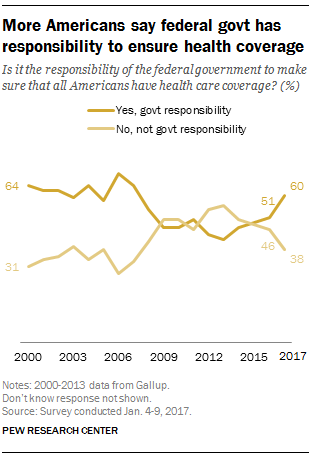
I'm not denying there's a disconnect between what americans say they want in surveys, and what legislators actually do. I am skeptical that this purely a post 1997 phenomena, as like your theory would suggest. I suspect this disconnect existed well before 1997. The oldest survey I could find on this topic was was this[1], which showed public support for federally provided healthcare at 64%. Sure, it only dates back to 2000, but barring some major national event, it's hard believe why public opinion u-turn in the years prior. Furthermore, most developed countries had public healthcare way before this. UK and France implemented public healthcare shortly after ww2. Canada had public healthcare by 1984. This wasn't something that was on the cusp of getting implemented, and the pharma industry shot it down after 1997. Public healthcare clearly wasn't something that was going to be implemented in the 90s or in the 2000s, with pharma intervention or not.
The author conflates individual YouTube channels with "publishers" which is nonsense. The publisher is YouTube. You don't read 10 different "publishers" when you read stories in a newspaper by 10 different journalists. Are we also going to say that watching, say, 20 TikToks from different creators is consuming content from 20 publishers? I sure don't think so. The whole idea of the article seems like nonsense to me. "Spotify for news" is your web browser or the home screen on your phone that has five different news/social media apps. We don't need another layer in between.
As the article explains at great length, the idea is doomed because its promoters assume news = old media like magazines and newspapers, which is simply not the case anymore.
I think instead of following a particular publication "New York Times", "Washington Post", etc., people will start to follow the authors. The concept of a brand with mostly invisible contributors should probably go away. Then, I do feel that a "spotify for news" could probably work. It seems a lot better than the current model where (I suspect) 99.9% of potential readers do not get past the paywall.


It's going to always tend towards quick-turn around, low-effort sensationalism because that's the most profitable configuration.
Speculation, accusation, defamation, and conspiracies will always get more eyeballs then careful balanced well researched reporting. Lying about something now is cheaper and more profitable than sending a reporter out and getting the facts tomorrow.
Especially after the rise of the modern citizen journalist where the costs of video hardware, production, and distribution are near zero. Naturally people doing near zero-cost content production quickly flooded the market and Bullshit will always be the cheapest content to produce.
There has to be a model where such manipulative lying doesn't pay off. We have to somehow separate how we've structured news from how we've structured entertainment.