> hunkering down in small, enclosed spaces is a kind of “swaddling” behavior left over from cuddling up with their moms and littermates when they were kittens.
This isn't cat specific. The concept of boundaries is very important in healing trauma, and just in general is a key concept in human being's emotional development.
> This is peculiar. How safe and cozy can a cat feel sitting right out in the open on top of the water bill? Dodman describes it as something like the placebo effect. “This virtual box may provide some misplaced sense of security and psychosomatic comfort,” he writes.
It is also an exercise I found in a book for healing trauma : make a circle on the floor with some towels, or a rope, or other objects and sit in it. It actually works and can help calm down the nervous system. It is a "patch" you could say, a substitute for weaker boundaries. When you sit in the circle, you can feel your body and emotions more easily.
Understand this isn't "scientifically proven", but certainly experientially verified at least for me.
Just wanted to highlight that the concept of sitting in a physical boundary, even if it's just a square drawn on the floor , does help with the nervous system and it's not cat specific - just something most people don't know about.
I would have never thought this exercise would work, it seems silly and yet in my experience it has reliably, consistently, provided relief when my anxiety was really high.
Someone with no significant trauma and relatively good boundaries (physical, emotional) may not notice any difference.
When I was a kid, story time at school always involved getting out the carpet squares, even though they were arranged on top of another carpet around the teacher, so it's not like the difference between sitting on two carpets instead of one was a big comfort reason.
I don't know if they knew it at the time, but maybe having all these tiny kids sitting on their own squares helped us self-regulate!
> > hunkering down in small, enclosed spaces is a kind of “swaddling” behavior left over from cuddling up with their moms and littermates when they were kittens.
This isn't cat specific. The concept of boundaries is very important in healing trauma, and just in general is a key concept in human being's emotional development.
It’s a fine line though. Modify the environment and you get the opposite effect. I’m an MR tech and we sedate about 1 in 20 to get them into the scanner.
Obviously an MRI scanner isn’t anything close to a snuggle with mum, but it is a relatively enclosed space.
I've been in an MRI scanner. It's not a calming experience by any measure. The shape of the thing is all wrong, the parts that move are unnerving, and it emits a stress-inducing sound. This is one device that REALLY needs a UX person to take a look at its outer design.
A lot of patients every day end up asleep and a fair few say they wish it was longer. I’d be in that group.
The noise is often described as a relaxing ‘white noise’ by this group.
The outer shells are different between vendors and the Philips ones I trained on definitely looked more ominous than the Siemens ones I use now.
The unnerving movement is partially due to the magnet interacting with the inner ear. It creates a sort of vertigo. Explaining this to someone who is anxious seems to help ‘it’s not you freaking out, it’s what magnets do to your inner ear and it eases after a few deep breaths’.
You don't like jackhammers above your head when listening to whatever cassette tape (I'm old!) you brought in being piped to your ears via ... Aquarium tubes?
Don't move equates to my face itches, immediately.
>I’m an MR tech and we sedate about 1 in 20 to get them into the scanner.
Another commenter has noted about the unpleasant sounds and ominous design, but I'm curious about your experience with other patient orientations - it occurred to me that a lot of the discomfort comes from going in head-first and on your back, that way you're losing any sort of autonomy.
I assume there are scans that require people be on their front and looking out from inside the machine (or otherwise able to see out of the machine directly rather than via mirror), do you find that patients for those procedures don't require sedation as often?
Breast MRI is usually done prone, and scans of the sternum or sternoclaviclular joints.
It doesn’t seem to make much difference, but maybe I just haven’t noticed? I did have someone who was too claustrophobic to have a pelvis scan request to go in prone (and look out). We for the scan but it was a bit compromised as the hip joints then moved with breathing.
Probably relevant, breast cancer and possible outcomes is a lot more scary than a sprained knee.
Some things that help include giving a mirror to see out, a blindfold or showing patients that both ends are open.
It’s definitely related to control somehow. Patients try to negotiate how far they go in or to come out for a few seconds. I always bring them out at that point, but once that starts it rarely ends with a complete scan.
Subjectively, the rate of claustrophobia is going up. This, despite scans getting quicker and scanners larger and more open.
> “…concept of sitting in a physical boundary…does help with the nervous system and it's not cat specific.”
I second this observation. I’m immediately reminded of children’s playgrounds—not contemporary, but the ‘dangerous’ ones from my childhood.
I think there’s something about the scale of these spaces. They’re made for small people.
Cats are supposedly solitary animals (as opposed to the dog’s pack social tendency). Maybe their little kitty egos are tuned to private-scale spaces—-this is my box and there’s no room here for you. Pffft
Cats are solitary hunters. They're actually very social animals, but due to their small rodent niche they are very territorial as well (population density of rodents is directly proportional to viable population density of cats, so territory is a matter of life and death). The individuals rarely need meet save for mating, but regular social gatherings still occur and the relationship diagrams of each individual are far more complex than those of a member of a pack-based species. Humans' extremely long period of adolescence necessitates mated pairs and families, but I think our basic social pattern is more catlike than doglike in many regards.
> How safe and cozy can a cat feel sitting right out in the open on top of the water bill? Dodman describes it as something like the placebo effect. “This virtual box may provide some misplaced sense of security and psychosomatic comfort,” he writes.
Maybe I was a cat in a past life (or on the autism spectrum in this one), but I get it.
Urban environments make me very uncomfortable. It's even worse when I commute to them by train or taxi. Once I'm there, it's very overstimulating, and there is no space within them that I can call my own. I can't take a nap anywhere, I can't sit anywhere unbothered, there's just no place I can retreat to and say "this is my personal space; leave me alone or die." The problem is mitigated when I drive into the city, since my car serves that purpose. It's my space, others respect that, and the law would generally support my reaction to anyone that violates it. Meanwhile I'm just expected to deal with it when someone reclaims "my" seat at the library.
I have a pet theory (no pun intended) that the homeless suffer the same plight, which compounds existing mental illness. There's zero stability for them. Noplace is theirs. Set up a camp somewhere and get chased away, find someone else looting it, or the city destroying it. Shelters and even jail are temporary-- never theirs.
I have a bunch of cats and see them do what I think I do. Sometimes, one gets pushed around a bit too much. They'll fuck off and camp out on some paperwork, inside a stray Amazon box or on top of the fridge (which doubles as a vantage point). Each delineates what is very clearly a personal space for them. Usually they don't get bothered again, but if they do, they do a total 180, become the aggressor and fuck the intruder up-- effectively fighting from a defensive position...which is exactly the comfort I get from having a car in the city (which I know creates problems for everyone; I avoid cities as much as possible).
> It is also an exercise I found in a book for healing trauma : make a circle on the floor with some towels, or a rope, or other objects and sit in it. It actually works and can help calm down the nervous system. It is a "patch" you could say, a substitute for weaker boundaries. When you sit in the circle, you can feel your body and emotions more easily.
The "personal space" theory definitely isn't for everyone-- my wife can't relate to any of it and yet sensory deprivation is what works for her. When she's overwhelmed, muting one or more senses (blindfold, noise-cancelling headphones, etc.) is what brings her back down. Maybe it's a male/female thing-- rather than reshaping her environment like I do, she reshapes her own perception of it.
> Someone with no significant trauma and relatively good boundaries (physical, emotional) may not notice any difference.
> Urban environments make me very uncomfortable. (...)
You could have (just a theory, I am not a therapist) weaker boundaries. From what I read it is not necessarily emotional. It is said that really invasive surgeries for example can weaken this internal sense of boundary for some people, which is added stress into the system that really never goes away unless the person can somehow brings back a good sense of safety.
> I have a pet theory (no pun intended) that the homeless suffer the same plight
Oh yeah. Absolutely... it must be awful. To live on the street means there is a level of stress in their body that just never quiets down. Unless they are in a group perhaps with safe people, or perhaps in an area of town where they won't be bothered. Can't even begin to imagine what it's like.
I always remember one night I missed the last train, and I walked around in town, I was looking for one of those shop entrances where there is a small hallway and I was so tired, I figured if I get in a corner there outside of the main street lights, I could just try to sleep. But oh no, as soon as I walked in those spaces, lights would turn on automatically. It was awful... I never realized how unfriendly and so totally unsafe being out on the street at night is like. There was literally nowdhere I could hide in the dark and crawl into a corner. And obviously lying down on a bench at night in the park wasn't a sensible option.
But yeah it's really about having a sense of personal space.
Violence, invasive surgeries, or even sometimes natural disasters can severely affect someone's sense of safety.
I remember one streamer on Twitch he said one night a tree crashed through the roof and that he never slept quite the same since! Hopefully for people who otherwise have good support and a safe environments these things can heal over time.
> rather than reshaping her environment like I do, she reshapes her own perception of it.
I use noise cancelling headphones for years now. It does provide relief, especially with noise from unruly neighbours. When I put the headphones on, I am also in my space in a sense.
I think ultimately it has to do with the amygdala, and a "internalized" sense of safety, from past experience and relationships.
Abstract: A well-known phenomenon to cat owners is the tendency of their cats to sit in enclosed spaces such as boxes, laundry baskets, and even shape outlines taped on the floor. This investigative study asks whether domestic cats (Felis silvestris catus) are also susceptible to sitting in enclosures that are illusory in nature, utilizing cats’ attraction to box-like spaces to assess their perception of the Kanizsa square visual illusion. Carried out during the COVID-19 pandemic, this study randomly assigned citizen science participants Booklets of six randomized, counterbalanced daily stimuli to print out, prepare, and place on the floor in pairs. Owners observed and videorecorded their cats’ behavior with the stimuli and reported findings from home over the course of the six daily trials. This study ultimately reached over 500 pet cats and cat owners, and of those, 30 completed all of the study’s trials. Of these, nine cat subjects selected at least one stimulus by sitting within the contours (illusory or otherwise) with all limbs for at least three seconds. This study revealed that cats selected the Kanizsa illusion just as often as the square and more often than the control, indicating that domestic cats may treat the subjective Kanizsa contours as they do real contours. Given the drawbacks of citizen science projects such as participant attrition, future research would benefit from replicating this study in controlled settings. To the best of our knowledge, this investigation is the first of its kind in three regards: a citizen science study of cat cognition; a formal examination into cats’ attraction to 2D rather than 3D enclosures; and study into cats’ susceptibility to illusory contours in an ecologically relevant paradigm. This study demonstrates the potential of more ecologically valid study of pet cats, and more broadly provides an interesting new perspective into cat visual perception research.
...which is closely related to the box phenomenon: I have a cat that currently spends the night in an IKEA basket (https://www.ikea.com/at/en/p/risatorp-basket-white-90281618/) that was actually meant for socks. At the beginning, some parts tend to stick out, but after a few hours, the "cat liquid" has filled the available space and forms an almost horizontal surface, similar to this image in the article https://assets.rbl.ms/845008/980x.jpg .
It confirms that cats like boxes but also posits that cats the reason cats like boxes might not be for physical touch / sensory reasons since they select fake boxes just as often.
They may try to sit on fake boxes, but I suspect they still prefer real ones if they have the choice - either for the reason given in the article (memories of cuddling up with their mother), or (this is just my pet theory) protection - if the enclosed place they choose to sleep in (which in nature would be some kind of tree hollow, rock crevice or underground lair) is just large enough so they can barely fit inside, they're less likely to be surprised by predators bigger than them while they sleep? Another reason is probably that curling up minimizes heat loss, which helps save energy when it's cold.
> I suspect they still prefer real ones if they have the choice
That would seem intuitive but the specific piece of citizen science research in this comment thread (not the OP) gave them that choice and found that they did not in fact prefer it.
It's (a) a small sample size & (b) an extremely uncontrolled environment, so I'd take it with a liberal pinch of salt, but this is why they're calling for further formal research.
It certainly seems more logical that they would prefer a real box, but that makes the possibility of them not preferring it all the more curious.
I don't have any cats atm, but my BFF does. I brought over some circular placemats and set a couple on the floor and the large ottoman that sits in front of the sofas. After a few hours you can guess what had happened.
I did an experiment with my cat for about a year, trying to ascertain preference with about 5 baskets filled with blankets. Blankets would be swapped and baskets moved around daily. It had an obvious favorite blanket previously ascertained. The only real important factor in where it would choose to curl up was location. Preferring a location in a corner with a single approach.
Critical, but not mentioned: How can we make keyboards (especially the ones on my home office computers) less attractive to cats? Perhaps keyboard-"print" cat nap mats, with USB-powered heaters, could serve as decoys? Would it help if those decoy mats were stiff-bottomed (to sit in my own lap), or made occasional clicking sounds? Might smaller cats prefer the "laptop" or "84-key" size, and larger cats a "104-key" model?
The keyboard is just a way to get your attention - you always put your hands on it, so I'll put myself on it and make you pet me! My cat likes to pull my phone from my hands too - he usually wants grooming or food or outside rather than YouTube. The remarkable perceptual ability of cats seems to be well-suited to tasks like observation, profiling, and behavioral manipulation, all useful for both sustainably hunting intelligent prey or tricking apes into giving it food and care.
Put another keyboard besides yours. There is a claim, that some cats want to mimic their human, and "work" with their tools too. Others are probably just greedy, or territorial, or simply want attention. But it overall seems to work in enough cases, there there are now even cat-toys in the form of laptops.
This is a very common problem. There may be a simple solution.
Cats have very sensitive noses and hate certain smells. Some smelly things are toxic - lavender, eucalyptus - but rosemary, thyme, and banana are cat-safe.
I'd guess a few dabs of essential oil on your MBP would discourage those inconvenient cat snuggle attacks.
I think it is more about attention, you are focused on this noise making device and staring at that bright surface thingy while I want to be cuddled. Obviously, for a cat, that is completely unacceptable!
What did work so in my case, is working on a laptop at the dinning table, because the cat knows the table is a no-go zone, at least when the humans are there. Well, it works most of the time, sometime curiosity is too strong.
...that they will then sit on, because it still fits the shape of "box."
Everyone is missing the point that the keyboard itself is rectangular/box-shaped. It delineates the boundaries of a territory they can occupy and claim for themselves. Get one of those ergonomic "wave" keyboards that aren't perfectly flat and I doubt they would sit on them.
They like laptop keyboards even more. Not only are they boxy, they're heated.
How about a laser on a servo, mounted so that it will point onto the desk but off to the side, with a hotkey to activate it? Then when the cat wants to climb onto the keyboard, you press the hotkey to give it something to chase that is not on the keyboard.
The cat will sit on your keyboard to get your attention. If you don't like that, don't let the cat do it. Just know that the cat will find another way to get your attention.
I dealt with it by getting a split keyboard, so the cat can lie in front of me with my arms around her while I type. It's less work than shooing her off the desk every 3 minutes.
something that is not mentioned in the article of commented here is that at least with my cats they used to go into ambush mode when they got into boxes.
my feeling was that since they are always hunting, they like anything that doubles as resting and hiding place to ambush anything that goes by.
I should think it's pretty obvious why cats like boxes.
Cats evolved into a niche where they are both predator and prey. So consider the benefits of a lair-with-a-view.
For the role of predator, they have a view plus concealment. Ambush! For the role of prey, they have both concealment and protection.
I think the only real question is, what's with cats sitting in rectangles painted on the floor ? Is it just the usual cat thing of going to wherever humans' attention is going ?
Or does a rectangle activate some pattern recognition circuit ? If so, does it still work if the cat has grown up in an environment without objects with right angles, such as / including boxes ?
When my kids noticed our cat sitting in the box looking around, I called it his "tank." So they promptly drew tank treads on the side and colored it green and built a paper turret. Now he looks rather regal sitting in his tank.
So yes, my kids gave heavy weapons to the animal definitely plotting an overthrow of the humans. I'm sorry.


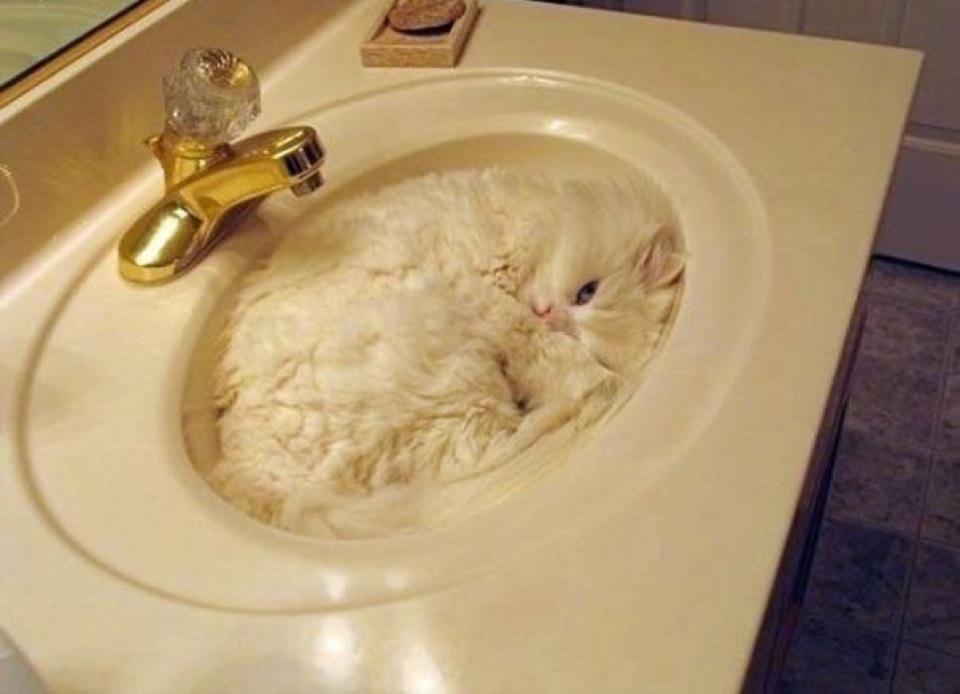
This isn't cat specific. The concept of boundaries is very important in healing trauma, and just in general is a key concept in human being's emotional development.
> This is peculiar. How safe and cozy can a cat feel sitting right out in the open on top of the water bill? Dodman describes it as something like the placebo effect. “This virtual box may provide some misplaced sense of security and psychosomatic comfort,” he writes.
It is also an exercise I found in a book for healing trauma : make a circle on the floor with some towels, or a rope, or other objects and sit in it. It actually works and can help calm down the nervous system. It is a "patch" you could say, a substitute for weaker boundaries. When you sit in the circle, you can feel your body and emotions more easily.
Understand this isn't "scientifically proven", but certainly experientially verified at least for me.
Just wanted to highlight that the concept of sitting in a physical boundary, even if it's just a square drawn on the floor , does help with the nervous system and it's not cat specific - just something most people don't know about.
I would have never thought this exercise would work, it seems silly and yet in my experience it has reliably, consistently, provided relief when my anxiety was really high.
Someone with no significant trauma and relatively good boundaries (physical, emotional) may not notice any difference.