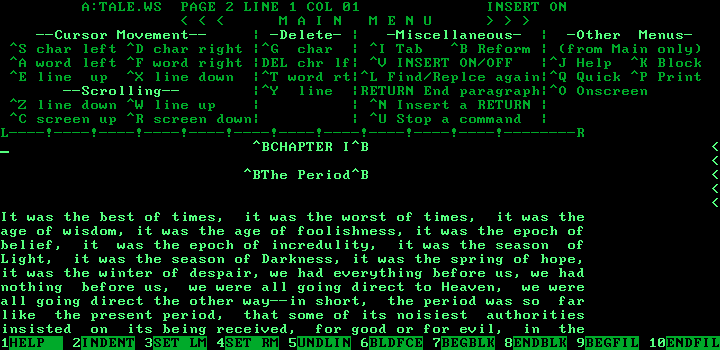
Mmm, the screenshots bring back memories... a place I worked in the early 80s (right around when you could still look at the IBM PC and plausibly predict that even with all of IBM behind it, it just wasn't going to work out, it got so many things wrong, and was so slow compared to older hardware... no really, we believed that) we did a lot of ludicrous things with an IMSAI. One of them was WordStar split-screen mode - you could open a second file - read-only - on the upper part of the screen, scroll through it with a subset of wordstar keys, and hit something to swap back and forth (I forget what, we had serial terminals with a lot of function keys back then, and brightly colored wordstar labels for them.) The trick was that wordstar had a documented hook for "custom" display drivers and keyboard drivers... so we could easily lie to wordstar that the screen was shorter, and edit the cursor movement sequences to all have an offset, so it would draw on the lower 2/3 of the screen and we had the upper 1/3 for our shenanigans.
This was a couple of years before I first used emacs. (Also, I am sort of amazed that we got paid to do it - very cheap highschool student interns basically, so there were a lot of outright anti-economic aspects of the whole thing. Loads of fun though :-)
Personally, I've been using joe since one of my IRC buddies told me about it in ~1996 or something, and it's served me well since. Much love to Joe and the rest of the contributors.
The only serious issue I've had with joe was when a boss was snooping around in my home directory and was perturbed by all the DEADJOE files, since his name was also Joe. :)
Big joe fan here. When I started using Linux full time I was already well familiar with wordstar, so it was a natural tool. It's a decent editor in its own right, and not just because it has a familiar set of keybindings.
> I've only encountered relatively few other users.
When my employer was acquired by Facebook, I joined the FB employee Joe user group, and it became the Joe users group. When I left, it went back to the Joe user group :/
I gather joe was fairly popular at some point, but as long as it keeps working, I'm going to keep using it.
I never liked all the temp files Joe littered. In the end nano became more popular and even though it's not WordStar compatible it didn't matter to me anymore since the days of DOS were long gone :)
I loved the ring binder manuals even though they were harder to read (but great to refer to as they'd open flat) and updates would say "replace page 6 with this, add page 10-A between 10 and 11", etc.
IMHO, software documentation has dropped because it's hard to write the documentation when the software isn't finished, and software isn't finished anymore.
Games (and other software) used to come with a large manual, and then a single folded sheet that had quick start instructions and updates to the manual. The large manual had to be finalizes before the disk images, in order to get them made on time... but the software had to be firmed up. Now, it's very common to have a huge day one patch, which could change a tremendous amount of things. You can't print a manual that addresses that, and nobody wants to retain writing staff to do constant updates.
Software not being "done" is a huge part of it now, because things change so relatively rapidly now that there's no real "point" to printed documentation (things like the "Missing Manual" series to the side) and it's all been replaced with tutorials and searches.
It's much better now, mind you, there was a quite bad time in the late 90s early 2000s where the printed manuals were going away but the "online help" features of the programs were pretty crappy (even if just that you couldn't read the help and look at the program at the same time).
And computers are much more powerful now so you can 'afford' to make things more discoverable and easy to figure out; many early software packages are completely obtuse (even games) without studying how to use them.
Interestingly the "no printed manual" really started much earlier in the Unix world with 'man' pages. Some early Unix documentation books are just literally printed man pages.
Great point. The obvious explanation for less documentation is that customers don't care much, and the obvious explanation for why customers don't care is that Stackoverflow/Google/etc. works fine in practice.
I still think dumping support on google and even a vendor's own "community" forum where they don't actually bother to provide support is a cheap-out.
But yeah if documentation was valued by customers, they would compare products on this point. But they don't.
As a syadmin I do sometimes hate this because our company often buys product with really poor documentation and support (and the documentation often hidden behind a loginwall too).
Microsoft has decent documentation I have to say. But when something doesn't work as it says, their support is terrible. It becomes a yes/no game ("It should work according to the docs", "Yes I know but it doesn't") and then when that finishes they keep stalling by asking to upgrade to the ever-available 'latest version' and provide more and more logs, by which time there is yet another new version and we start the whole circus again.
In the end I more often find the answer on community resources like admin slack groups (MacAdmins is great in particular). But really, this is not how things should work.
Back in those days software came in a box and the box contained the media for the software and at least one book, which was the user manual. Some software included multiple numbers of books, covering different topics. But these were real books written by technical writers with 200+ page counts.
In world of the internet, that information has moved online, and the days of hiring technical writers to producing technical documents, is not as common as it once was.
My Apple II had a Microsoft CP/M card[1] in it just so we could run WordStar. I think I was the only kid in sixth grade turning in papers written on a word processor.
After AppleWorks[2] was released in 1984, I don't think I ever booted into CP/M again.
For some reason, I never used Apple Writer[3] even though it was released in 1979 and apparently a decent word processor. Decent enough for Paul Lutus[4] to retire and sail around the world anyway[5].
AppleWriter was interesting as it had its own built-in language, WPL, a macro language that could do a chunk more (https://archive.org/details/wpl-manual/mode/2up). That was not the sort of feature expected given the inherent limitations of an 8-bit machine.
Yes, WPL was the most amazing feature of Apple Writer. It reminded me of programming a scientific calculator, but with text rather than numbers. When AppleWorks came out, I was really disappointed that it didn't include anything like it (this was alleviated a few years later with 3rd party macro packages).
The first program I sold for actual money, back when I was in high school, was a set of WPL programs that allowed teachers to generate exams by picking multiple-choice questions at random from a master file. The answers were also randomly permuted. It also produced the answer key for each. The idea was that teachers would use it to generate exams where each student's version would be different.
I sold a grand total of two copies. A marketing genius, I was not.
I never used WordStar itself, but the integrated editor in Turbo Pascal used the same key bindings. I haven't used anything related in many years but I'll never forget ^kb and ^kk for marking blocks.
and this is probably the reason anybody even remembers it. Because when he actually WAS writing, you had a whole new generation of up-and-coming writers listening to him wax poetic about the great WordStar
For in the tech world, tons of people who used computers in the 80s and 90s remember WordStar regardless of Martin, there are blogs, cloning attempts, etc. Just like there are fans of WordPerfect, the Atari, Amiga, and others.
Just saying. Him waxing poetic about it during a time when the watercooler topic was what happened last night on GoT is the reason that anybody else even recognizes the name.
My dad was a professional writer who wrote for everyone from Time Life Books to the National Enquirer. He picked up several of the early Osborne computers, with Wordstar, and used Wordstar until he passed (I also got an Osborne out of that, when I was 10). Wordstar is the first word processor I ever used, and I used it a lot (wrote my first fiction story with it). It was an amazing piece of software, for what it had to work with. I loved it, despite its quirks (such as dot formatting).
  - Electric Pencil on a TRS-80 Model 1
  - Word Writer on a C64
  - PC-Write on an IBM XT
  - WordPerfect for DOS 4.2 on a XT clone
  - Describe for OS/2
  - Lotus WordPro
  - WordPerfect for Windows
  - Microsoft Word
  - Google Docs
I went to a mostly liberal arts university and the new my freshman year, 1987, computer lab consisted of around a dozen non-networked XT clones running WP 4.2. Two of them had dot matrix printers attached and were dedicated to printing. I had my own XT clone, which made me the computer lab for my friends, but no printer so WP 4.2 was somewhat forced on me. That being said I found it to be extremely productive and is the only one I have any sort of nostalgic feeling towards. Once AT layout keyboards became the norm it was much less productive to use.
I know Microsoft Word is disliked around here, but I regularly produced complex documents hundreds of pages in length both by myself and in collaboration with others. I found it to be a good tool for doing so.
I did try Wordstar at one point but it lost out to PC-Write which used many of the same control keys.
I mostly retired a few months ago and now part time manage my fiancee's horse farm. Google Docs meets those needs.
> I know Microsoft Word is disliked around here, but I regularly produced complex documents hundreds of pages in length both by myself and in collaboration with others. I found it to be a good tool for doing so.
Anyone who doesn't think Microsoft Word is now on-par or superior to every other word processor in ability and function, tells me they have no idea how to use.
Part of that is Microsoft - Word is extremely complex with, literally, hundreds of options, much of which you need to be actively taught (a high quality book or a long course) - the other part is that it's user interface is still very much rooted in earlier computer design ideology. It has to be.
This kind of reminds me of the people who complained that Maya was so much more complex than KPT Bryce. Yeah... it has to be. One of them is almost unfathomably powerful for creating computer-generated graphics, and the other displays its limitations well within the first hour of usage.
Seconded. I'm mostly a LibreOffice user now (since I use the Linux desktop almost all the time), but Word is an extremely capable piece of software.
Sadly, the atrocity that is the ribbon interface manages to obfuscate or hinder most of this advanced functionality.
A lot of people told me "I wanted to do X in Word but it cannot be done...". Yes, it can be done, you just have to discover that functionality and learn how to operate it. Used to be easier ("Just go to Tools > Mail Merge, and follow the wizard"). Now you have to learn which tab of the atrocious ribbon interface, and in a completely unintuitive way.
+1 Microsoft Word is a very capable piece of software. If Microsoft's software engineers were forced to write board papers and legal contracts, it would probably be more intuitive too. IntelliSense for defined terms would be amazing.
I am the one doing word processing software for my firm. Secretaries and typist like multimate more due to Wang heritage. The frightening scene of nothingness of wordperfect is …
Word is a mac software as Microsoft is mainly an application software firm for mac and basic I suspect. Never evaluated that.
As far as I remember the key combination of wordstar, the slowness of it due to I always found its keyboard mapping hard and with menu not enough space and even slower. Never a fan.
I wonder how vim would work as a writer tool vs wordstar.
how did the Z80 cards work interfacing with the Apple hardware? I presume CP/M software loaded onto the Z80 was accessing (what I will call) "S-100 memory and displays"? Did you run a piece of software on the 6502 that translated/transported that virtual hardware state on the Z80 card to the real Apple hardware? Or did the Z80 card translate the available Apple hardware memory and display to be directly accessible to the Z80, and put the 6502 to sleep? The mind boggles. Hardware was much simpler back then, seems like anything could be possible, but memory was expensive so you wouldn't want to duplicate it or waste it.
I once heard from a reliable source that Paul Allen's Z80 card was Microsoft's big cash cow funding Microsoft's growth in between the BASIC era and the MS-DOS era, it was a really important product.
I’m also suspicious of this. IIRC, our primary reason to get a Z80 card was to run WordStar.
We had a very active piracy club in the early 80s with easily a thousand floppies and I don’t recall ever hearing about a native 6502 WordStar. (We met every Sunday at the local school cafeteria.)
Author here. That was added after a comment by de Jong.
Edit: specifically he stated “the genius Rob Barnaby had written WordStar entirely in Z80 assembler which was then cross assembled into 6502 Assembler for the early Apple computers.”
I was only maybe 9 when my dad brought home an Apple II, but I grew up on that machine. It was a completely maxed out Apple II. Upgraded to a II+, Z/80 softcard, 16k language card, 80 column card, enhanced keyboard, modem, dual disk II drives, etc. I had a ton of software, both purchased and acquired through other means.
If there was a native WordStar for the Apple II, I find it hard to believe it would have escaped my notice. I certainly would have remembered it. None of the other commenters here recollect it either. No trace of it can be found on any Apple II archives on the net.
WordStar was semi-famous for being the reason people bought the Z/80 softcard (that and dBase). I know it's the only reason my Apple II had a Z/80 card in it. If there were a native Apple II WordStar, they'd have been little reason to buy that card for many people.
No mention of it here which also cites de Jong and Barnaby:
He replied but I honestly think he's misremembering and/or forgot about the Z/80 card that was needed to run WordStar on an Apple II. He doesn't really answer the question that you asked:
> The 6502 CPU is the one that was used inside the early Apple computers. You added an 80 column card, and for a big discount and no service contract you had something that would replace the popular Wang word processing machine. The spreadsheet and word processor drove the computer revolution.
I'm as confident as it's possible to be about 40 year old software that there was no WordStar for the Apple II that didn't require a Z/80 card (i.e., there was no native 6502 version.)
I was able to find some reference to an Irish dev team that made the ports, but the 6502 port was scrapped in favor of CP/M-86. Brain dead move imo. I updated the article. Thank you for your corrections to the record :-)
Edit: Actually just found more info, and it would appear that it was actually just the dual effort of 8086 dos and cpm that killed all efforts at 6502, and the team in Ireland were never tasked with it. So, it would seem that that port never get any further than Barnaby having run it through a cross assembler.
WordStar was the first application I used. Way back, in 1993 on Windows 3.11... hahaha I remember trying to draw things with ASCII before I knew that was a thing. I was only allowed to use WordStar and play Sokoban back then... I distinctively recall knowing there and then that all I wanted to do "when i grow up" was going to be something computer related. Good memories.
You lucky. When I was in Elementary we played a math puzzle and maybe Pacman.
Pacman was cool, but, you know, it was the same level over and over.
Sokoban at least has some variety.
Wait, a 6502 version of WordStar? I was a serious hobbyist in my Apple II days, and I never heard of that.
I bought a Z80 expansion card so that I could run CP/M and WordStar on my Apple II (also Turbo Pascal, which was the main reason for getting the Z80 card).


This was a couple of years before I first used emacs. (Also, I am sort of amazed that we got paid to do it - very cheap highschool student interns basically, so there were a lot of outright anti-economic aspects of the whole thing. Loads of fun though :-)