The real problem with having a sham mixed in with non-shams is that I've seen folks develop the attitude of "all recycling is a sham!".
For those not aware, recycling aluminum is absolutely not a sham. It takes about 2x the energy to make new steel than to melt down old steel. For aluminum, that energy difference is 20x!!!
This is why people will actually pay you to recycle aluminum, because running electrolysis through bauxite ore to make new aluminum is incredibly energy expensive.
I think asking whether they pay you or you pay them is probably a great way to guess which is good and which isn't. The cost of recycling something is probably mostly energy (i.e. carbon emissions) as is the cost of manufacturing a replacemement (even the materials cost itself is probably largely a function of energy spent to dig them up and get them to you) so if they pay you, it is saving carbon emissions and if not it isn't. You can get paid for dropping many metals off somewhere, you have to have your city pay to do anything with the plastic. I realize there are other factors but if one needs a quick guess that would be a good way.
If people can wrap their head around the idea that landfills are not dumps and are instead very safe and borderline irrelevant, then the carbon emissions should clearly determine what one recycles.
From the first link, it seems like the slightly to moderately higher cancer risks (correlational) of living near a dump are due to socio-economic factors (smoking).
Quotes:
A proximity analysis, which modeled how many cancer cases could be explained by distance to Fresh Kills, found that none of the five cancer types had elevated rates closer to Fresh Kills between 1995 and 2004, although it did find that some thyroid and bladder cancer rates were higher near the former landfill site between 2005 and 2015. But the researchers still saw little evidence of a link to the landfill because they could not find any reasonable explanations for how residents would have come into contact with materials in the landfill that were known or suspected to cause bladder or thyroid cancers, especially since Fresh Kills closed.
“More plausible” explanations, the authors wrote, were higher screening rates for thyroid cancer and Staten Islanders’ higher smoking rates. Smoking is a known risk factor for bladder cancer.
The link between landfills and cancers is kind of iffy. Some research shows higher rates of cancers, others don't. My guess is that it depends a lot on what's been buried and how. What seems more certain is that you can run into other health problems like heart/respiratory issues and then there's the stench which I wouldn't want to live near even if there were no health issues.
> ...and then there's the stench which I wouldn't want to live near...
For active landfills, yeah.
For decommissioned and capped-off landfills, nah, not if they've done it right. (And given that this is a regulated industry, it's very likely that they've done it right.)
In my experience in the American Southeast, Academy of Model Aeronautics airfields are often built on top of decommissioned landfills [0]... so I have spent a lot of time standing on and around these things. I've never noticed any odor, soft spots in the terrain [1] that is the cap, or any of most of the other weird things one might think of when one thinks "site of a former landfill".
[0] Why? Because the land is quite cheap, and a ~100 foot strip of tarmac, a few little structures (sun shelters and the like) and parking for a couple dozen cars isn't all that much weight.
[1] To be fair, the runway did have to be worked on every three, five years as the terrain under it settled. But bear in mind that we're talking about bumps in a runway for model aircraft, so the amount of settling was actually not very large.
Meh, none of this is at all convincing and I’d expect to see these things, based entirely on fear, even if landfills were completely benign.
But even if true, this is just making the argument that we should probably try to put them further away from people’s houses, which sure. I don’t want to live next to one even if there’s no risk at all so I agree.
> I think asking whether they pay you or you pay them is probably a great way to guess which is good and which isn't.
I sort of am being paid to put my plastic in my recycling bin. My garbage company charges $47/quarter for a 35 gallon regular bin, and $22/quarter for a 64 gallon recycling bin.
It would require two regular bins to handle everything, which would be $94/quarter, which is more than the $69/quarter that one regular bin plus one recycling bin costs.
Unfortunately, how much you pay to recycle is hidden, in your taxes. You kinda need to know how much your cities pays for the recycling, vs trash, for each kind of material. Probably possible, but not easy. (But we know you can get paid for metals.)
In this case, it sounds like GP is using a private garbage collection service because their municipality does not provide garbage collection services (as is common in rural areas).
One would expect that the costs in that situation are likely to be more representative of the actual cost to dispose of the material, as the company can't obscure its economic reality with taxes.
My city charges extra if I don’t recycle. But, I know from the data they publish that they are simply paying to recycle everything and the rate is higher than the rate at which they dispose of garbage. So I’m still paying for it, it is not paying me.
I think you’re right in general but in Australia and I think some other places as well we have a 10c refund on plastic bottles made out of PET
(Also glass and aluminium)
Most of our PET bottles, for stuff like soft drinks is now also made partially out of recycled plastic, many are made out of 100% recycled PET
If I understand correctly this is only economical because there is this whole system where all plastic soft drink bottles are made of PET, and so easily identifiable as PET and to get the refund you have to take it to a collection point where the only plastic entering the system are these bottles.
When I was a kid almost everything was recycled. People took your metals, glass, paper, peelings, wood and so on off your hands and frequently paid for it. Now you have to do the sorting yourself and you have to pay for the privilege. The large conglomerates that then take your pre-sorted scrap sell this for the market rate. And they're sitting pretty on decades long contracts with municipalities.
This is the opposite of my experience. When I was a kid (80s and 90s) every place I lived made you separate your recyclables. It's only been relatively recently (maybe 10ish years or so?) that I've seen single-stream recycling become the norm. I'd also point out that a ton of plastics recycling and e-waste was never really recycled - we just shipped it to China to sort-of-recycle it, but they stopped being the world's dumping ground a few years ago.
I think its less anti-competitive corporations and more that recycling most things just isnt cost effective. I find it hard to believe someone in the supply chain is making a killing by amassing large quantities of cheap plastic or lithium batteries.
It's because they saw short term gains. Corruption, maybe, but not that I'm aware of.
The big haulers here were all established parties that got to bid on these contracts and they played a very smart game but given the various downsides for society and the municipalities themselves in the longer term I can't rule it out either. It certainly doesn't make a whole pile of sense. One day glass was a valuable resource, the next you had to pay someone to get rid of it. Likewise for paper, compostables etc. This all happened in the 80's or so and recycling was the nominal driver. It outright ignored that we were already recycling. The big killer was to package everything in plastic and with plastic liners, even things that look like paper are often coated with plastic on the inside. So now we have two problems: the valuables are recycled and create a profit twice for the haulers and they charge real money for the ever increasing mountain of plastic.
People harp a lot on the straw ban, I get it, it is symbolic. But I would have gone much further: anything perishable that can be packaged in paper should be packaged in paper, and the paper industry should be incentivized to recycle as much as possible with the least energy as possible. Because right now recycling paper often gets skipped on account of the energy requirements (because we like our paper to be white). Instead it gets lumped in with the compostables or biomass and burned for electricity.
There is a ton of information on all this and it is obviously very variable from one locality to another but in the end resource extraction, energy use and leftover waste are the killers, those need to be curbed and far more drastically than we are doing right now. So much stuff is single use it is just terrible, and there are no real alternatives either. If you shop at a normal supermarket for a family of four at the end of the week you'll have a small mountain of packaging.
I've often wondered how different things would be if producers and manufacturers were required to pay for any waste they generated from their products, at no additional cost to the consumer.
Individually wrapped candies in a plastic sleeve? Landfills will send you a invoice based on the volume that enters their site.
Phones designed to be replaced every two-years? You might be able to save money by making the original container a prepaid shipping box to cut back on sending out new ones for proper disposal.
Fruits and vegetables? That's bio-degradable and people will pay to have it in their soil. Make a deal with some local group to set up compost bins charging $1/scoop, and its like a built-in subsidy for farmers.
Have a novel solution that's 100% re-useable/recyclable? Enjoy the good times while entrepreneurs offer to pick that up for you to sell back to recyclers themselves.
EPA discovers that by "recycle" you meant "throw it in the ocean when no one's looking"? If you can't pivot quickly enough to cover both the new disposal fees and clean-up fines you'll be a good case-study for others who want to take shortcuts.
Sure, companies would absolutely pass the cost straight into the purchase price, but a company that wraps your sandwich in plastic and adds a $5 disposal markup won't last long when someone starts wrapping theirs in paper and only charging $1 more.
I know it's not that simple, but a man can dream, eh?
I agree with you on a lot of this, but I don't think it matters if we get better at recycling paper because paper is renewable and the more paper we need, the more trees are farmed, that wouldn't be farmed otherwise. It seems like people believe that paper comes from unspoiled ancient rainforests, when really it comes from rotated tree farms in Canada as far as I know. If we recycled paper so well that our demand halved, a lot of those tree farms wouldn't be planted anymore. It seems to me like if paper is dumped in the landfill the carbon those trees capture gets buried underground. Big win.
Also, I'm maybe a monster environmentally thinks utility needs to factor in. Straws are made of plastic because straws are useful and because plastic makes a very good straw. Paper makes a useless one, so they're pointless to even make. So many things use a lot more plastic than straws do, so I sincerely think straws should be the last to go after we've ended plastic water bottles, takeout clamshells, milk cartons, etc. Put all that crap in reusable glass or recyclable aluminum.
The problem with reusable glass is that it's heavy and transporting it back to the factory to be washed and refilled takes a lot of effort and energy on it's own.
I think this problem mostly exists in places where people have a single recycling bin. If each type of material is collected separately, it's easy to establish when recycling makes sense. And then you can also create incentives for using packaging materials that can be recycled.
Agreed, the single stream is the biggest joke ever. Like, what kind of recycling can you really do with paper covered in food drippings from yogurt containers, food and beverage cans, etc. And what's the exact process for washing those plastic containers just caked in food? And given that they're commingled on the scale of entire buildings or residential blocks, do people really believe that 100% of such large numbers of people meticulously wash their garbage? Personally I would just recycle aluminum and that's it. Everything else is just a roundabout trip to the landfill in the current setup.
How exactly does multi-stream recycling solve any of the problems you've mentioned?
It's pretty easy for recycling centers to sort out most of the glass and metal from that stream and then as technology improves they can sort and recycle even more of the plastic.
As for the food waste, I just assumed it was mostly destroyed by the recycling process. The high temperatures for metal and glass recycling make that seem easy to me. Plastic would be harder, but I think that's also part of the reason plastic can only be recycled a couple of times (it's not "pure" after it's recycled.)
There isn't and won't be a technology that is going to ever economically recycle (closed loop, meaning used for a similar purpose over and over) most of the plastic containers in the trash, especially when it's 40 different types of plastic all mixed together (with generous amounts of contaminants mixed in). Sure, it can sometimes be downcycled once, like shredded into some kind of filament and used to stuff a low-quality cushion or something. That's about it.
If it were economic to really recycle it, China wouldn't have stopped taking ours. And most of the rest of Asia followed suit, which is why municipalities are sheepishly hoarding it in warehouses now without a plan, or just admitting to themselves (if not their citizens) it's a sham and diverting most of those plastics we put in the blue bins straight to the landfill.
One more thing: You're right that multi-stream recycling wouldn't fix the problem for the plastics, though just collecting metal and glass and letting the plastic take a more direct route to the landfill would be more efficient and would have a chance of getting people to understand that the blue bin doesn't redeem any of their sins when it comes to plastic.
It goes through a process. It doesn't make metal or glass useless.
Biological Treatment: Organic waste, including food waste, is often separated either at the beginning of the process through manual sorting or through processes like anaerobic digestion. In some facilities, organic waste is processed separately to produce compost or biogas.
I don't know about glass, but any junk in molten metal just burns up and the ashes can be skimmed off the top. It's not really the metal I'm talking about, it's the plastic and paper which are pointless to even have in the system.
In my locale, throwing aluminum cans in the recycle bin earns me a disparagement from my garbage/recycling company and maybe even threats to cancel my service. The only thing accepted in the bin is relatively clean paper materials.
I have to take the cans down to the recycling center and throw them one by one into some machine and maybe they'll get recycled. Any compensation I might get is from the state, which is basically a dime for a can.
At that point I'm just going to throw them all in the trash, not worth my time nor fuel to drive down.
Can and bottle deposits are older than the general recycling push, at least where I live. It was more about keeping trash off the road sides than re-use.
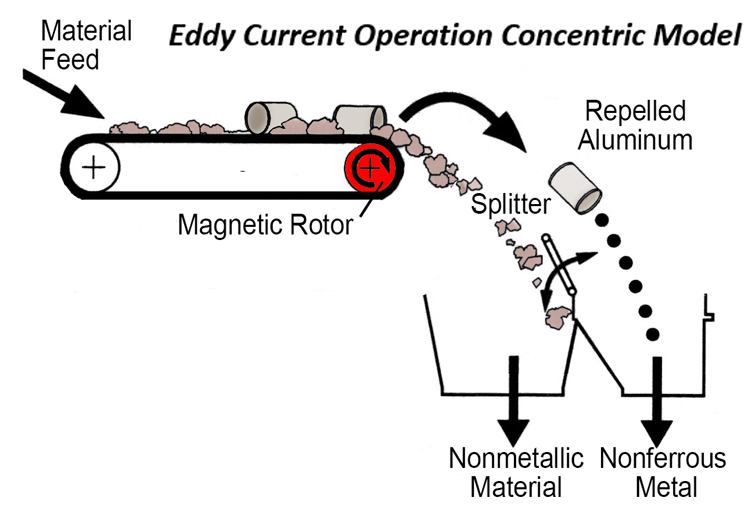
In my locale the waste management company encourages us to toss aluminum cans in the bin with everything else except for glass and paper. They use powerful magnets and eddy current sorters to separate them from the rest of the stream.
The rotor contains powerful magnets and when it spins quickly it induces a magnetic field in nonferrous metals like aluminum, repelling them from the rotor so that they overshoot the "other waste" bin.
A dime a can is more than they’re worth. Of course, you already paid that dime when you bought em, but it’s not as if scrap value instead of deposit would make your payout go up.
The liners are so they don't corrode because of the acidic contents (not necessarily scary. Acidic doesn't mean deadly but it's not good for cans.
But anyway, what I've been told is that any kind of adulterants on metals aren't even a big deal because that will easily burn off when they melt them. Think about the Terminator in Terminator II. The leather jacket, and indeed The Chip were not a problem when he was lowered into the steel. :'(
There is. A quick Google search found several companies near me who will by scrap metal off of me.
The problem is that a pound of aluminum goes for about $0.45.
That does not come close for paying for a weekly curbside pickup service, which is what most individuals use for recycling.
Heck, they probably wouldn't even take an unsorted collection of "recyclables". The company I am looking at drops the price for unspecified "dirty" aluminum to $0.25 per pound.
Because plastic isn't very recyclable, recycling is therefore a government scam to control the masses, according to John Stossel https://youtu.be/NLkfpjJoNkA?si=C-PEyGnk4M109WuP&t=333 . He clowns the idea of reusing a plastic container as making people "do things they don't want to do"? What??
The whole segment is so pro Capitalism that it is anti caring about the Earth at all. The message could have more easily been "We were fooled by Big Plastic for corporate profits".
I dont know what all he says, but recycling plastic absolutely is not cost effective and it cant be reused for most purposes. And to top it off, we’re now finding all sorts of bad news about microplastics which are exacerbated by recycling them (heating, shredding, etc.)
Free market is not capitalism. You can have capitalism without free markets (in fact, capitalism exist outside of free market most of the time). The origin idea of libertarianism, probably the most pro free-market ideology, is anti-capitalist, and hate the idea of LLC, which is anti free-market, and pro-capitalism.
Can you go into more detail here? My understanding is that a free market requires capitalism (privately owned wealth) to function. And capitalism needs free-ish markets to actually use the wealth.
I'm also unsure how libertarianism is anti-capitalist.
Capitalism is about who own and decide what will be produced: the capital owners (it can be the State, like in China). In a free market, the market itself decide what will be produced, as all agents have full, unaltered information.
US libertarians came from individualist anarchists, who basically thought that under capitalism, volontary exchange could not exist, as wage workers could be forced to work by power imbalance created by capitalism.
Even some neo classical liberals (liberalism is the ideology promoting free market) have played with the idea of natural monopolies created by land use. Hence you will see a lot of georgists amongst liberals who really thought about a perfect free market capitalism.
Finally, a good critique of free-market socialism (where every company is employee-owned, with real liability) is that interest groups will still form and lobby the government for advantages, distorting the free market, like the asset owners do currently (hence it cannot work in a representative democracy).
Capitalism is a system composed of many agents with conflicting wants.
A lot of the capital owning capitalists would prefer the markets to be less free in many ways. If I own a toll road, I really don't want a parallel toll road. This sounds like a ridiculous allowance in a capitalist system but look up the Ambassador Bridge. It is very much in that owner's interest for the market to not be free at all.
If you look at lobbying, many capitalists advocate for less free markets all the time. I'm not just talking about the capital owners either. Labor advocates push for less freedom in the markets consistently through wage floors and legal restrictions on employers.
It seems like there is an equilibrium point where a completely free (meaning every person for himself) devolves to the point where the lack of trust becomes too high of a transactional cost. Both food producers and food consumers benefit from regulations that don't allow you to sell sawdust disguised as flour just because you are able to convince someone that it will work the same.
When I was a kid, you'd be socially shamed for not recycling or questioning it as a solution.
Moving into college, people started feeling socially safe to quietly call out that the recycling program might be net-negative for the environment.
Slowly the conversation evolved in my circles to rewriting recycling's history as a "raising awareness" program. Where the goal was to bring awareness to this issue or that issue by socially pressuring a bunch of people into sorting and washing their rubbish.
Finally we are getting to the point where we can have an honest conversation about recycling.
But it's a real bummer because we've spent _decades_ misallocating capital into potentially worthless infrastructure that fails to meaningfully move the needle on the problem.
Would have been really cool if, instead of this whole social/political signaling thing we did, we instead spent that time and tax money developing processing facilities for compostable materials that are suitable for shipping/packaging and food storage.
Many current social/political ecomovements seem to be going through the same trajectory.
Something that I remember from when I was a kid and the first big recycling awareness programs kicked off was how much they emphasized all "Three Rs" at first, how much all three were required hand in hand, and also how quickly that tapered off (both accidentally and presumably some cases intentionally) until people mostly forgot the other two Rs. The original campaign goals to focus on Reduce, Reuse, and Recycle. Recycle was always meant to be the fallback after you've worked to Reduce and Reuse. Recycle is easier to claim action on, you've got the right bins and they are marked and you sort some of your junk stream, so you are doing your part. Reduce and Reuse are so much harder. It's certainly hard to pat yourself on the back individually for reduce/reuse goals: those are the system goals, the big collective behavior problems.
I do sometimes wonder what some of the educators would change in hindsight based on the overall failure of Reduce and Reuse to be the stronger messages over Recycle in the long term. I bet there is some frustration there because they tried.
I try hard not to throw things out and give them a second life. Upcycle. Unfortunately it makes me a bit of a hoarder... I need more sheds... or to do 10x more and more diverse, projects.
My thinking on plastics recycling has evolved several times over the years. One concept that influenced me is the idea that plastics contain carbon. To bury plastic somewhere where it will never decompose is, essentially, a form of carbon sequestration. There is some tipping point where the energy necessary to transport and recycle plastic might be outweighed by the net removal of carbon through simple burial.
Another thing that radically changed my mind about ocean plastics is that most all of it comes from a handful of rivers. The solution to ocean plastics isn't to eliminate or recycle all plastics, or even to filter it out of the oceans. Rather, we just have to to stop a small handful of countries from dumping garbage into their own rivers.
That's simplistic thinking narrowing it down to a few countries. In reality there are a bunch of western countries that send their 'recycling' to 'recycling specialists' in poorer countries. An in reality the western countries are just dumping all their waste over the fence and pretending that it's being recycled.
Also you seem to ignore all the health problems that come from plastics like disrupting the endocrine systems in animals. I wouldn't be surprised if a petrochemical company is behind that article because they tend to push PR (propaganda) that shifts the blame away from the source of the problem which is them.
1,656 rivers is still not a lot of rivers for 80% of all ocean plastic though considering the actual total number of rivers in the world.
Because the key bit of data there is that ocean-borne plastic is not primarily coming from beaches, or city storm run-off (at least in modernized areas) in an even distribution but is very obviously a product of local regulation (and in turn suggests that other measures - like foreign aid or imposing standards of behavior on local companies with foreign suppliers/subsidiaries would likely solve the problem).
The issue is no one's truly freed themselves from the "individual sacrifice" narrative of environmental remediation: the desire is to accuse people on an individual basis of ruining the world, and requiring all solutions to involve individual consequences for their "sins". There's much less enthusiasm for the reality, which is that other then some slight changes in tax allocation we might be able to just solve the entire problem and give a slightly improved standard of living anyway (i.e. people in wealthier cities generally like their waterways and beaches not to be clogged with trash).
Carbon sequestration for carbon that should never have been pumped out of the ground in the first place? Maybe just don't make plastics from petroleum. Leave it in the ground.
Better yet, make plastics from 100% bio-sourced polymers(carbon from CO2 in the atmosphere) and bury those. That would be effective sequestration.
There is absolutely no reason we shouldn't use oil to make plastic. The entirety of the problem with CO2 in the atmosphere is from the use of oil as combustible fuel.
Like "shouldn't have been pumped from the ground in the first place" -- what? (also ignoring that historically oil was discovered literally just coming up out of the ground on it's own).
I think a lot of things would get fixed if we simply required the originators of the material or item to pay for its recycling or disposal. If it's not economical to recycle an item, the cost would be borne by the organization that made the item.
100%! You see a lot of reusing of resources when it suits the businesses. Shipping containers, pallets, kegs & gas bottles are all standardized and get recycled for many years. By recycled I mean the literal meaning before it got molested by corporate propaganda campaigns.
I suspect if the manufacturers were forced to pay for the externalized costs of plastic junk they might start:
* making their own durable packaging to buy back.
* figure out how to standardize package shapes and centralize collection/washing.
* Stop overpackaging and over marketing the food. A lot of foods don't need to come in a shiny colorful plastic packet.
The big problems (which I know of) are that defining 'originator' is actually a bit tricky, and that the 'originator' is often somewhere very far from the end-user, and has very little ability to take any part in recycling or disposal.
If a small-medium sized company exports a product, it's very difficult to get involved in recycling/disposal, and there are a lot of small-medium sized companies exporting. Not everyone has a subsidiary in every province of every country, and shipping all used products back to HQ is probably more carbon-intensive than just throwing stuff in a landfill.
But you can solve this systematically by just having that medium sized company pay for it. They don't have to do it; but they have to pay for it; meaning the cost will be transferred along to the end user.
I agree we should have started decades ago and not gone down with path, but it was cheap at the time. We now know some of the externalities, the impacts to society at large, and we should demand that the cost to our future be included. Maybe then glass use, reuse, and other materials can compete with the currently under-priced plastics. I think some sort of carbon tax is going to be required.
social/political signaling? Let's just call it plasti-corps propaganda.
This really is the fault of the corps. Recycling _could_ be practical, but corps want to throw it out and make more, because that's cheaper.
And if the article wants to talk about lying, it really needs to include the lying that US waste disposal corps are doing about what can go in their recycling bins. 3/4 of what current waste disposal says is recyclable goes straight to the landfill.
A lot of people want you to believe a lot of things for a lot of reasons.
I do not believe any of the people that I saw generating social pressure around recycling in my childhood worked for plati-corps... But they did have their personal identity and social/political in-group signaling tightly coupled to being _perceived_ as caring about the environment.
No need for a historical lens though. The same dynamics are at play now.
The more frequently someone uses in-group and out-group signaling language to short-cut critical thinking in discourse, the more likely it is that they're perpetuating some form of "propaganda."
Is it really the fault of corps? I mean, is that a useful explanation? Corps exist to maximize profit don't they?
Perhaps we have to consider why single use plastic is appealing in the first place. The culture of use once and throw away might have started with plastic but didn't stop there.
It was actually a stretch at first to get people to throw packaging away. You can find ad campaigns comparing picnics with reusable containers to picnics with disposable containers for example, so you could argue that disposal didn't come naturally but rather was socialized by people who wanted to make and sell a lot of plastic.
Definitely, if what a corp is doing is legal they are going to maximize profits. It might not be ethical, but corporations are businesses created to generate money.
I'm sure most of us here could find something unethical about their employer if we looked deep enough. That action might even be a product of globalization or the society and the only way for the corporation to exist is to do that unethical thing.
Its on the government to protect the people and the land. If plastic is an issue they should force the producers to do something about it. They would then need to increase the cost of the product, which could force people to use cheaper alternatives.
You’re being downvoted and it’s an intriguing question.
Corp is gonna corp.
The fact is there is an externality that exists to be taken advantage of, and it can try to be corrected in a few ways. Punishing the corp with taxes, regs etc is only one way
> However, it is still better to recycle plastic at home than throw it away.
After acknowledging that recycling is a scam, you cannot introduce a statement like this without a lot of careful justification.
If everything previously in the article is true (which it is) it is not better to recycle plastic at home than to throw it away: it is approximately equivalent.
Your recycle bin ends up shipped somewhere halfway around the world, where most of goes into a landfill.
It's not that recycling plastic is 100% a "sham". Recycled plastic is real, and products made from recycled plastic are real. The "sham" is that recycling plastic is not efficient. Still marginally better than straight into a landfill.
Firstly, there are too many plastics mixed together (and the article touches on that).
There is also the issue that even if you have waste that is made exactly of one kind of plastic, and it's the right one for some application, recycling works by chopping plastic into pieces. This chopping shortens the long-chain molecules that give the plastic some of its important qualities like impact strength. The resulting plastic is inferior to the original, even if pure and homogeneous.
I was thinking the same thing. The article didn’t go into what percent is actually recycled vs landfilled.
I’d hate for this movement to push people to simply skip the recycling step.
The narrative that recycling plastics is never effective isn’t accurate and drives demand for more plastic manufacturing as stocks of recyclable plastics diminish.
And landfill if it’s lucky. For a long time US “recycled” plastics went to China where they were burned. When they had to clean up the air pollution for the Olympics they stopped doing this, so the plastic was just shipped somewhere else, Malaysia if I remember correctly. (There is an Netflix documentary about it)
A local landfill is dramatically better than shipping it on a giant freighter halfway around the world to be set on fire.
The best option seems to be to reject single use plastics as much as possible. Force companies to make changes if they want to make sales.
Knowing that this whole thing was a scam (which has been known for quite a while) should push governments to take action. Not only against a the plastics industry, but also to push companies to move way from single use plastics.
Even single-use items like plastic forks/spoons that typically come wrapped in a ton of plastic these days, it's everywhere. In a typical delivery order they'll give you several of these even if you don't ask for them. CA tried to reduce single use plastic bag waste by mandating the 10c surcharge and "sturdy" bags, but now you just added a meaningless cost to the consumer who's going to largely use the bags in the exact same manner as before, but now they're even HEAVIER plastic.
The western concept of "dirty" has contributed a lot to waste. In certain other cultures, human hands are considered to be clean (with the onus being on the handler to make sure their hands are, in fact, clean) and it's quite OK to touch something someone else will touch with their bare skin (or even eat from).
It's not even a rational obsession with zero human contact. A (true) chef is not expected to cook with gloves on. His hands are going to be all over your food while he's in the back. Chefs probably will taste something out of the pot to see if it's coming along ok. We know this (though perhaps try to avoid thinking about it). We'll eat nasty hotdogs at the ball game that have been handed to you down the bleachers by eight pairs of hands, but insist that our plastic cutlery come wrapped in further plastic.
That hot dog is wrapped in foil and probably was prepared by someone wearing gloves though. Health depts around the country are more and more insisting on glove wearing for basically everything, though that has its own problems and is debatably less sanitary in certain ways.
Health depts are particularly obsessed with utensils too. The plastic is because of all of the hands that might be reaching into wherever they are if they're self-serve, if they're dropped, etc.
You kind of addressed the gloves thing, but I want to express my confusion how gloves make things cleaner. Where you put your hands, you put your gloves hands, so cross-contamination works the same way.
Gloves work to:
- not get your hands dirty
- easily switch between a dirty state to a clean state (remove dirty glove)
- prevent.. body contamination? How much is that a real concern though?
Right so gloves are an obvious win if you have a cut on your fingers or something like that. Chefs could generally be relied on to use them in that situation anyway, for their own protection. There are a lot of acidic salty things that hurt.
In other situations, food-borne illness mostly happens through cross contamination. Gloves would help there too if one changed them frequently, but people tend not to and it’s hard to make them do so at appropriate times. Some studies show that basically they are more likely to wash their hands when needed (likely because you feel that chicken juice on your hands) than change gloves. That’s why it’s debatable. People either wash their hands or change their gloves, and (excepting things like a cut on your fingers) whichever they do more is probably safer.
I wonder, is this obsession with sanitary utensils founded on some real-life study? Or is it pure paranoia and made-up lab tests ("What would happen if I dip my fork in this anthrax solution?").
Well, the fecal oral route of transmission of things like norovirus is very real. If you just set out a big bin of utensils, I've no doubt gross people will spread gross diseases that way.
That certainly is not a slam dunk case for individually wrapping forks though. If the fork is in a plastic wrapper, you touch that and can still pick up the germs from it. It's some amount of reduction of spreading pathogens I am sure, how much I do not think we know. It is also, however, cheap and easy and not a really big hit to the environment, plastic wrappers on utensils probably don't make the top 1,000 sources of carbon emissions or landfill space.
The best solution (and you see this at places like stadiums now, and spreading to fast food) are the little machines with a hopper that dispense the utensils. You can get a sanitary supply with no individual wrapping. But they're not practical in situations like a hot dog vendor who is walking around passing stuff out. And you're still touching the little lever that 1,000 people before you did.
Nothing's perfect, it's all tradeoffs, but to a health department, they get no thanks from the public for sparing landfills from plastic wrappers, but they do get blamed whenever an outbreak happens, so you can expect them to err on the side of caution.
Some of it is “real” but some of it is kind of cargo-cult. Someone wearing gloves for their entire shift doesn’t really provide anything protective. You have to regularly change gloves to make it worthwhile.
Besides some filthy cultures in the East, the majority of Eastern cultures have cleanliness even baked into their faith affecting everything from how they shower to how they pray to how they eat.
I put "dirty" in quotes for a reason. People are just expected to hold themselves to a higher standard of cleanliness in other cultures instead of hacking around it with copious amounts of plastic.
Much of the rest of the civilized world holds cleanliness in high(er) regard, but they're not germophobes.
Hand washing doesn't need to be constant to be effective in the vast majority of situations, especially the situations where you're setting up a big bunch of items and you could wrap them.
I don’t think that it is about hands being clean or not clean. The wrapper on a disposable utensil is a kind of tamper evident “seal” attesting that this particular utensil hasn’t been used yet.
I can see that having started as a marketing ploy and have very little to do with hygiene reasons. I.e., how much can one manufacturer differentiate their disposable plastic forks? Very little. They're all plastic, they're all forks.
Until someone put them in a plastic wrapper and marketed them as "sealed for your protection". They hit a nerve in the society, and soon people demanded them and they became the norm.
I don't think it has to do with cleanliness per se... might be about legal liability? An unopened package tells you that it's there as-is from the manufacturer. It seems more like it's about ensuring the product's integrity through the chain of custody than anything else.
It absolutely is not a western concept. China takes the spirit you describe, but not the gloves or food example, and ramps it up to 10. There was no such thing as a cloth mask in China, for instance. There is also no market for used goods. If its not new its dirty.
And just talking plastic waste in general, East Asia is far and away the biggest polluter.
Single use plastic bags are not really a problem in the amount of plastic they use, these are something like 5 grams. They are actually better in that regard than most reusable bags because it takes a lot of reuses to beat that, often more than their typical lifespan.
Where they are a problem however is that they have a tendency to fly away and end up where you don't want them. In the ocean, in nature, littering the city, they are en eyesore, cause problem with some animals, and end up as microplastics everywhere.
Sturdier, paid-for bags may not result in less plastic being used, but it results in less litter, which is good. And yes, it works. Some people will continuously pay their 10 cents, grumble and throw away their bags, but most will do the smart thing and just reuse their bags.
The paper, LDPE, non-woven PP and cotton bags should be reused at least 3, 4, 11 and 131 times respectively to ensure that they have lower global warming potential than conventional HDPE carrier bags that are not reused. The number of times each would have to be reused when different proportions of conventional (HDPE) carrier bags are reused are shown in the table below.
With regards to the plastic bag surcharge, this is a policy that has largely worked in some parts of Europe as far as I can see.
They charge typically 10c for a single use bag, and 30c for a reusable bag[0] (which is much heavier plastic indeed). And people actually reuse the bags, or bring their own cloth bags, to the supermarket.
Additionally, single use plastics have been mostly banned and I can't recall seeing any (apart from straws, which were banned more recently) in the last 15 years. This was met with some grumbling early on, but people got used to it rather quickly.
[0] To give you an idea about how sturdy these 30c reusable bags are, I routinely use these to transport car parts (like brake disks & calipers, or suspension parts), fluids, power tools, or even lead batteries around.
Anecdotally, this seems to be much less prevalent in the US due to cultural differences. I live in Chicago and their is a 7 cent surcharge for bags. I'd say 1/3 of people actually bring their own even after this has been in place for years.
The heavier plastic means those bags have a longer reusable life. Unlike the thin plastic bags which were often only good for single use yet still takes centuries to breakdown.
As for the plastic bag tax, in other counties which that has been introduced there has been a reduction in the use of new bags. Every culture is different though, so it might not work in CA. But what they’re doing is far from untested.
We have thought about it. We are already taking about hundreds of years for plastic to degrade and even then, it’s to microplastics that are just as harmful to biological life.
So if “bags for life”, as the heavier bags are often referred to, means fewer plastic bags are made and thus thrown away, then that’s still a net positive.
Because the time scales we are talking about are massive, what’s matters more is reuse.
If fact, that’s a key factor to consider regardless of the material you’re trying to conserve. Reuse is far more important than recycling.
Being heavier plastic is good in a couple of ways. It makes them less likely to blow away from containers and get into the environment. They are less likely to float in the ocean looking like the jellyfish that turtles and other animals eat.
there may be other problems, but there are at least those two advantages.
A chinese takeout by me recently switched from paper bags....insulated plastic bags, complete with that reflective liner...all for the same $12 takeout cost. It's insane but this is in NY.
And many more restaurants are trending torwards "flashier" packaging as part of "branding".
I don’t disagree with you on single use plastics but I think another thing flies under the radar. There is just so much STUFF. Without plastic Id wager people would probably own about 20% of the number of items that they currently do.
I often think about my grandparent’s house. She never seemed to be missing anything that was needed, and didn’t seem to want for anything, but it never felt like there “stuff” everywhere, like so many homes today. Everything was used and had a purpose, and many things were reused. My grandpa’s workbench was all organized with old glass jars to hold various sizes of nails and screws. These days people buy a plastic organizer and throw the glass jars away.
Also contributing to the problem is the marketing departments in every company wanting their package to be a unique color and shape. Before 'recycling' glass milk bottles and beer bottles would be a standard size and be bought back by the shop. This is what we need to return to but the corporations are always peddling greenwash nonsense about how eco-friendly their (PFAS coated) cardboard packaging is or how you don't need to feel bad because 5% of the bottle is from recycled sources.
We used to have a pretty great system in the Netherlands with reusable PET bottles for soft drinks. These were much thicker than the current types (so thick you couldn't crush them), and they'd be returned for a fee, washed and refilled.
Unfortunately this system was dumped in favour of the usual single use "recyclable" bottles. I still lament their disappearance :( the current bottles (the same as everywhere else) are a huge step back for reuse.
I am somewhat suspicious as to whether this works out as being environmentally friendlier - i.e. the dishwasher paradox (in short: a dishwasher makes things easier, and uses less power and water and detergent to wash dishes then doing it by hand - people mistake struggle for effectiveness).
Because at a large scale, you've got a couple of parameters I can think of:
1. the mean lifetime before a bottle fails / is removed from service
2. the failure mode of the bottle (i.e. if it shatters, does it go to landfill or do you end up with pieces in the environment?)
3. the amount of water and detergents needed to wash them properly, given the uncontrolled nature of the environment they come from, and the amount of power.
4. revalidating that the bottle is in fact clean - again - due to the uncontrolled nature of the environment they come from
5. the extra shipping involved in moving the bottles around for reuse.
It's easily possible they reusable bottles don't actually work out being lower resource use then single-use disposables with controlled disposal (i.e. stabilized landfill). Cleaning things when you don't know where they've been is fraught and difficult.
Basically it can easily be possible that reusing bottles you already have in your possession and wash yourself is better, it's not necessarily true that it works at a larger scale.
I'm not sure what the reason behind it was, but I doubt it was environmental. We did this for 15 years or so (previous to that there were reusable glass bottles) so I doubt it was really unfeasible. If it were it would really have been stopped much earlier.
I think it's more the industry wanted to bring things in line with the rest of Europe, or that it was cheaper, rather than because it was better for the environment.
I had always suspected this to be true and also wondered how it’s allowed to spray cardboard with plastic making that also impossible to recycle.
I’m willing to bet even glass is still difficult to recycle let alone plastic with hundreds of different types and colours.
So now that we know this can we start making changes now? I often wonder what happened to feeding seaweed to cows reduces their greenhouse gas impact from methane… I presume we never actually implement these findings and just carry on boiling ourselves alive.
> This includes feeding cows seaweed based additives, but one of the longest commercial trials failed to meet hoped-for methane cuts and led to the animals eating less food. ... “The commercial viability of those [food additives] means they are not something likely to be widely adopted by the industry.”
So yes, business as usual. Nothing has changed.
> A 2022 CSIRO report commissioned by MLA found the industry emitted almost two-thirds the volume of greenhouse gases in 2020 compared with a 2005 baseline. But it said the reported reductions have been driven by a decrease in land clearing and an increase in forest regrowth, as recorded by Australia’s national carbon accounting system. An analysis by the University of Queensland said the NCAS may be grossly under-reporting land clearing rates.
Think "cheap relative to glass making" - which is a small high value operation compared to say, concrete production. (or put it this way: 1 ton of sand costs me about AUD$79 / ton and volume would make that cheaper).
Paper recycling isn't much benefit either. Paper mills are carbon neutral as they power themselves with byproducts(1) of paper production. Add that you're burying carbon when you dump paper in a landfill. Recycle paper isn't carbon neutral. Then factor in the demand of paper leading to more tree farms.
Glass containers are great for reuse though. For years beer, soda, and milk bottles used to be returned washed and reused. You don't need to melt them down and remold them.
Reduce Reuse Recycle in that order. Big plastic really wants you to ignore the first two.
It has led to massive uptake of single use containers. I believe as of this year the German regime felt it necessary to levy an additional tax on these because the people are rejecting schlepping their containers back and forth.
Basic physics says otherwise. A commercial bottles washer sterilizes and cleans with water at about 140°F for about 15 minutes. While glass melts (depending on the type) between 2500°F and 3000°F. Then after that the newly formed glass needs to be kept in a annealing oven as it cools slowly from 1000°F to 600°F. the amount of energy needed is several orders of magnitude higher. also this doesn't mention the work needed to grind the glass to be melted, or the cleaning of the glass that still needs to be done so as not to introduce impurities to the glass your making.
Right but imagine that millions of people have to transport bottles to thousands of retail locations. Those need to be sorted and picked up and send to many locations to be cleaned, inspected, relabeled and filled. If it were centralized that’s one thing. But every company that makes drinks will need to collect their bottles.
We had that solved by people laying down a deposit with their initial purchase, and would then exchange their empties for full bottles at the point of sale. The same trucks that delivered full beer/soda/ect bottles can return with the empties back to the distribution center and another truck take them back to the bottler on the return trip. Those trucks all have to go back anyway so its not an additional burden.
I assume we'll have similar articles a decade or two from now calling out another obvious one, that everyone knew corn ethanol fuel is a farce as well.
The problem with so many of these programs is that you may subsidize an industry but that won't make it more efficient than physics allows for. Politicians love putting their names on expensive programs that sound great and won't prove to be a waste for decades. By then we're all left holding the bag after they've retired or died.
We need to stop demonising landfill. I love landfill - it is a focused area to put toxic waste.
There is a massive problem with society's obsession with keeping stuff out of landfill.
Tell me would you rather have waste plastic in the contained area of landfill, or would you rather than plastic was put into roads and leeched into land, air, food, water, people, ground, earth and air as cars and trucks grind it out of the roads.
Its a good point tbh. We are continuing to learn about the harms of plastic and dividing and heating them are always central in this equation. Plastic roads just sound like a recipe for microplastic runoff.
That’s a fair point. I cringe when I see some dumb invention like turning plastic junk into toxic bricks. But even better would be to actually re-use the packaging like old school beer bottles and milk bottles. Industry has no problem standardizing containers when it suits them like shipping containers, kegs and pallets.
Greenwashing is the worst option of all as you waste your time on things that don’t work.
If recycling was profitable in the main, someone would be auctioning off old landfill sites to mining companies. If it was predicted to be profitable with new technology, someone would be operating landfills while developing that technology. And so on. The fact that it needs consumers to sort recycling for them (in aggregate, this is a large amount of unpaid labor) hints to me that the fundamentals of a profitable enterprise simply don’t exist to be found.
Such facilities do exist, dirty and/or wet material recovery facility is the search term you'd want. Most material recovery facilities want a clean input stream though.
It's not particularly lucrative, but it often makes sense for a landfill operator to do material separation, because the combination of selling the separated material and not using the landfill space makes financial sense.
Given that my county landfill is the beneficiary and will either need more tax money or close down and increase my disposal costs, separating the saleable stuff into a clean stream doesn't bother me too much.
This gave me a flashback to a public speaking class in college back in... 2006ish. I gave a speech about how recycling was bullshit and a waste of time. It was very poorly received haha.
I guess I assumed that recycling advocacy groups did some due diligence, dug a bit deeper, took the trouble to find out how everything was going. And now we are claiming that nobody checked. The plastics industry was lying, and everybody just believed them and took it at face value. Because we all believe what industries say.
The thing is, everybody didn't "just believe" them. What I find really weird about this moment in time is how the roles appear to have been flipped. I'm old enough to remember when it was the right wing / business / pro-capitalism side of US politics calling out recycling as big sham (e.g. the Penn and Teller BS episode on recycling was 2004, though how "right wing" you consider that depends on your view of libertarian politics). So it's sort of weird to me to watch the modern story about how recycling was a lie propagated by big business and its supporters on the innocent American people, and the predictable reactionary response from the right wing reflexively defending what they were previously decrying. We finally have something everyone agrees on and yet we're still arguing about it. Probably because like most political topics its a proxy for a different discussion entirely. Just a weird moment in time.
That misses an important point: Recycling as a "solution" was easy to fund for "awareness" programs and other forms of essentially propaganda, because corps could easily see the ROI for reducing a potential cost, so there was ample money (read: force, power, or simply human resources) to tell people that "this is the way".
Who could possibly have comparably the same level of funding for a "hey this isn't doing what they say it's doing" awareness campaign? That took like twenty years to organize.
That's the central problem of any capitalist system; It by definition produces ready made organization of resources towards whatever a capital class wants, while making it inherently harder for the non-capital class to similarly put their technically significant resources towards their own goals. Capitalism inherently puts more control over large amounts of resources in the hands of those that prioritize individual rewards and have strong individual incentives against collective improvement. It inherently pressures the Capital class to be against collective improvement that has any cost on them, even extremely vague or distant costs, or hell, even just "costs" that are actually just personal subjective preferences, because they can afford that.
My trash can is very small and expensive but my recycling can is huge and basically free. So even though plastic recycling is a scam I put my plastic in the recycling container.
These days I only recycle numbers 1 and 2, the only ones that have a chance of being turned into something else. Everything else I just put in the trash (with an eye on avoiding plastic in the first place, opting for things in glass containers, cooking from base ingredients, etc)
In my area they recycle 1, 2 and 5, so that's what I do.
PET #1 is very recyclable in general. Not so sure about 2 or 5.
My biggest frustration is all the recycling labels smeared on things that aren't recyclable leading to everyone calling it a 'scam' when in fact some recycling of plastics (namely PET) is much better than the alternative (burning or landfill).
The free market works great most of the time, but is a tragedy when it comes to externalized costs.
The earth is screaming at us to begin a steady, regulated phaseout from plastic, at least in disposable consumer products. The government will need to take action here, and it will happen faster if more consumers stop being so complacent about the problem.
If anyone is feeling doom and gloom, the field of plastic pyrolysis looks promising. It will require processing similar in scale to manufacturing hydrocarbons, but there is still hope.
There's got to be more to this theory because it doesn't really make a whole lot of sense on the surface. There aren't that many instances where consumers are given a choice about the plastic content of the products they buy or the packaging they come in. And consumers that can afford to pay more to avoid plastic seem to do so, not for any environmental reason but because wood, metal, glass, cotton are perceived as higher quality.
It doesn't really seem that consumers as the end buyers of goods need to be convinced when we're mostly takers of goods.
In the mid-1970s, the growing environmental movement tried hard to tax or ban plastics, especially plastic packaging. The plastics industry responded by promoting recycling purely for its public-relations value. It was never economical, and often isn't even practical, even today.
I.e. An Exxon VP in 1994: "We are committed to the activities, but not committed to the results." [1]
It makes a lot of sense. Corporations make more money the more junk they produce.
If you have 10 minutes I recommend watching this video about how the lobby groups invented the whole idea of recycling plastic with the little numbered resin identification code that looks like a recycling symbol.
https://youtu.be/PJnJ8mK3Q3g
Can we switch to aluminum and add in a small recycle "deposit" like they do on soda cans? If there is money to be made on the deposit, this creates a strong incentive to recycle the containers.
Recently introduced in the Netherlands, alongside glass and PET bottles. At least in the Amsterdam city centre it's led to a substantial increase in trashcan scavenging. It's sort of a weird tax on beverages for many, but it does keep the stuff out of landfills!
Oh no, the press can't get away that easily with putting all the blame on the industry as if they never jumped on this wagon never caring about doing their due diligence.
Frontline did a whole episode about this about four years ago. Sure the plastic container holding your strawberries has a recycling symbol on it with a number 3 in the middle, but there may be only one facility in the entire state or region who can process that type of material. Since most can’t, it goes in the trash.
Quoting someone from Exxon saying that you can't recycle plastic, and so need to buy more of their inputs to make more isn't quite as conclusive as an impartial lifecycle analysis.
Most of which conclude that recycling is a good economic and environmental option once you have reduced and re-used all that you can.
Getting the corps to pay for the externalities, as Extended Producer Responsibility laws do, is a much stronger strike against fossil fuel using/producing corporations than repeating their stale propaganda out of context.
How much plastic in the ocean gyres might be our supposedly recycled plastic?
Has anyone audited this by putting a few GPS-tracked plastic bottles into the recycling stream to see how many went to landfills or incinerators vs. being dumped in the ocean on the way to alleged recycling?
I wish "reuse" had more focus than "recycle" since it's so much more feasible. You don't need science to do reuse. You just need logistics.
For example, if more people bought used goods instead of brand new ones, less goods would need be produced in first place, which would be great for humanity in general.
And “reduce” should get even more focus than that. People don’t need most of the garbage they buy. Of course, that would be bad for the economy, so we don’t talk about that anymore.
Anything reused or recycled will at some point become waste, but if it isn’t produced in the first place, that’s ideal. It obviously won’t work for everything, but it can work for a significant amount of things. The entirety of Temu and Shein would be a good start.
Recycling saves me money because I pay monthly for my garbage service. The 64 gallon recycle can is free, but the 32 gallon garbage can has a fee. Without the free recycle can into which goes all the cans and paper waste I generate, I'd have to get a 64 gallon garbage can and pay more each month.
It is pat time to impose an excise tax on all packaging based on how long it takes to decay to base elements. Time until naturally “recycled” shouldn’t be a cost you can externalize. The tax owed can be reduced when recycling actually occurs, essentially passing on the difference to the recycler.
Or, "Public has head in sand about plastic recycling." In my city it's public knowledge (even if not well known) that nearly all plastics that get collected on recycling day end up in the local landfill, yet everyone dutifully washes, separates and collects plastics for recycling. This costs tax payers hundreds of millions of dollars, just so they can feel good about not putting plastic in the trash.
Instead of blaming the public who are doing their best and making an effort, send the bill to the people who are lying and not making the effort. Maybe send some of them to jail too, the US has far too much tolerance for corporate fraud.
This is really the only way to improve the situation. Hold the companies generating the plastic “trash” responsible via taxes/fines. The regulatory pressure will make a difference.
> Instead of blaming the public who are doing their best and making an effort, send the bill to the people who are lying and not making the effort
Evidence for this? I can point to dozens of members of the public that I know who aren't making an effort or doing their best, and people in companies who are. It seems like you just have an axe to grind.
The people who are recycling their plastics are doing their best, even though their well-intentioned actions aren't effective. A previous post was suggesting that they are somehow at fault for not paying ore attention and compelling regulators to act.
As in, a URL that you could post or something? Because if Redmond, WA came out and made it "public knowledge" that Waste Management was tossing our plastic straight into the landfill, someone's getting a spanking. Now, that's not to say that it doesn't happen, I'm just questioning that any municipality would be so upfront as to make public want many already suspect. But if that's actually the case, I'd love to read up.
None of these links back up your initial allegation.
They mostly talk about a recycling center that is producing low quality recyclables with other materials mixed in because they've had issues with their sorting machines, currently involving a lawsuit with the manufacturer.
The closest parallel is the use of crushed mixed glass as landfill cover, which is down-cycling, since they'd need to buy sand instead, which crushed glass is a substitute for.
Thank you for going to the effort to post links. However, I wasted my time on the first link only to find that it doesn't support your assertion. I will assume the other two links are equally unsupportive of your point (and sibling comment confirms).
This thread is so filled with doomerism and it's depressing how common this is in seemingly any thread on this site that isn't explicitly about some specific product(and even then!)
So what are we going to do about this? Is recycling as a concept doomed to failure?
Now I'm wondering about those states that charge a fee when you buy a plastic bottle to encourage you to recycle it to get your nickel or dime back. Should those fees be dropped?
Yes the culprits are industry and not local government who giggled with piggish glee to set up meaningless and costly recycling and compliance regimes which generated them billions
The "wishcycling" challenge and response of the city of Amsterdam might be relevant. A couple of years ago the dedicated plastic recycling bins were removed and the separation is done centrally.
A problem with recycling glass is that it comes it several different colors.So do you want consumers to put clear glass in one container, green glass in a second container, brown glass in a third container...? And note that window glass is different from bottle glass.
I wonder how many green initiatives turns out to be a farce, synthetic meat? Fuel cell? We'll probably hear the same thing for lithium-based EV and wind turbines
It wasn't a secret. Penn and Teller did an episode of Bullshit on it in 2004 which itself was based on an older study showing that recycling almost everthing is bad for the environment. It's been public knowledge for just as long that most of it was going on a boat to China.
I think the real scam is the way recycling shifts the blame and responsibility for sustainability from government and corporations where it rightly rests and onto consumers. Shifting that blame does nothing to improve sustainability, but is great at keeping the issue out of politics and boycotts.
It’s a classic tragedy of the commons situation and our best tool is government regulation of producers.
The plastic industry knew, but not the government or environmental activists shaming everyone into sorting their garbage like a hobo for the past decades? This is the one thing they trusted the oil companies on? Give me a break.
the oil gas and coal industries also spread fud about nuclear and funded anti nuclear environmental groups (including but not limited to; Friends of the Earth, Sierra Club, Environmental Defense Fund, Natural Resources Defense Council, and Greenpeace) starting in the 50s till the present day. So its not the only BS thing environmentalist believed big oil about.
It’s easier to put all the blame on the producer than come up with more effective solutions and messaging. You see this with climate activism all the time.


For those not aware, recycling aluminum is absolutely not a sham. It takes about 2x the energy to make new steel than to melt down old steel. For aluminum, that energy difference is 20x!!!
This is why people will actually pay you to recycle aluminum, because running electrolysis through bauxite ore to make new aluminum is incredibly energy expensive.