This is good. Flight 1 had 63 corrective actions and it took 5 months to complete the report. This one took 3 months and had 17 corrective actions. They'll get to orbit this year for sure
With the Falcon 1 they also needed a several attempts before they started getting it right. The Falcon 9 went through a similar set of launches and also it took a while from successful launch to successful landing.
The ambition level is really high with Starship but if there's any company that can get it done it's spacex.
Basically what they are doing is a form of agile development where instead of speccing out the whole thing years in advance, they basically iterate and redesign what needs redesigning. Even if the project ultimately fails, there are multiple things coming out of the project that are at this point valuable. Like the merlin engines. Or their welding innovations. The notion of launching a steel contraption this size to orbit is ludicrous. Yet, they almost pulled it off last time. Worst case they have learned a lot to do a better falcon rocket. Best case, this thing actually starts working.
Even here on HN plenty of people seem to misunderstood the fundamentals of "hardware-rich development" and assume that it must be fantastically expensive and/or reckless.
It is not exactly cheap to do it like SpaceX does, but the savings in time and increases in robustness may very well offset the cost of all the prototypes that undergo a RUD.
The focus on making lots of prototypes reduces cost. They streamline the largest and most expensive manufacturing bottlenecks.
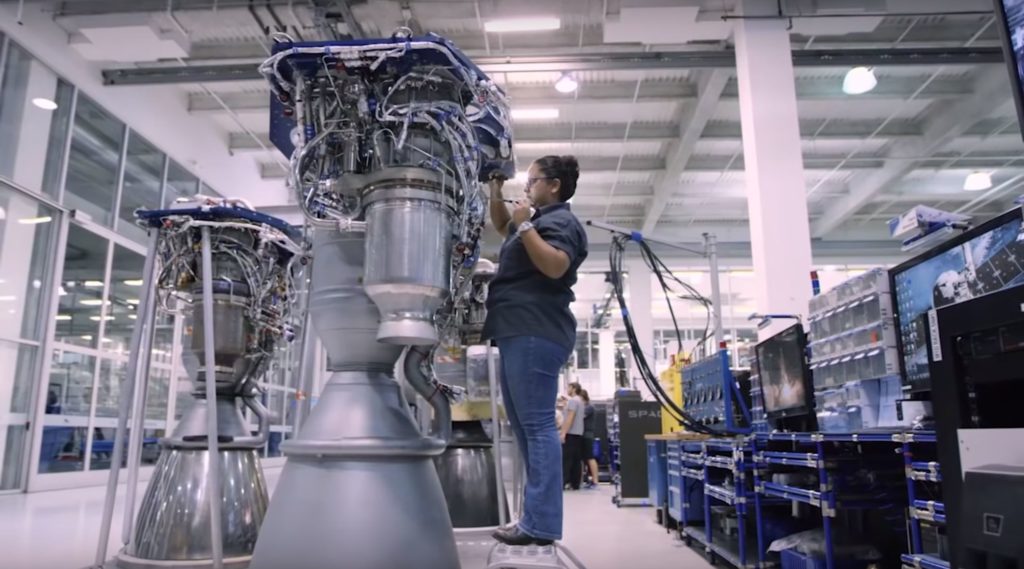
Each Starship has 30+ engines required per flight and tons of precision welding. All of it can now be made in a month. That means massive cost savings going forward, the faster each can be made
Hmmm, from a manufacturing prespective this is probably the safest way too, because you have already scaled production, you arent suddenly trying out all these new manufacturing processes when starship enters production. All your processes have been continuously validated already.
Failing fast also reduces cost. It cuts down on the time wasted on things that aren't going to work. With traditional design it can take years to find out if something will work or not. And when they don't, it leads to lengthy and expensive redesigns. You avoid all of that by iterating rapidly and building on and perfecting what works and scrapping/replacing what doesn't work before you sink a lot of time and resources in these things
Even better, since larger payloads can fit, the design can be far less complex due to weight and folding limitations.
Rather than spend 10 years designing and building one telescope, they could spend 2-3 years and keep refining the hardware, with multiple types on the same platform
The downside is that rapid iteration doesn't always give the same insight in terms of scientific understanding.
E.g.,
Design_A fails. We quickly pivot to Design_B, which works. However, we don't spend the time ultimately understanding why Design_A failed. This can be operationally great, but it can also risk conflating being lucky with being good. If you don't fundamentally understand why the thing failed the first time, it's much harder to understand if those failure modes are fully mitigated.
Personally, I think the ideal approach is to have SpaceX continue the rapid enginneering iterations, but give NASA (or some other entity) the resources to research the rest.
That's just your assumption. SpaceX is actually doing all that. They invested early in good simulation tools and they are developing their own. They have great material science teams and engineering teams. They do invest a lot in actually understanding the fundamentals and they make good use of the data from things that failed.
Take for example the work on the failure of Amos 6. They went really deep into that one and its a pretty interesting result from a scientific perspective.
On the other hand, there is no point in doing endless science on why the pad blew up during the first orbital flight test. They solution was already in development anyway and its pretty clear that the solution would migrate the problem. It might introduce new problems but the old one wasn't happening again.
So there is a limited need to the exact detail of underground steam explosion or whatever exactly happened there.
Sure, you can if you dedicate the resources to understanding the failure. What I saw personally is that is not always the case with SpaceX. In my experience, they changed a design and seemingly used that as an excuse to not further investigate the original design. (This was related to COPV failures. The general consensus seemed to be “we don’t need to understand why it failed because we’ve moved on to a different design.”)
1) The failures themselves aren't all too complex (relatively speaking), and by the time the design made it to a flight vehicle it has been vetted for all immediately knowable risks. The rest you discover during flight. And even then the actual nature of the problems rarely (if at all) are esoteric or present breakthrough scientific discoveries.
2) Failure in rocket launches are catastrophic leaving behind very little evidence. There could be a limit to how much you can learn. But...
3) ...SpaceX is a business serving customers, and if a pivot means going away from a complex cloud of possible failures (known and discovered) to more robust, more deterministic, more reliable, you should do it.
4) At what level do you stop and go "this is fundamental enough"?
I think I disagree on many points here in this specific case.
>The failures themselves aren't all too complex
The COPV failure mechanisms may not be terribly complex (e.g., voids or delamination), but managing the processes to mitigate them isn't.
>by the time the design made it to a flight vehicle it has been vetted for all immediately knowable risks.
SpaceX has already shown some bad processes that disprove this statement. E.g., the strut failure was due to poor supplier quality control, which is a relatively mature process in the industry. I'd give them the benefit of the doubt and say they've gotten better as they've matured as a company.
Failure in rocket launches are catastrophic leaving behind very little evidence.
The difference, I think, is that you are constraining this to launch failures. I'm talking about knowledge and data about individual component failures, from which you can derive the overall reliability of the design.
if a pivot means going away from a complex cloud of possible failures (known and discovered) to more robust, more deterministic, more reliable, you should do it.
I don't disagree that more simple tends to be more reliable. However, the point was that iteration doesn't necessarily advance knowledge of failure. I think these two points are not mutually exclusive. A good business case doesn't mean it makes for good engineering or good science.
At what level do you stop and go "this is fundamental enough"?
It's a tough question. But if you can't characterize why a failure mode occurred reasonably well, that's probably not good enough. So if they say, "We know voids in the COPV manufacturing process contributed to the failure" they should probably make sure they have a good understanding of why they occurred. (And maybe they have at this point)
You're dealing with incredibly smart people here. Now of course perfect knowledge is almost impossible. But each of the designs is probably specked out with at least pluses and minuses and theory is as to whether or not the design is viable, which ways it will perform well or fail.
This is just basic science: theory experiment result.
And with all the documentation and instrumentation on the flights, The theories can be experimentally validated or invalidated.
This isn't like some agile programmer shoving in a couple hundred lines of code over the course of a one week sprint.
Would you have said the same about NASA pre-Challenger/pre-Columbia, or Boeing pre-CST-100? I don't think SpaceX is inherently unique in either the ability of their people or their innate human biases. They may have a different culture, and related to that, I'm pointing out what I've experienced as a potential downside of rapid iteration philosophy. I'm not even saying it's bad, just that we need to be cognizant of it's downsides.
Not a particularly good strategy here for a couple reasons:
1) Risk on safety critical operations is not something people tend to want to roll the dice with.
2) The nature of the industry makes each trial pretty expensive. Over decades, the shuttle only had something like 135 launches and the managers still didn't have a good handle on the actual risk.
Sort of proving the point here, no? There is a reason SpaceX has gone to orbit more times than the Shuttle has. Soon they will have launched more Starship prototypes than the shuttle ever did. And they will be safer, because SpaceX understands why their rockets fail.
Obviously this strategy does not work with humans in the loop. It might have been impossible to do what SpaceX is doing now in the 80s given the advancements in computer control and simulation that have happened since then.
I don't think so, for the same reason you identified: it only works when the risk isn't safety critical (ie when humans are in the loop). In other words, it's acceptable when risks are low. It's the same reason NASA is more risk-tolerant with non-human-rated missions. But keep in mind CCP is also meant to transport humans. The risk we'd want to bolster against is the human biases that lead us to get complacent. There are some instances that make me wonder about that with SpaceX, but I'm giving them the benefit to the doubt that they've learned from those.
> However, we don't spend the time ultimately understanding why Design_A failed
Did you read TFA? It's about the release of an extensive report documenting why Design_A failed and what corrections are to be made regarding each specific failure.
You are right. It was essentially a bigger Falcon 1 and not a complete redesign. So, the risk was not as high. It was an incremental upgrade. Not a small one but still.
It’s so exciting to keep track of. Feels like everything I hoped to see happening in spaceflight back in the 90s and 00s is finally (maybe) becoming reality and absolutely shattering the stagnancy that had overcome the field, hopefully this time for good.
If this pace can continue unabated, maybe it’s not too unrealistic to hope that my grandkids’ generation in a few decades has astronaut as one of their most aspired careers much as was the case for the kids of the 70s, 80s, and 90s… except this time it’d be much more practically achievable since there’d be greatly increased demand for people with that skillset.
In my mind the potential for profitable industry beyond earth orbit depends almost entirely on how low we can manage to bring cost of kg to orbit.
It doesn’t have to be cheap enough to make e.g. asteroid mining profitable on its own (which is an awfully high bar), just high enough to make construction of large, permanently spacebourne ships feasible.
Ships like that ease the bootstrapping problem and make it more feasible to mine asteroids in-place instead of having to move them to an orbit that’s not expensive to reach. Their flexible, multipurpose nature also helps pay for them over time; they can for example drop crew and cargo off at the moon and Mars en route to the asteroid belt.
Reliable, viable Starship means the military can rapid deploy a force anywhere in the world in an hour or two.
That would mean huge savings to the military in naval fleet investment, overseas bases. The military would likely pay SpaceX ongoing contracts of tens of billion dollars per year for that exclusive nation-state capability.
The growing Starlink constellation will sustain huge business.
NASA would fund additional missions with the reduced launch costs.
Space tourism and fast global travel is worth another 10 billion dollars annually.
Then there's space telescopes and instrumentation.
Space industry is completely TBD. Here's a kooky idea: how much is antimatter harvested from the solar wind worth? Near earth asteroid capture and mining may be feasible. Moon mining may be on the table.
Militarization of space is an inevitability, and starship provides the payload to get equipment into space.
Starship might provide the launch ability to deal with space junk.
Anyway, you drop the cost of launch by 10x-100x, THINGS WILL BECOME POSSIBLE.
The asteroid Psyche is expected to have a lot of gold content. NASA sent a probe last year, but it's a long trip and will take until 2029 to get there. Even then it just orbits.
Heavy elements like gold and platinum sank to the center of the earth's core while the whole planet was molten and this is why they are rare near the crust. Asteroids have never been entirely molten, and as such have valuable heavy elements dispersed relatively evenly throughout. In other words, much higher concentrations of valuable elements are expected to be available much closer to the surface of asteroids than on Earth.
Composition should actually be very similar if not identical. All were formed from the same accretion disk around the sun. Distribution of heavy elements within asteroids will be much different from the planets, however, due to the planets having had or still having molten cores.
Starlink V2 sats are bigger, so they definitely won't be sending 400+ up at a time with Starship - probably more like 100-200.. but I don't think they've had any official updates/figures on this in a while.
Probably why they're hoping to get permission for 9 launches this year. Even if they throw away the entire stack, it probably costs less than the equivalent number of F9 launches.
I strongly suspect they'll achieve at least partial re-usability if not full by 9 launches. If not SpaceX will at least have a very clear understanding of the engineering problem by that point. I'm most worried about the final landing which I would not want to be anywhere close to until they've had a solid string of successes without any issues.
I'm not sold on them achieving partial reusability in practice in 9 launches (assuming that the 9 launches happen mainly this year as they have requested). I think they'll have achieved it in theory (ie demonstrated a hover landing of the booster over water), but they've only just started to build out the second tower that'll be needed to actually test reusability without risking the entire launch infrastructure.
Between the construction pauses during testing/launch, and things they can't really speed up like concrete hardening times, I don't think they'll be able to both have 9 flights AND operationalize the second tower this year.
Yes, we solidly agree on the risks associated with an as yet, as far as I know offhand, completely new landing system... Two really strong metal toothpicks.
There are customers from three letter agencies who could find a use for this payload capacity, for sure.
OTOH imagine if a reusable launch of this costs approximately the same as an expendable Atlas 5 in it's most performant configuration and reliability is proven - NASA could launch a Pluto probe like New Horizons, except it'd be able actually make orbit over there.
Atlas 5 is already completely obsoleted by the Falcon Heavy which costs about half as much, for a reusable launch, and carries about 3x as much.
But for Starship, most people don't seem to realize what a potential game changer this is. The goal for Starship is to get costs down to about 15x less than Falcon Heavy. When you can start sending stuff to space for a few dollars per pound, we're not talking about just probes, but rather opening the door to the complete commercialization and exploitation of space.
Such an exponential jump (downward) in prices would also largely end the only-for-the-super-rich phase of space we're currently in. You could be doing a flyby around the Moon for what you might spend on a holiday to Asia, in the very foreseeable future. That's what makes Starship so tantalizing. If it succeeds - this is a revolutionary step forward for space. Of course, there's no guarantee that it will succeed, but it increasingly looks like it will!
>Atlas 5 is already completely obsoleted by the Falcon Heavy which costs about half as much, for a reusable launch, and carries about 3x as much.
Which is why the rocket has been discontinued.
This is also why Boeing Starliner is dead man walking. Starliner is only certified for Atlas 5, and there are enough spare boosters for the launches NASA contracted with Boeing for, no more. The consensus is that Boeing will fulfill the contract then that'll be the end of Starliner, which is great for Boeing in the sense that it'll finally close that money-leaking wound, but not great for NASA because the whole point of Starliner + Crew Dragon was to have two separate US-owned ways to send people into space.[1] Even if Starship passes every test going forward ahead of schedule and gets man-rated, NASA would prefer to not have one company provide both methods, but I don't know what would be a better alternative. Sierra finally gets that big contract to man-rate Dream Chaser? Blue Origin?
[1] Setting aside how everyone at the time believed that Starliner would be the first one into orbit
There is still the possibility of either New Glenn or Vulkan being crew rated to carry Starliner. With Vulkan the concern was mainly that no one was willing to foot the bill, but with the rumored acquisition of ULA by Blue Origin, there's a chance they might want Starliner as their own crew vehicle. The main limitation being that Boeing has already shutdown Starliner production, only making the 2 needed for the ISS contract. So even if anyone else wanted them, they'd have to put in a bunch of money to restart production. Putting all those costs together it might just become better to do something else, e.g. crew rate Dreamliner.
That said, right now it's kind of up in the air, since as it stands, Dragon's second crew contract and Starliner's existing contract are likely to cover all remaining ISS launches. So what's needed afterwards depends on the commercial space stations NASA is pushing for.
I'm not certain what is meant by "certified" because it still hasn't made a human flight test yet.
Notwithstanding the retirement of Atlas and Delta, Starliner was intended to be compatible with multiple launch vehicles, including the ULA Atlas V and Delta IV, and the SpaceX Falcon 9
> When you can start sending stuff to space for a few dollars per pound, we're not talking about just probes, but rather opening the door to the complete commercialization and exploitation of space.
It almost sounds too good to be true or something.
Most of what SpaceX has already achieved has sounded similarly, but costs were so astronomical to begin with that it didn't make any immediate difference to most people. So for instance the Space Shuttle was only retired in 2011. After all was said and done it ended up costing $1.6 billion per launch - about $30,000 per pound of payload. The Falcon Heavy costs about $0.1 billion (in reusable mode) and brought the costs down to less than $700/lb.
That's a greater than 40x reduction in costs, which sounds too good to be true - but the problem is that even at $700/lb, that's still far too expensive to do anything remotely interesting. But take that down again and suddenly everything changes and we, more or less instantly, enter into an entirely new stage in human development and history. It'll be akin to the automobile. Henry Ford didn't make the first automobile, but he did make the first commercially affordable one. And, in the blink of an eye, society permanently changed because of it.
---
As a fun aside, when doing a web search to grab the numbers above somehow this [1] ended up in the search results. It's from 2012 and somebody pondering SpaceX's wild claims of being able to get costs below $1,100 per kg ($1,500 inflation adjusted).
>So for instance the Space Shuttle was only retired in 2011. After all was said and done it ended up costing $1.6 billion per launch - about $30,000 per pound of payload. The Falcon Heavy costs about $0.1 billion (in reusable mode) and brought the costs down to less than $700/lb.
Is that an apples-to-apples comparison? Each shuttle launch cost $1.5 billion when including development cost (that is, $200 billion in total spending on the STS program / 135 launches); as your link discusses, the incremental cost per launch was "merely" $450-500 million. The $0.1 billion figure per Falcon Heavy launch is only the incremental cost since we don't know how much Falcon Heavy cost to develop (And how to account for the Falcon 9 development costs that Heavy is heavily based on?). Obviously Falcon 9/Heavy has every potential for launching far more times than the shuttle, further reducing the development cost allocated to each launch (or at least, until Starship gets going I guess). But we ought to be as accurate as possible in comparing Falcon and STS.
It's all about what the customer pays. In the case of the Space Shuttle the customer also completely paid for the development of the launch system, so it doesn't really make sense to exclude that. It's also fair to include it because it's also included for SpaceX. When we say a Falcon Heavy got launch costs down to below $700/lb, that also includes a enough of a profit margin built in to completely fund their past operations and development, as well as future ones.
SpaceX's 'real' (in the sense you're speaking of) per launch costs are going to be substantially lower than even $700/lb. In the case of Boeing/Lockeed/etc, they didn't have to pay for any of this - as it was all completely taxpayer funded. That should have enabled them to offer prices that would be unbeatable by any company paying for their own operations.
---
To put this another way, imagine Boeing et al operated like SpaceX, or frankly most any "normal" company does. They would need to set their launch prices in a fashion such that they'd be able to recoup their tens of billions of dollars in development costs on the Space Shuttle, and then also add a profit margin on top. It's likely their charged cost per launch would have been even higher than $1.6 billion!
> It's all about what the customer pays. In the case of the Space Shuttle the customer also completely paid for the development of the launch system, so it doesn't really make sense to exclude that.
Good point. I agree that from the customer's perspective, the flyaway cost is what matters. That said, wouldn't that also mean that for Starlink launches, the development cost would still have to be amortized across them when they are not for other launches? That doesn't feel right to me; surely the flyaway/incremental cost is still what matters.
That link compares a cargo Dragon mission to ISS against a Shuttle launch. Did a Shuttle mission have more overhead because of the people on board? I'm not clear if the Shuttle cost is just the launch, or the whole manned mission with all the astronaut preparation.
That begs an interesting comparison in fuel usage (kJ or $ basis): supplying dV for one pound to orbit vs. the energy required to perform the work needed to overcome ~8,000 miles of marginal drag from +1lb of cargo on a ship.
Fuel usage being the limiter of terminal economics once launch systems are commodified to the degree ships are.
Asteroid mining I think is one of the most interesting initial space industries. Something silly like a single asteroid having metals with current valuations of a million times the global GDP. Obviously you can't sell for that much but asteroid mining could make a lot of commodities become insanely cheap, and that would enable some pretty amazing things here at home, and in space.
Like what if steel were cheaper than plastic? If there was enough of it around to build a bridge between New York and London? If you could build a ship the size of Manhattan and then a city on top of it to roam the oceans? If you could build entire cities in orbit or city-ships that slowly wandered the solar system.
Yes, send up the robot miners. Plow the results onto the moon a safe but close distance to a base. Manufacture parts in lower G and far easier vacuum (it's super useful for MANY industrial things). Possibly even use solar collector ovens to melt/cook.
Returning bulk products to earth might not be viable in the short term, but this could really bootstrap what we do off planet and I'm hopeful it might eventually make space elevators viable which would open a lot of options.
Think of all the science you could do with asteroids! Peer into the early history of the solar system . . . see what precursors to life existed before Earth was habitable. . . and all people think about is how fast they can strip-mine our extraterrestrial heritage. . . All that belongs in a museum!
Imagine vacuum foundries. AFAIU lot of metallurgy gets very complicated by the ubiquity of everything rusting all the time, exponentially moreso if it becomes hot.
Also, wont it theoretically speed up and decrease international shipping + travel. We should be able to go from the US to Japan in an hour or two in the future.
I am pretty skeptical of Starship ever getting used for suborbital transportation, other than maybe for ultra-elite VIP transport or something like a rapid deployment system for military special forces. It seems highly unlikely they will ever get the price down to where it can compete with commercial airliners, and Concorde's commercial failure showed us that people will happily choose cheap subsonic flight over fast supersonic flight. You can get almost anywhere on Earth in 36 hours' notice with conventional jet travel relatively cheaply on 1-2 weeks of US median income for a return ticket - that sweet spot of speed and cost is hard to beat.
I think there is a pretty large market for a trip to space and an hour flight from LA to New Zealand, New York-Sydney, London-Shanghai, etc. for $10-20k. What an amazing combination that would be.
I don't think there are many cities that have suitable launch sites near them. It's unlikely they'll ever get approval to launch over populated areas, or even from most populated coastal locations.
Also, the issue of getting boosters to all of these destinations seems like a problem. Planes don't split in two and have half return to the launch site but Starships do. So you could land the upper stage in Tokyo, but then what? How do you get a booster there for the return journey?
Personally I doubt they'll even use these to bring people to orbit anytime soon. I think they're purpose built for launching massive LEO constellations.
> Also, the issue of getting boosters to all of these destinations seems like a problem. Planes don't split in two and have half return to the launch site but Starships do. So you could land the upper stage in Tokyo, but then what? How do you get a booster there for the return journey?
IIRC, the suborbital point-to-point transport use case doesn’t use the booster (SuperHeavy), just Starship.
Yeah the short term approach for crewed Starship seems likely to involve transporting crew to a Starship once it is already in orbit and vice versa for return.
The NFL wants to expand to Europe, Asia, South America badly. Problem is the logistics of Mach-1 air travel won't allow that. Same for the NBA, NHL, and MLB. A true world super league of futbol.
We're talking 10s of billions of dollars in new annual revenue for these sports leagues ... if they could transport a whole team anywhere in the world in 4-5 hours.
It costs a couple hundred thousand per flight for a team? Um, the Super Bowl brought in 600 million in ad revenue and probably another 50-200 million in ticket costs.
A transcontinental flight ranges from low five figures for a long range business jet to upper five/lower six figures for a widebody jetliner. Those are machines purpose built for the job of moving people transcontinental distances. They benefit from decades of heritage building tens of thousands of units leading to extremely aggressive cost optimization. I just can't see Starship getting the cost per flight down into the hundreds of thousands of dollars range. Not to mention the boring (but important) constraint of trying to insure a team of valuable athletes flying around in a rocket with way less of a safety record than conventional air travel.
That said, having a sports team arrive in town by literally descending from the heavens on a burning rocket sounds badass. Unfortunately I can't really see it happening, but I'd be happy to be proven wrong.
sub-orbital military applications would be risky as they'd look like an ICBM launch to other nuclear powers. Commercial rockets depend on advance public disclosure of launch dates to stave off WW3 from itchy trigger fingers.
Watch Elon call it something like Airship and have it be fit for tens to hundreds of people per launch with no need for a pilot (though one may be present). It'd take twenty years to get to market, sure, but hey that's progress.
I thought Concorde failed commercially because it couldn't get approval to fly over the US elsewhere over land because of sonic booms. I know reentering spacecraft cause sonic booms but thought that they occur high enough to not cause the same problems on the ground.
It failed because trading slightly shorter flight time for much higher cost was not worthwhile. Instead, airliners have been optimized for cost reduction and efficiency at high subsonic speeds.
I am aware that airlines today fly slower than 50 years ago, to improve fuel efficiency. That said, all orders except the British and French flag carriers' were canceled because of the overland bans, correspondingly greatly increasing the per-unit cost of those that were sold. I think the NYC-to-London/Paris routes were (slightly) profitable; were there no overland bans, are there really no other routes that Concorde could also have flown?
Not sure why you're getting downvoted, this was definitely a key factor that made Concorde into a niche product.
It's not that customers preferred slower and cheaper flights over Concorde—they didn't, Concorde had very healthy average occupancy rates and operating the flights was very profitable for BA and Air France (they got the planes for free, of course).
It's that you can't fly a 1960s plane forever and you also can't amortize the design and development cost of new models with the only addressable market being first class customers travelling between the East Coast and a couple of European capitals (and this was directly caused by the overland flight restrictions).
It was cancelled because Boeing were late and over budget; by the time they started work on a prototype, Concorde was already being shown at airshows, and the US Senate voted to stop throwing more money at them. Sonic booms were at most one contributing factor among many to that senate vote.
Concorde was also late and over budget. And until Congress defunded the 2707, it had more pending orders from more airlines than Concorde did. Sonic booms weren’t the only reason for the cancellation but they were probably the single biggest reason.
Also, Concorde wasn’t even the first supersonic airliner—that was the Tupolev Tu-144.
But imagine the PsyOps impact of the enemy looking up and seeing the US raining down literal ODSTs on them ;)
Realistically, they'd be dropping into an allied base in-theatre with a pad able to support a Starship landing, and then taking conventional means the rest of the way. Of course, I suspect that when it comes to "drop operators from space" vs. "train extra operators who can be forward deployed," the latter is probably going to be way more cost efficient. Would make for a cool movie though.
The fundamental physics involved in suborbital flights mean that you are likely experiencing sustained acceleration of 3+ Gs minimum. That is a lot, something near the max g force of a roller coaster but lasting for minutes. Combine that with the launch/landing zones needing to be many miles from anything, and it isn't really ready for primetime. Just for reference 1.3 Gs is the max sustained load you will feel in a regular airliner, very rarely 1.5 Gs for terrain avoidance.
For cargo, maybe medical stuff like moving organ donations around, but largely I can't imagine a ton of use cases where getting something to an antipode in 3 or 4 hours is that much more valuable than getting it there in 19 hours.
If you’re a military unit about to get wiped out by an enemy force due to running out of ammo, I imagine getting 100 tons of ammo in 1 hour vs in 19 hours would be a big difference?
The scenario where you have access to a space launch system, and an LZ at the front, and abundant supplies on the opposite side of the earth, but your logistics have failed to keep supplies in theater doesn't exist.
Forces that run out of ammo don't have access to cutting edge ICBMs is a rule that I would bet money on.
It might actually be cheaper even if the booster is expended.
Falcon9 is estimated to cost about $30M/launch. $20M to build the upper stage, and $10M to launch. Starship is estimated to cost about $100M to build both the booster and the second stage. Add $10M to launch.
$110M is insane. Anything under $1B seems unfathomable. $25M for a 2MN full flow staged combustion engine seems cheap. SpaceX plans on building them for $250K a piece. They're not there yet, but current estimates of $1M a piece are just as insane.
Considering the reusable Falcon 9 costs more than twice as much as launching a Soyuz despite the reusable components. It's a bit of a boondoggle, but I am so glad we have national capacity for launching payloads.
Metaculus shows a 74% chance Starship reaches orbit in 2024, and a projected date of March 26 for the next launch. That seems pretty bullish to me! Next year (2025) will probably see the beginnings of practical customer usage of Starship.
Bullish? Is there someplace I can bet against them? I don't see how Starship isn't getting into orbit on this or the next launch, barring major regulatory sabotage.
No need to assume, you can check the prediction history and see that they generally do quite well. You also look at the histories of individual predictors' profiles and see some with consistent successes.
Well what is interesting is not how well the aggregate does, but how much better it does than individuals. After all if individuals can predict stuff consistently then what does the prediction market add?
Right, but that doesn't do anything unless there's life-savings-amounts of money on the line such that anyone is incentivized to actually try. And even when people are incentivized, just look at the stock market for clear evidence that it doesn't work: a market doesn't magically make people good at things; people screw up and lose bets and go bankrupt all the time. Sure some of the decently-competent banks and hedge funds don't---but there is no reason to think there are any actors close to that sophisticated on a prediction market.
You're of course that it's not yet as sophisticated as the stock exchange, but I wouldn't be as dismissive of the importance people attach to internet points.
The problem isn't that they don't place importance in them. It's that there is nothing weeding out failure. Financial incentives in principle (although definitely not very well in practice lol) punish failure in a resilient way: you actually can't keep betting if you can't win. Where... I don't think that's true for prediction markets?
Anyway, I dunno. I also don't believe that people predict well even with incentives, and think the whole thing is a farce, so I'm just a pretty dogged skeptic.
How well does this work when there is fundamentally little information? It works in stock trading because so much information is standardized and regulated. I am skeptical of it being as useful here simply because the crowds don't have much relevant information, as far as I know. For example, do the crowds know about the design redundancy? What about the supplier quality control? Or the reliability data on the check valves used? etc. etc.
Engineering, physical principles, I guess. Those who place bets or making predictions may know a thing or two on mechanics, rocket science and history of building launchers.
To put a finer point on it, those seem like rather blunt instruments for prediction compared to how risk is typically measured by aerospace reliability engineers.
Think of it like top down budget va bottom up budget.
RAMS engineers do a bottom up analysis. However, it is fairly typical for the to be subtlety biased in a way that changes the final answer. (Usually by ‘rounding up’ on individual hazards).
Top down takes an outside view and says ‘this looks like these other past projects. It should land in around the same place.’
I’ve found top down tends to be more accurate project wise. Bottom up more accurate for specific subsystems.
Related to this discussion, the results found by Feynman in the Challenger investigation found that the top-down risk assessment was off by orders of magnitude.
I'm sure some aerospace professionals are wondering how it's possible to predict stock behavior on an exchange, but have no problem with educated predictions of launcher performance.
That right. The point being, they are very different systems with different information inputs. Meaning what works for one may not be a good method the the other.
Should be much more accurate than a simple poll, because people with the belief that the odds are undervalued will put money in the game to hopefully profit off their belief
There's no skin in the game with Metaculus, it's a prediction aggregator, not a prediction market. Nothing is at stake.
This is why you see a somewhat absurd skew on AI doom/safety questions, using Metaculus is a hobby of the cult^H^H^H^H movement, and no one's swooping in to steal their money because there isn't any.
It’s somewhat more complex than that because Metaculus weights its aggregates by how accurate predictors have been in the past. Definitely not perfect though, and the efficient market hypothesis isn’t relevant at all.
> "The most likely root cause for the booster RUD (rapid unscheduled disassembly) was determined to be filter blockage where liquid oxygen is supplied to the engines, leading to a loss of inlet pressure in engine oxidizer turbopumps that eventually resulted in one engine failing in a way that resulted in loss of the vehicle," the company stated. "SpaceX has since implemented hardware changes inside future booster oxidizer tanks to improve propellant filtration capabilities and refined operations to increase reliability."
Why do those rockets have a fuel filter at all? I get why we have them in cars; we refuel quite often, in dirty environments and with possibly low quality fuel. For space rockets, it seems that it would be (comparatively) easy to ensure that the tanks are clean and the fuel is of high quality.
On the other hand, if there wasn't any dirt, the filters would not have clogged, so I guess it does make sense after all.
Most rockets don't have fuel filters, but this requires their tanks to be kept in a much more strict state of cleanliness, and any failure to do so would result in mission failures.
SpaceX has long had a very different idea about FOD than most other rocket companies, famously Merlin engine qualification testing contains ingesting stainless steel nuts.
What size nuts do they pass through their engine? Every engine before it goes to space has to have a nut passed through the system? Like a 12mm "go into space" grade nut or a little itty bitty nut like I might find holding down a heat sink assembly in a 1998 vintage motherboard?
Actually I'd rather have such "bonkers" tests than the other extreme, like NASA not thinking about what could happen if pieces of foam from the external fuel tank impacted the Space Shuttle on launch until it was too late (https://en.wikipedia.org/wiki/Space_Shuttle_Columbia_disaste...).
The really shitty thing is they knew early on the O-rings were slipping and partially extruding themselves, which wasn't part of the original design. They shrugged and ignored this, which then opened the door for disaster when the O-rings behaved differently (and still wrong) when cold. If they had pumped the brakes when the initial deviation from the design was discovered, it wouldn't have ended in disaster.
"Boisjoly wrote a memo in July 1985 to his superiors concerning the faulty design of the solid rocket boosters that, if left unaddressed, could lead to a catastrophic event during launch of a Space Shuttle. Such a catastrophic event occurred six months later resulting in the Space Shuttle Challenger disaster."
Engineers objected and were ignored for the foam strike as well. What I don't know is how many engineers object, are ignored, and everything goes fine anyway. Maybe these are the only 2 times engineers objected. Maybe they get 100 objections for every launch.
That one is a classic example of normalization of deviance. They knew there were temperature limits, but they'd pushed the boundary a bit in the past with no ill results, and so began to feel complacent about the risks of pushing them even further.
Probably more "qualification of the design", like those bird ingestion tests they do on airliner engines. And the test probably doesn't look too interesting, the nut might not even come out the other end.
Let us know what you find. I find it not 'bonkers' but a great idea, and hope they are qualifying with the largest nuts found upstream, in 'go to space' grades.
Robustness and anti-fragility may not be so critical for an expendable vehicle that operates once for something like 12 minutes, but seems a key attribute for a refuel-able and reusable spacecraft?
Oh I agree it's not bonkers from the perspective of "wait you want to put people on that bomb and then explode it?"
You can make all sorts of rules about what's not allowed to happen, but often those things happen.
I'm just ... astonished if they've got a little practice room somewhere in their factory where they give each of their new rockets a nut to process... "Okay kid here's your graduation test!". A "we need screens to cope with big things and filters to deal with small things" is probably smart for any anything that's going to be reused.
A nut's probably in some ways easier to deal with than a blob of wd40 (in your lox tank).
> I'm just ... astonished if they've got a little practice room somewhere in their factory where they give each of their new rockets a nut to process... "Okay kid here's your graduation test!". A "we need screens to cope with big things and filters to deal with small things" is probably smart for any anything that's going to be reused.
That's what their McGreggor test site in Texas is for. It's a long, boring, two hour drive from anywhere or anything.
"anti-fragility" is probably not a design goal for Merlins and Falcon.
Anti-fragility means more than robustness, it means that the system is getting stronger with each adverse event, and it is not a realistic goal that ingestion of a nut should make the engine better/stronger etc.
Of course, not for individual rockets on individual flights (but self-repairing would be way cool!).
But Anti-Fragility as you define it definitely should be a goal for their overall organization and system of building and operating the fleet.
Each issue or incident should feedback into the engineering of new units and updating of existing units so that they are improved, stronger, less likely to create issues, more able to handle issues, etc. on each iteration. This actually seems to be the case at SpaceX, including this incident.
Oh yes, that is an excellent observation. The components themselves cannot be antifragile, but the development process certainly can.
Thinking about that, an important feature of that antifragility is not to risk human lives during the process if that risk can be avoided. Even though space exploration is inherently risky, any actual fatality is a huge setback.
The tradition of passing nuts comes at least from the history of developing engines for Soviet Moon launcher, N-1. The engines used on all four launches, NK-15, were notoriously unreliable, and the suspicion was that their turbopumps, having quite tight clearances, sometimes had rotors touching walls during work. In oxygen-rich environment that led to engine fire. The engine which fixed those problems, NK-33, was working much better, and to demonstrate that it's robust for the problems like turbine misalignment, some metal parts, like nuts, were intentionally dropped into the propellant flow.
I can guarantee you that “ingesting a nut” through the engine is not part of the official engine qual program. Maybe it happened once and somehow the engine survived and they were able to ascertain what had happened. But this is not a common thing.
Edit: I will say that what actually is a test commonly done (also in industry in general) is doing a “roll test”. They put the stages on these massive rollers and slowly turn them… listening for any “clinks”. Pretty funny seeing it done.
> Part of the Merlin’s qualification testing involves feeding a stainless steel nut into the fuel and oxidizer lines while the engine is running—a test that would destroy most engines but leaves the Merlin running basically unhindered.
They're not running it through the engine, they're verifying that the filter is installed and functional so it doesn't get to the engine.
yeah and even if starship tanks are perfectly clean you would also have to assume the tanks on the trucks delivering the fuel/oxi are also perfectly clean. As well as storage tanks, plumbing, and everything else.
Also meaningful to consider that as a vehicle meant to be reusable, it's going to be pretty much impossible to keep the tanks pristine over time unless they add a cleaning process that would be expensive and time consuming to every refurbishment (which runs counter to Starship's goal of rapid reusability). Relative to all other rockets, SpaceX's are refueled pretty often.
I wonder how frequently the filters need to be clean/changed? After every flight? After X flight hours?
And what is involved in changing them?
I imagine, initially at least, they'll remove all the engines after every flight, and that will give them easy access to inspect/clean/replace the filters, when necessary. However, I expect the longer term goal is they don't want to have to remove the engines after every flight, just like how a commercial aircraft doesn't have its engines removed after every flight.
1. Launch vibration is real. There's a reason why the Merlin 1 engine has to survive a nut being fed into the fuel and oxidizer lines while running.[1]
2. My understanding with this particular issue is that SpaceX uses autogenous pressurization. It pressurizes the LOx tank with the output from the oxygen-rich preburner. Well, that output is mostly oxygen, but it contains various hydrocarbons. Which, when combined with pure oxygen can form ice and dry ice.
It's generally not good to feed solid CO2 and H2O into a high performance turbopump that's designed to accept liquid oxygen.
Rockets and cars have fuel filters for different reasons.
You car has a fuel filter because dirt causes wear and tear on the engine over time.
In a rocket, a stray particulate is a potentially explosive event. the Fuel pumps are approximately 100,000 horsepower and particles in flow can have enough kinetic energy to trigger combustion with the walls of the system the fuel is flowing through. Most metals will burn as fuel in a high oxygen environment, even at standard pressures, let alone pressures 100x higher.
Don’t forget about all the equipment needed to fill the tanks and transport the fuel to the tanks. Probably easier to assume contamination gets introduced somewhere and just slap an in-line filter.
Imagine if the engine failed from FOD. The reaction would be "Why don't they use filters on their fuel pumps?" Whenever you make an engineering decision there are trade offs like this.
In my mind a rocket engine would be much more tolerant of debris since you just pipe the fuel into a giant fireball (yes I can practically see the eyes rolling, sorry! :-). For ICEs I can understand clogging tiny injectors or carbs would be a problem, do rocket engines also have injectors or other narrow parts susceptible to clogs?
Yes[1]. You want the fuel and oxidizer mixed as well as possible to achieve efficient combustion.
There are also other small channels fuel has to flow through, like the ones used for regenerative cooling[2].
And not sure how well most turbopumps[3] would tolerate debris either, though that probably depends on the exact design.
There are some really simple rocket designs out there that I could imagine tolerating debris (like solid motors[4] or pressure fed hyperbolic engines[5]) but Raptor definitely doesn't fall into those categories.
I posted upthread, but another concern is that stray particulate is an ignition source. Rocket fuel pumps are ~100,000 hp, and that energy is put into kinetic energy of the fluid flow. A stray particulate can cause the metal pump and fuel lines to burn in the presence of O2 at 300 atmospheres.
Fuel pumps are one of the most important design considerations of a rocket. When people talk about a rocket's specs, it's often going to be in the approximate order of thrust, efficiency (called ISP), fuel, and then what kind of fuel pump it has, aka its cycle
yeah copper burns green and is commonly used in liners and other components. If it starts to burn, which it's not suppose to, you see green. You'll see a green flash when the merlin engines startup but that's because of the hypergolic fluids used to get the pumps running and ignition started, not copper burning. During Falcon night launches you can really see the green glow of the starter fluid on ignition.
Yes, they do. All of the fuel and oxidizer goes through injectors to atomize it as it is sprayed into the combustion chamber. For a Merlin 1D, that’s about 340 pounds of propellant going through the injector plate every second.
The problem is that that fuel gets routed through a thin tube around the engine bell and then goes through a turbo pump before going into the engine. Both of those would have tight tolerances.
The thing is the energy density, flow rate/volume, and heat flux in a raptor is just so extreme. For example, there's two turbopumps operating at around 100k HP each in a volume not much bigger than the propane tank on your grill.. and those are basically just fuel pumps, not even where the real party is (pre-burners and combustion). Anything not going according to plan like a very small piece of debris in a filter causing turbulence or a change in flow rate is almost always catastrophic.
I wonder the kind of sensor package they fly to be able to get to this conclusion. I have a real passion for monitoring things (for me, mostly web apps and data/message flows) and this is a really interesting case.
SpaceX is at least known to have some kind of high resolution/precision microphones around the structure recording constantly so that they are able to do 3D triangulation inside the vehicle.
True, but add telemetry, and all other sensors who have shown nominal performance throughout the flight and that gave them the information they needed with the time resolution required to see an highly energetic cascading failure from one engine to the others.
How do investigators find leaks in a craft that has exploded? I imagine it’s difficult to determine (though evidently possible) whether a defect is in the design, or if it has been introduced by a defect in manufacturing/installation of parts like with Boeing.
Unlike a normal aircraft flight, rocket launches constantly broadcast telemetry data and are watched with tracking cameras. Large leaks would be visible in the video footage, and the type of leak (fuel or oxygen) can be determined by the change in flame color. Also, telemetry such as various tank pressures and propellant levels would indicate if (and where) leaks occurred.
Determining whether it was a design defect or a manufacturing defect would likely require ground testing. After CRS-7[1] exploded during launch, SpaceX tested a batch of struts from a third party manufacturer and found they failed at 2,000lbs of force instead of their rated 10,000lbs. Their solution was to switch to a different type of strut and implement more rigorous QA processes on their hardware.[2]
It's nice to see that they don't use it, just to use it. For example, in describing what happened with the Ship, they didn't use it because it terminated autonomously as intended by the software.
Of course. Other space companies would just say something about "an anomaly" and that would be it. "RUD" is just a rocketry inside joke. It is not - and it never was - anything else.
Exploded is a loaded term that has been ruined by media to make it so that people interpret even development testing as a failure.
RUD conveys the same idea of the vehicle losing structural integrity, serves as a bit of tongue-in-cheek humor for those who understand it, and limits the number of idiots screaming "look this project is obviously a scam" slightly.
Same energy as sqlite using etilqs as their file extension for no reason other than to mildly amuse onlookers who "know" and to deter the uninitiated from sending them unearned complaints.
Actually there is a reason for that, as described in this source code comment[0]
    ** 2006-10-31:  The default prefix used to be "sqlite_".  But then
    ** Mcafee started using SQLite in their anti-virus product and it
    ** started putting files with the "sqlite" name in the c:/temp folder.
    ** This annoyed many windows users.  Those users would then do a
    ** Google search for "sqlite", find the telephone numbers of the
    ** developers and call to wake them up at night and complain.
    ** For this reason, the default name prefix is changed to be "sqlite"
    ** spelled backwards.  So the temp files are still identified, but
    ** anybody smart enough to figure out the code is also likely smart
    ** enough to know that calling the developer will not help get rid
    ** of the file.
in 10 years RUD will mean exploded, that's how language works.
retarded used to be a medical term to replace loaded terms such as imbecile. You can see how successful that was.
It turns out, dressing up an idea does absolutely nothing since it's the idea that has the negative connotation. And why shouldn't "exploded" be viewed in a negative light?
This process is called pejoration (sometimes pejorativization).
It is a fascinating linguistic phenomenon, but it makes sense if you think about it. People start using technical terms as a pejorative, so those technical terms over time become less professional, so professions introduce new terms, and the cycle continues.
Another fascinating thing is that pejoration can be cyclic, sometimes enough terms are introduced to replace a term that eventually the original pejorative term becomes innocuous or even becomes endearing.
"Dickens" went through a pejoration cycle when it was used to replace the word "devil." There was a time when saying "what the Dickens" would be quite rude, but now would be seen as old fashioned to the point of being charming in some circles.
The difference is between viewing exploded as simply something going wrong and viewing it as an indication of general failure.
A starship prototype exploding in a flight right now is completely different from a Falcon 9 exploding in a flight. With the former it's almost desirable by making points of improvement obvious, with the latter it's a potential capacity crisis for the US launch industry.
Yet that's not really how most journalists will report it, and also isn't how most people who don't actively keep up with developments will interpret it.
Also, as you say, retarded replaced imbecile, and since then retarded has also been replaced, same will happen with RUD. Not really a big deal since they'll just change their language usage too.
The rocket exploded because it was instructed to explode. In fact, one of the problems was that it didn’t explode on time: the flight-termination system did not destroy the vehicle immediately.
Many rocket failures, especially those are high altitude, do not explode in a classical sense. The correct term would be that they failed; RUD seems more fun.
I don't think RUD suggests self-destruction. It even suggests the opposite, because having a self-destruction system involved means the explosion wasn't entirely "unscheduled". Indeed, SpaceX describes the lower stage explosion, which wasn't caused by the flight termination system, as a "RUD", but not the upper stage explosion, which was caused by the flight termination system.
FAA says they must avoid populated areas, but the laws of physics don't stop rockets from rapidly disassembling into a boat or any area where people may be living. At this point the lexicon will revert, and it will be a "crashed into" event.
This is why they don't launch over areas where people are living, and why rocket launches are occasionally scrubbed due to the presence of a wayward boat. They're actually being careful here.
They cite the filter for the liquid oxygen supply line got blocked.
We generally recommend a bypass valve for any filter so that the valve opens with sufficient back pressure blockage. It is generally better than complete failure.
Rovers and helicopters on Mars, leaving the solar system, close-ups of Pluto, asteroid material brought back to Earth, etc. etc. Those weren't exciting, but reaching orbit real cheap is?
> the production values on some of them (leaving the solar system, helicopter on mars) was pretty bad
What does that mean? The videos aren't slick enough? Personally, my excitement isn't based on hucksterism. The worst sophists (and megalomaniacs) will have the best self-promotion and slickest videos.
Oh yes. I don't bother watching them anymore. Initially, I was excited about the possibility of successful landing, after a while, I was secretly waiting for RUDs, but past the first Falcon Heavy launch with a pair of boosters landing safely at the same time, I started to feel they've solved automated powered landing and didn't tune in again until Starship trials.
Funny thing though: I occasionally see some old (like, 1970s old) book or comic cover with a rocket ship landed vertically, or most recently, such drawings in my daughters' books; I used to laugh at them being nonsense, but after first few successful booster landings, I'm no longer laughing. I'm ashamed to admit that our forefathers got that thing right, and Star Trek et al. got it wrong.
Also, one of the books my little daughter has a picture of Falcon 9 next to the usual lineup of Vostok-K / Saturn V / Space Shuttle lineup. I shed a few tears when I saw this - for the first time it really hit me that there was meaningful progress in space exploration that happened within my adult lifetime, a fundamental shift I got to see and follow closely as it developed, and which my kids will see as "just how the world is". Sure, same is true about the Internet and smartphones, but neither made me feel the generational perspective gap, the way SpaceX rocket landings (and subsequent uptick in space missions) did.
Yeah they won when insurance on used rockets became less than on new ones. If you said that in public a decade or so ago, you’d be laughed at all the way to the psych ward.
I didn't realize that insurance premiums' costs had changed. Has it gotten to the point where customers prefer used Falcons 9 because they're proven, as opposed to new boosters? Or are there still customers that prefer new boosters?
That's a shock to me too. SpaceX dubbing reused boosters "flight-proven" started as tongue-in-cheek; I never considered it becoming true taken at face value.
Their own streams are now only on Twitter, but 3rd parties like NasaSpaceFlight run their own streams, usually with worse visuals but better commentary
Everyday astronaut is, last I checked, the only one on YouTube streaming starship launches in 4k. And in my experience there's less commentary, just the SpaceX audio.
The Obama administration opened the doors for private companies to do what they're doing now. NASA is moving more to the roles of regulator, purchaser of services, and deep space science. Seems to be a better path now than the one we were on before opening spaceflight to commercial entities.
Who says NASA isn't getting funding? They're getting billions of dollars for Artemis. If your complaint is that NASA is contracting out to companies... they always have.
I think NASA also has higher public/pr standards they’re held to. A few spacex failures no one cares much about. If nasa fails a few times everyone (particularly more conservative leaning folk) starts complaining about their precious taxpayer money. Hence NASA likely sticks to project that are very low risk. I’m not saying this is good or bad per se, but public opinion is what it is.
It’s also a bit of damned if you do, damned if you don’t with nasa - play safe and people complain they’re not doing much, why are they funded. Play more risky and inevitably end up with a failure, get questioned why they’re wasting money. I don’t think I’ve seen much criticisms of when SpaceX or blue origin win govt grants for funding.
Again, this isn’t to say that enterprises don’t deserve govt support if they’re truly helping (lobby concerns aside). But it’s a multifaceted issue.
There's also a political angle since NASA represents the US. If anything goes wrong with a NASA project it's a massive propaganda opportunity for agitators and rival countries to mass spam the internet about how horrible America has become, what a laughing stock, etc., etc., doing everything they can to push their anti-US propaganda as hard as they can. There's more repercussions for NASA to fail at something than a private company.
This is an interesting angle that I haven't thought of.
NASA projects carry a lot more gravitas than "move fast and break things" Musk projects. If something explodes at SpaceX, as long as people aren't hurt, no one really cares. People who dislike Musk will simply point at the debris and say: "We told you he's an idiot" and people who like him will rush to his defense, but the standing of the US as a whole isn't on the line.
I think it is more that SpaceX has a fail fast engineering culture and was clear about that from the start. I mean they made a blooper real “How not to land an orbital rocket booster”.
Also SpaceX’s launch stream production quality and PR has been surprisingly good from the start as well.
This is hardly surprising in a society that prefers to dole money to contractors rather than invest in any practical technology. What value has SpaceForce demonstrated to justify its investment? That's just graft.
It means that the field has grown a lot, and is now more diverse than ever.
NASA is great in some tasks (interplanetary probes etc.), but not so great in others (getting people into orbit). That is quite normal in every quickly developing field: specialization.
As an analogy, Microsoft is quite good at Windows on desktop, but failed miserably with Windows Mobile, and other players are dominating that field.
Starship is the most powerful rocket in history and should be the first ever orbital launch system that is fully reusable. I don't know what you consider to be "genuinely" exciting, but I would consider entirely new generations of rocket launch tech to be genuinely exciting.
What the difference? Do you think people pretend to be interested in a product when marketing is good?
I think they become genuinely interested. People pretend when there are some benefits from pretending, social or monetary or whatever.
I can say for myself that my excitement about space is genuine, but I cannot say is it a result of the marketing. When two Falcon 9 boosters land side by side with a sub-second interval is it marketing or engineering excellence? I do not care, I like that moment, it seemed unreal at the time, it changed my perception of what is real and what is not. In other words it changed my perception of reality. It is a big deal, and I cannot care less if it is a marketing.
That's why they're fun. I always got the impression they're making fun of the usual management euphemisms. No one is under any illusion about what an "energetic engine failure" or "rapid unscheduled disassembly" is.
"Engine-rich exhaust" is another one that gets a chuckle.
For those wondering, it refers to when a rocket engine is literally burning itself into oblivion—so the exhaust plume is compromised less of fuel particles and more of, well... engine :)
I mean, it makes sense. Rocket engines are machines for controlling the release of enormous amounts of stored energy. So, many of the failure modes can be broadly categorized as either "not enough energy" or "too much energy in the wrong place".
Every time Elon says or does something cringey nowadays, I just keep repeating the same mantra to myself: "There's no way he can fuck up SpaceX with his antics now, it's too far advanced for his ego to ruin it all and plunge us back into another space exploration winter, stay calm".
Not sure we're referring to the same "antics". You cannot deny that Elon has changed as a person ever since he got hooked on Twitter. A lot of his personality and how he acts these days is very much focused on trying to get the most likes. Pre-Twitter "fame", it's true that he disregarded what others thought, but he also wasn't so focused on maximizing his likes either. Twitter was like heroine for him, and he now lives for the dopamine rush of going viral by pandering to lowest common denominator. He's far more focused on seeking attention.
Is it really so hard for you to accept that he's just being like any person and sharing what he finds to be worth sharing?
He was always like this. He started SpaceX because he thought putting a dome on Mars within which plants would be grown would be inspiring. The only reason it wasn't on social media was because it wasn't really much of a thing at the time. He didn't care about the optics and tried to buy an ICBM from Russia for this purpose.
To me that sounds like the same person as he is on social media.
Yeah, or look at Tesla history. Any “normal” ceo would’ve just cashed out and doomed that project, but Elon… I remember that time when he asked Engineers to make sales calls. What normal CEO does that? Whatever people think of them at least it is interesting and fun to live during these times.
> To me that sounds like the same person as he is on social media.
So randomly claiming someone's a pedophile is somehow "the same" as wanting to put a dome on Mars because it's inspiring?
I honestly don't see how you can say that sounds like the same person.
> sharing what he finds to be worth sharing?
Are we honestly looking at the same tweets? Just looked and his pinned tweet is about Mexico and asylum seekers, does that sound "inspiring" to you? What about "My pronouns are Proscute/Fauci"?
He's fully lost the plot. He's no longer about grand inspiring endeavors, and is instead knee deep in social wars, posting shitty memes all day. What's the last inspiring thing he's done?
His pinned tweet expresses concern about the border crisis, specifically the risk of undesirable people crossing the border.
He's expressing what he cares about, is the parent's point. Abrasive or animated expression of views, isn't losing the plot.
As for jokes about pronouns and other triggering issues, it can sometimes be defended when the joke is similar to the Gemini jokes. That is, poking fun at things that might deserve a bit of poking fun at, even ridicule in the case of Gemini.
Maybe he didn’t “change”. Maybe you just see more of him now, and see how he actually is, foot in mouth and all. People who got very rich very early often lack the “filter” - they don’t have to consider your opinion of them. In fact, considering it would probably be strongly counterproductive if they’re ambitious. Popular opinion is akin to a lawn mower - stick your head out too far above others and you’ll lose it. But that’s for you and I, that logic doesn’t really apply to centibillionaires.
Change likely wasn't the right word. Rather, Twitter "enables" him to be the worst version of himself, as you allude to. Point is, he's no longer focused on any big inspiring project and instead spends his days fighting stupid culture wars and posting shitty memes on X.
Bought twitter and assigned an entire team to work overtime and figure out why his follower count is dropping? And banned the ‘Elon-jet’ account? And called cave diver that rescued children a pedo after Elon’s rescue - submarine failed?
Hear hear! Without Elon, inter alia, pointing out the Democrat plan with Jewish support to take over the US political system via illegal immigrant votes replacing good honest Americans, SpaceX wouldn't have happened. Put an extra set of quotes around "antics", it's time to shame these short-sighted people.
~ Jonathan Swift, demonstrating Horatian satire, characterized by its attempt to raise questions with gentle humor rather than attacking -- that is characteristic of the Juvelian school of satire
What Elon is pointing out, in his own, unconventional way, is that this is not a game, and bringing in 30 million low skilled minimum wage earners (3+M in 2023 alone) of unknowable backgrounds is not conducive to national security or solvency. But your politics make you blind to that fact. Maybe the problem isn’t Elon in this case, wdyt?
If we're talking about economic sustainability, that's not how it works. Many things in your daily life are disposable (remember this point for the next paragraph) and yet are economically sustainable for the companies making them because they bring in more money than they cost.
If you're talking about environmental sustainability.. get over it. Rocketry, even as SpaceX's scale, is a tiny drop in the ocean of throwaway consumer culture.
If it’s all so possible, how come SpaceX has no viable competition? I get it, you don’t like Elon, that’s understandable, but let’s please give adequate credit where credit is due. Pulling off just one of the things he did would be a monumental achievement for anyone. He’s done what at this point, 3-4? Does that really mean nothing to you just because you don’t like that he has the gall to use the First Amendment?
Did Pope Julius II pull of the frescoes of the Sistine Chapel?
I get it that Musk was necessary to get the money but money doesn't build rockets otherwise Bezos company would have succeeded too.
Seems like the actual engineers are the ones to praise.
Musks seems more like the type who has read a sci-fi book or seen a movie and has enough money to pay people to build what he has read or seen.
The problem is that he often underestimates the technical challenges. This sometimes works when the problem only needs an evolutionary step, like landing rockets, but fails when it comes to revolutionary discoveries.
The whole Twitter thing is only accelerating the destruction of his nimbus.
When he makes announcements and promises, I now always hear in my head: "Monorail, monorail"
It's something that has increasingly bewildered me: why do we as people get so biased when we don't like someone? So biased that we can't see anything good in them anymore, and we can't recognize (sometimes any of) their accomplishments?
Biden, Trump, Elon, etc., depending on what side you are, there's always someone to think of as an example.
BTW Musk is the guy who thinks that if one man with a plough can't produce enough food in his field, we need more men with more ploughs instead of just one man with a tractor.
Or how do you explain his desire for a growing population?
The concept of increasing productivity seems to be foreign to him in this context.
This is what Musk haters have to tell themselves I guess. Of course Shotwell was the sales person during the Falcon 1 days and only later took over more of a leadership roll.
And even if she is 'the genius' then Musk is the guy who recruited her, promoted her multiple times and put her in the position she is in now.
But its also just the reality that Shotwell job is made 10x easier because she has a reusable rocket to build, sell and launch, while the others do not.
Shotwell is awesome, no question. But the Musk hater story line of 'she is the real hero while Musk hits himself in the head with a hammer' is just nonsense.
SpaceX has many super smart super talented people, and of course in any company the leader can only do so much, by definition most of the work is not done by the leaders, Musk or Shotwell.
But on the other hand we also no that leadership is incredibly important. And there is no question who is leading and has lead SpaceX since Day 1.
>But on the other hand we also no that leadership is incredibly important.
I was with you until this part. The general common sense and MBA consensus is that leadership is important. And I suspect that it is more so with smaller companies. But the data seems mixed with large companies and some research seems to point out that high level leaders don’t have an appreciable impact.
Hard disagree. If you turn around the question, and ask how many amazingly successful companies that are at the very front of technology development and have strong growth, do it with bad leadership.
Also there is a difference between short term and longterm. Most companies don't have the same leadership for 20+ years. Musk has been leading SpaceX for 20+ years and SpaceX has been consistently growing and consistently amazing track record of execution and technology development.
I don't really think there are companies like that who have terrible leadership.
Look, you can have a personal opinion on the subject. I’m just saying the actual research is far from definitive. I’m always a little worried when someone has a very strong conclusion based solely on their personal feelings rather than data.
Gwynne is not involved in Starship. She handles the customers and related requirements, while Musk handles R&D and related requirements.
For example, Musk wanted to cancel Falcon Heavy when it started to become clearer how tiny its impact would end up being relative to cost (since F9 had improved so much as to eat up most of the demand they had expected FH to take). It was pretty fair reasoning, but Gwynne insisted that they keep FH development going because they had already started trying to sell it to customers and she felt that cancelation would affect how seriously customers take future offerings from SpaceX for rockets which haven't been fully built ahead of time.
We should maybe remember that he is still in his full mental capacity and keeps improving things from the drivers seat. Look at what he’s done after the first launch.
That is correct, but there is much more success than failure if you look into it unbiased, they delivered all commit tasks and then some stretch ones too.
Based on your response I won’t go any deeper, it would be time wasting, you appear to have made up your mind already.
Such a ridiculous comparison. SLS started 5 years earlier and had 10-20x the budget, and it uses mostly legacy components. SLS uses existing mature engines. Existing production facilities. And so on.
If SpaceX had ask themselves, can we make a Super-Heavy of SLS class and launch it the first time, SpaceX could have almost certainty have done that.
But that not the goal or the ambition of the project.
I'm sure when he said he decided not to allow the Ukrainians to use Starlink to do a sneak attack because of his conversation with the Russians that caught the national security establishment's attention.
I don't hate him, I simply find his views on most (?) topics reprehensible, naive and/or delusional. I think he's doing great harm to his businesses by oversharing them. I particularly despise his pathetic bothsidesing of the war in which fascists are invading and murdering my relatives in my country of birth.
> I particularly despise his pathetic bothsidesing of the war in which fascists are invading and murdering my relatives in my country of birth.
As a Ukrainian you ought to be on your knees thanking God that Musk was born. Starlink is that vital to Ukraine, and he had zero obligation to provide it (let alone for free) when the Ukrainian government asked for his help early in the war. The US-funded Starlink subscriptions and Starshield have only increased the value Musk's enterprise provides to Ukraine, of course, but it all began for free.
Let me repeat: Zero obligation. Musk is not Ukrainian. The United States is, contrary to what many subreddits' denizens seem to believe, not actually at war with Russia. Ukraine is not a member of NATO or EU. He can say whatever he wants whenever he wants about anything thanks to freedoms that exist in the US but not in Russia (or Ukraine), and Musk is a lot more entitled to do so than you or me or every bleater on Reddit whose collective actions have saved fewer Ukrainian lives than the results of Musk's capital and innovation and risk-taking.
Name any private individual who has done more for the defense of Ukraine then Musk.
Suggesting that a civil war will end in a cease fire along battle lines is a very common way for civil wars to end. Even if during those wars both sides absolutely are convinced that they will have total victory.
Except that this is not a civil war but an old-school war of conquest. If the war ends in a way that doesn't include Russia withdrawing behind the 1991 borders, it goes a long way towards restoring the pre-WW2 world order, where conquest is a legitimate reason to start a war.
It’s not a foregone conclusion that it is a good thing. Some strategists like Peter Zeihan think if Ukraine “wins” it will prompt a defensive nuclear exchange from Russia. In that case, history might look at Musk differently.
The most likely "Ukraine wins" scenario is a frozen conflict (e.g. Korea) in which Ukrainians can feel relatively secure about their future albeit without regaining all of their prewar territory. In this scenario, a nuclear tantrum from Russia seems extremely unlikely. Rather, they would probably cope by claiming they won and the rest of Ukrainian territory was sour grapes anyway.
Ukraine actually managing to retake all of their prewar territory might plausibly cause Russia to go totally insane and start nuking, but the way things are going it seems like a pipe dream for Ukraine to make that much progress. Maybe if some serious changes to the balance of force occurred, like a surprise admission of Ukraine to NATO, but this isn't very realistic.
(Anything more than that, some sort of "Ukrainian forces in Moscow executing Putin for war crimes" is just pure fantasy. So no matter what happens, relative security is the best anybody can hope for.)
That's a different scenario. You're describing an effective stalemate and, in Zehain's opinion, the best possible outcome. If Ukraine were to "win," i.e., take back all their lost territory, Zehain feels they would have the opinion that the Ukrainian thought is that the only way to prevent Russia from regrouping and trying again is to take the fight into Russian territory. This would include logistical hubs like Belgorod and Rostov-on-Don. In that scenario, Russia, already losing the war, would feel a nuclear strike may be their best defensive option.
Ukraine pushing the front into Russia is a fantasy scenario. Of the realistic scenarios, a frozen conflict has the best outcome for Ukraine; that's their "win" scenario and getting will take quite a lot of determination.
What makes you think so strongly that it's a fantasy? I'm not sure if you're conflating "Ukrainian forces in Moscow" with what I had actually said. I'm not claiming they push into Moscow. The logistics hubs I mentioned are less than 50 miles from the border; it's not implausible to me that Ukraine strikes them just to prevent them from being a staging post for yet another counterattack. I think a lot of the plausibility also depends on the level of support Ukraine has from Europe and the US.
While others think that if Ukraine makes "peace" with Russia it will simply set the stage for another invasion attempt and/or a nuclear exchange later.
The history where for the last 400 years the were part of the same country and share close history for 2000 years and only a tiny amount of time they were fully separated. They speak essentially the same language (often the very same) and use the same national origin story and the Russian Orthodox Church was literally representing people from both sides of the border. There are tons of families and other connections over the boarder as well.
During that time of separation the actual elites of the country treated the boarder between the two countries as essentially meaningless. The same group of oligarch took over in both countries for the most part and treaty the sovereignty and democracy as a joke.
I think its totally fair to call it a civil war. You could call it other things as well that wouldn't be incorrect either.
For historical context, the Austro-Prussian War is often called the German Civil War, or in German 'Deutsche Krieg' or 'Deutsche Bruderkrieg'. And those two countries were no where near as close historically as Russia/Ukraine.
Its more like if England and Scotland fought each other, but they are both Anglican and English people believed they origin of the Angles/Saxons was in the Scottish highlands. After 250 years of British history, calling that a civil war would be totally reasonable.
Russian and Ukrainian have similar roots, but are not "essentially the same language."
The "national origin story" (unless you mean the 1917 Revolution) is nothing like how the two countries were created.
Mexico and the US have "tons of families and other connections over the (sic) boarder as well."
The reason the elites treated the border between Ukraine and the Russian Federation as meaningless was because ex-Soviet cronies were running Ukraine to plunder its assets. Until the Maiden Revolution, these cronies were basically stooges controlled by Moscow.
The current conflict (2014 to now) is nothing like a civil war. Moscow uses some proxy forces from the Luhansk and Donetsk oblasts, but the majority of forces are from the Russian Federation. They control everything, supply all the equipment and determine goals and objectives. If you were to remove the Russian forces from these two oblasts (as well as Crimea and Zaporizhzhia) these proxy forces would collapse immediately.
Oh and regarding England and Scotland, well, many Scots would like to leave the UK. That wouldn't be a civil war either, but an independence movement. A civil war would be the more like the Hundred Years war...
I am talking about Kievan Rus when I am talking about the 'origin story'.
If we like it or not, national myths are and always have been an integral part to nationalism. So what different countries consider their origin myth does matter. Just as religion and language matter. And of course shared history.
> The reason the elites treated the border between Ukraine and the Russian Federation as meaningless was because ex-Soviet cronies were running Ukraine to plunder its assets.
This was literally my point. So you had the Soviet Union, witch was a country. And now different parts of that Union are fighting one another. Both countries were controlled by the former elites of the previous country.
The collapse of the Soviet Union literally was an Ukrainian/Russian independence movement based on the politics of the elites at the time. And the war now could be described as a independence war again.
My point here is that its simply isn't a strict defined what all these different things are. You can call it a civil war, and independence war or an imperial war. All of them are correct depending on how you look at it.
> The current conflict (2014 to now) is nothing like a civil war.
What we call things depends on how you look at it.
Consider the situation in Yemen for the past 35 years (the same amount of time as the Ukraine exists). You can call it a civil war, an independence war and many other things.
You seem to be attached to perfectly rigidly designed categories of what everything is. The real world just isn't that simple and fits nice into those categories. You seem to be against calling it a civil war between you interpreted what I sad as it being a 'Ukrainian Civil War' but you don't like that because the 'Ukrainian rebels' are outside supported and would normally not actually have a chance. Guess what, that is true in many civil wars.
But whatever, I wasn't even saying 'Ukrainian Civil War' anyway. I was just calling it a Civil War because of the extreme close historical connect, simply put for the last 400+ years what is now Ukraine and what is now Russia were one country. That to me is by far enough to consider it a civil war.
During the Soviet period, 'in theory' the different members were independent and just part of a voluntary union. But we know this wasn't the case because the communist elites really controlled both governments and the party was really in control of the whole thing. And while the Soviet Union went away formally, 'in theory' the two countries are now fully separated and independent, but in actual reality this was never really the case.
A civil war is not just a situation where you have a international recognized country as defined by the UN at the current moment, splitting into two groups fighting each other (with nobody from outside involved) until one wins and then are are reunified the same way.
> Oh and regarding England and Scotland, well, many Scots would like to leave the UK. That wouldn't be a civil war either, but an independence movement.
Speaking in actual realist terms England and Scotland don't actually exist, its one country called the UK who had a unified foreign policy for many 100s of years. If different parts of the UK fight each other for whatever reason, calling that a civil war is totally reasonable.
The Southern States were also an independence movement but yet somehow its called a Civil War. Independence movements often lead to civil wars. Literally a leading cause of Civil War. To say 'it wouldn't be Civil War but an Independence movement' makes no sense what so ever. Its would obviously be both.
Which dissolved itself peacefully enough and with no outside prodding of any kind on 26 December 1991. In the process, fully and unequivocally recognizing the complete sovereign independence of all of its constituent members at the time -- along with their inviolable borders -- including Ukraine.
End of story, full stop.
This idea you have that it's basically "still one country, hashing things out" is seriously misinformed nonsense.
Kievan Rus
And the idea that anyone, anywhere should be fighting a full-scale war in 2024 based on (or "explained" by) events of the 9th-13th centuries is, by all objective standards -- batshit crazy.
They're just spouting the various Russian justifications for the invasion. It gets tiresome when they can't even agree that Ukraine is a "real" country and that Russia is completely at fault.
Don't put words in my mouth. I have been studying Russian history as a hobby for decades. Ukraine is a fully independent country. I am against the Russian invasion of Ukraine. And I am pro-supporting Ukraine against Russia. That has nothing to with what I said.
I have been studying Russian history as a hobby for decades
If you've been studying the topic for "decades", and then you say things like "they speak essentially the same language" (in reference to Russians and Ukrainians) -- then I don't know what to tell you.
First of all, many people in Ukraine speak Russian. So those people very clear 'speak essentially the same language'.
Second, I am Swiss and Swiss German is quite different then High German with somewhat different historical routes. When I was in Ukraine we were talking about languages and how they differ from each other and came to the conclusion that Swiss German <-> High German was a reasonable comparison. In some way Swiss German is more different to German then Ukrainian to Russian.
I do consider Swiss German and High German 'essentially the same language' as well. Now if Germany invaded Switzerland I would likely also argue against the notion but that's just politics.
You can of course be nitpick and quibble with the term 'essentially', the fact is they are extremely close related languages.
There is a lot of interesting history of both nationalist movement trying to influence the language. Imperial Russian tried to make Ukrainian more Russian (generally promoting Pan-Slavic policy with Russia as the leader). Specially in the Pre-WW1 period when it became increasingly clear that Ukrainian nationalism was a potential disaster for Imperial Russia. Ukrainian nationalist did the opposite, tried to remove Russian influence and promote the differences. Language unification and dis-unification is an interesting aspect of all modern nationalist development and its always political.
If you were to remove the Russian forces from these two oblasts (as well as Crimea and Zaporizhzhia) these proxy forces would collapse immediately.
As would all of the so-called rebellions in the East from the very start (2014).
While there were indigenous elements - even their own leaders acknowledge they wouldn't have gotten anywhere without support (or at least the hope of support) from the Motherland.
Moscow uses some proxy forces from the Luhansk and Donetsk oblasts, but the majority of forces are from the Russian Federation.
What strange talk is this. They annexed them, period. 17 months ago.
If you were to remove the Russian forces from these two oblasts (as well as Crimea and Zaporizhzhia) these proxy forces would collapse immediately.
In 2024 (which is now) there is precisely one proxy force in this war. That would collapse immediately without support. You can’t spell its name without “rain”.
For the last 400 [barely 300 actually] years the were part of the same country
The same Empire, you mean. Are you saying that all empires that ever existed need to be maintained into perpetuity?
They speak essentially the same language
Absolutely not the case. Are Spanish and Portuguese "essentially the same language?"
And use the same national origin story
Nope.
I think its totally fair to call it a civil war.
You really are very misinformed.
After 250 years of British history, calling that a civil war would be totally reasonable.
And if you tried walking into a bar, and telling an Irish person that the whole situation with England has been just a "civil war" and that they really ought to get over this idea of Irish independence -- I think you know what would happen.
Wow how grateful. In objective reality he helped Ukraine a huge amount and thus is clearly very pro Ukraine. Ukraine should literally be thanking him everyday. But I guess that is totally irrelevant. What have you done for me lately asshole.
Frankly I think the way they treat him is ridiculous. A media discord based on bad and inaccurate information heavily biased reporting somehow making him out to be the bad guy.
Ok got it. Makes total sense. War really makes people lose touch with reality.
It is true his work speaks for itself. It is also his views speak for themselves which include a repugnant homophobic conspiracy theory about the attack on Paul Pelosi and a covid one about Lebron James' son.
I cant wait to see that progress.. Imo the upper stage / re-entry design so much more elegant and practical than Starship. It re-enters just like an Apollo capsule, not like the space shuttle or starship's weird bellyflop. Also it doesnt rely on ceramic tiles, which were a big problem with the space shuttle. Even forgetting about Columbia, maintaining and replacing the tiles after each mission was incredibly expensive and time consuming.
Imo re-entry is the biggest hurdle to a re-usable upper stage and Stokes Space have based their design around nailing that issue first and foremost.
funnily enough, elon himself gives me such great shame. he perpetuates an us vs them mentality with his personal beliefs, boosts racists, fascists, and antisemites, and uses his loudspeaker to attack minorities almost every day.
he has put a lot of money and taken risks on interesting and useful ventures, but i don’t think his vision for humanity outweighs the negativity and hatred; we can’t go to mars if we all kill each other
SpaceX is number one, you belittle incredible accomplishments across the board. If it’s so easy, why didn’t anyone else do it at this pace/scale? Why doesn’t anyone else do it at their scale today?
The hardest thing to achieve is delivering when anyone has access to the same technologies, resources etc. He delivered, the others didn’t. Especially NASA, by comparison.
Be fair and give the man the props where the props are due.
Good god. SpaceX is doing "more and cheaper satellite launches", as you so dismiss them, on a scale and at a cost utterly unachievable by anyone else today. Not Russia, despite 65 years of spaceflight experience and an entire nation state's resources. Not ESA, despite resources of dozens of the wealthiest and most sophisticated nations on Earth. Not NASA itself.
Question: Who is the actual brain at SpaceX?? They must have at least one mega-genius level engineer / project manager with a lot of authority to have progressed so far.
Its Elon. He has obviously also hired some very, very smart dedicated people, but undoubtedly he is making all the key decisions and also driving the project forward.
If you don't believe me, believe Tom Mueller - Ex SpaceX Propulsion CTO - He was with SpaceX from the very start and the Merlin (Falcon 9 engine) and early work on the Raptor (Starship engine) was him. Tom has commented in various articles and on his twitter (I'm too lazy to find a link) that Elon was 100% involved in the technical issues and design of everything, and knew his stuff. He has said this after leaving SpaceX too, so it not just don't-badmouth-the-boss going on there.
Yep, it seems Elon has also become a hard-right asshole in recent years. Maybe he always was?
Why? Teams of non-mega-geniuses accomplish most successful engineering projects, including really hard ones. SpaceX have progressed so far because they've had a lot of funding and are willing to try stuff, fail, and try again.