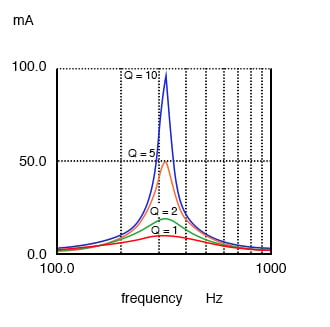
I remember Van Jacobson saying in the early 90s that IP would work over two tin cans and a piece of wet string. For several years, I set this as a possible student project, partly as a joke, but it was had no takers for quite a few years. Then in 2009 a student finally took me up on the offer. The main things we learned were that the tin cans were a bad idea (undesirable resonances), and that you could either do on/off coding at the string's resonant frequency, or try to stay well away from the resonant frequency, but then the signal strength was very low but you could distinguish multiple frequencies so do more interesting coding. In the end the project was successful, but the student ran out of time before he could really investigate in great depth.
What do you mean, cannot change its magnitude easily? I can just pluck it harder or softer? Do you mean frequency response?
And the bandwidth of a resonant circuit depends on its Q. Hence my question about a wet string’s Q, which might well be different from a guitar string’s Q.