Many soccer associations are saying — what a stupid name, soccer, you know everybody else calls it football, the NFL has been mean, we should really do something about that, can we do something about that?, let's get some people on that to change the name of football to something else and then soccer to football — they're saying, and these are some of the best soccer associations, the real best, FIFA in fact, it's saying we got the FIFA peace prize, and you know it was the first one, because I'm the president of peace, some say the most peaceable president, and the radical left hates it, but Venezuela you say?, I can't say I've heard of it, but the people who deal with those things, they tell me, and they're very smart, the greatest, some say, they say that this just has to be done, so we're doing that, and did you know they stole our oil?, stole it a long time ago, and it's ours, it really is, they tell me, but I haven't heard about this strike yet, if it's important I'm sure its reach my desk, it's a beautiful wood desk
It probably doesn't really matter, as this thing is never going to be built. I kind of suspect everybody is just going into "ok grandpa" mode until he loses interest and starts chasing some other half baked thing.
There's also potentially a substantial opportunity cost re: parity with China in the near to mid term even if we don't actually end up cancelling the next gen destroyer in favor of this thing: https://youtu.be/qvUbx9TvOwk
Money isn't real. Yes, allocating funds to this means there is a large swath of the population (with accompanying hard resources) which would work on this when they could arguably be working more productively on something else. But would they be spending their time more productively? Keeping what little remains of our shipbuilding capacity on life support might actually be more productive than the alternatives, given how little of value the US seems to produce when it comes to heavy manufacturing.
"Spending billions" is meaningless concern until you ask the question: what would these people have been doing instead?
Of course money is real. Any financial movements humans make + the sovereignty of our respective states are completely beholden to purchasing power parity via the modern economy.
The "spent billions" isn't about me/my constituents/the US not having those billions. It's that those billions where finely calculated by (supposed) experts to help maintain PPP advantages over adversaries.
When one "side" starts playing pretend with money (IE; using 50 billion in western currency on the Zumwalt class of destroyers before tossing them) the other side doesn't do the same, and stop taking advantage of PPP.
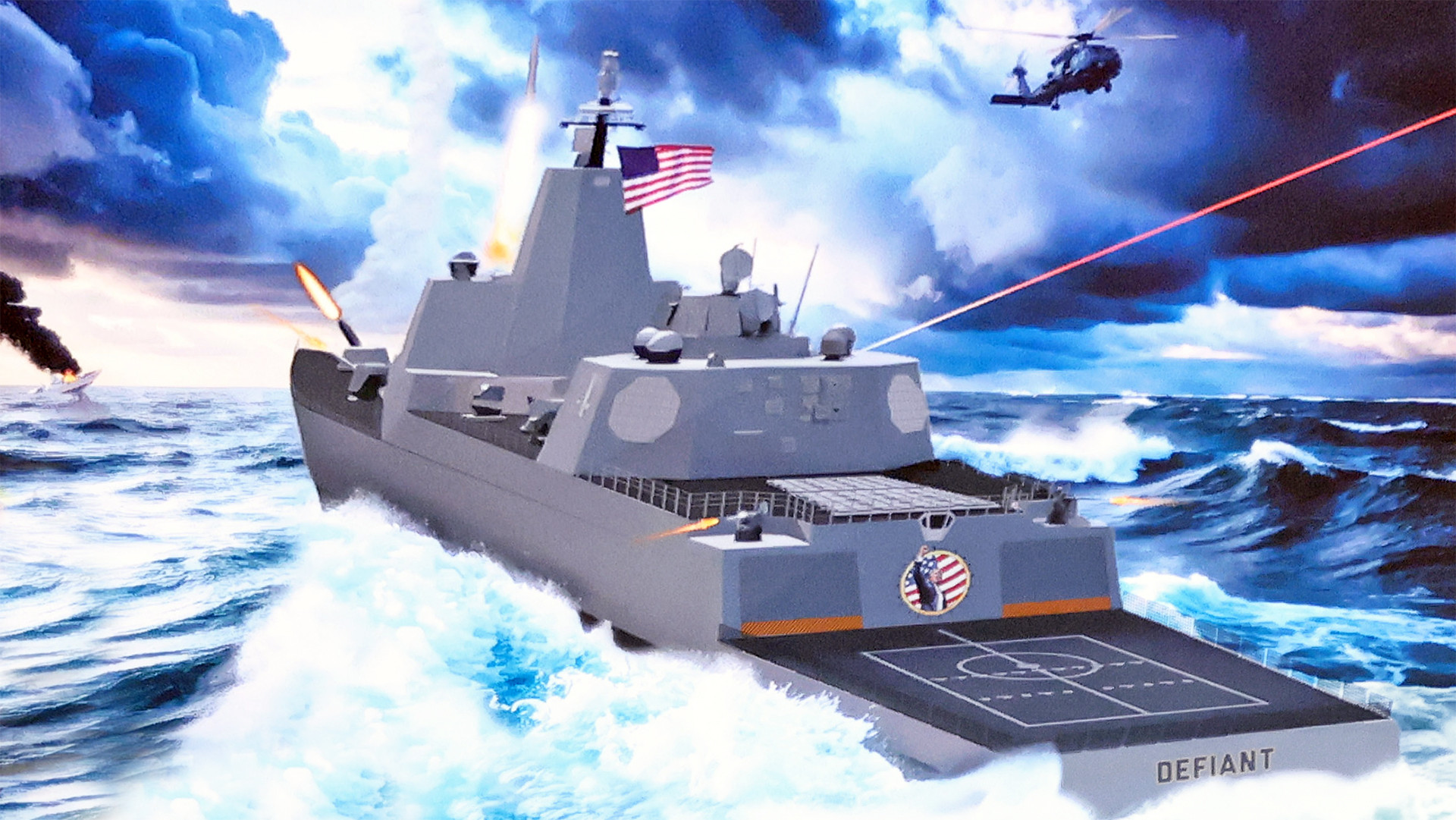
It reminded me of Chinese style military naming conventions, which makes sense since for all the anti-China bluster, Trump seems to be a big admirer of the power Xi has.
Not "wasted." Handed to allies of the administration. It's just naked kleptocracy.
I suspect that the "ball room" attachment to the White House will also still be a hole by the end of the administration, but a lot of money will get handed out.
I mean, define "wasted"? Presumably money will flow to American companies, American employees, American steel industry and so on.
In other words, yes it is billions pushed back into the economy, and yes, there will likely be very little "permanent" to show for it (and presumably the navy won't be much better for it) but it's not like they're just burying the cash.
It's important to understand that for the military industrial complex the goal is to "feed the machine", not actually to produce anything. In that sense this money is not wasted, it's doing exactly what it is supposed to do.
As much as I love any opportunity to stick it to Trump, wasting billions of dollars is about the only thing the US Navy does anymore; in this case he's keeping them on-brand and on-mission. It's kind of hilarious they announced this at the same time as the Constellation-class getting canceled, just to make sure there's no chance the Navy goes even a single day without an active boondoggle of a ship which will never sail.
Indeed. WW1 and WW2 battleships are incredible pieces of engineering and (IMHO) rather beautiful in their own way. And some of them were built in very short time frames when you consider they had no computers to design them with.
Based on them being involved in one battle in WW1 and being massively vulnerable to air attack in WW2.
It’s an exaggeration saying that they were outdated in WW1, as they basically acted as a deterrent, but it was at enormous expense and they don’t do much. Too big, too slow, too expensive. The argument was playing out even prior to WW1.
It doesn’t matter if you assume that large scale conventional conflict between the us navy and the plan over Taiwan is impossible in a world with strategic nuclear weapons, otherwise it very much does matter, because navies are built on the timescale of decades and the plans you make today very much determine the future you will live in 10/20 years from now.
Yes, the opportunity cost is the real problem with all of this. A navy takes approximately forever to build.
If we are extremely lucky the outcome of this will be increased shipyard capacity and refined shipbuilding practices just in time to switch back to building a multitude of actually-useful ships.
But most likely is that this ends up delaying the U.S.'s ability to build back its navy in time to matter, which is a tremendous issue given how we do our commerce and where some of our deepest friends are physically located.
If the navy diverts funds from the ddgx program for this, the usn goes from struggling to keep up with the plan’s expansion to being at risk of being completely outmatched in the late 2030’s / 40’s.
> The new Trump-class battleships will replace the Navy's previous plans to develop a new class of destroyer, the DDG(X). However, the sea service intends to incorporate the capabilities it had planned to employ on that platform into the new Trump-class ships.
I think there needs to be more awareness on how dire the navies situation is. Most Americans assume the 100s of Billions per year to the USN keeps us at some unparalleled level, but that doesn't seem likely to hold true.
The usn has consistently failed to procure any new surface ships other than upgrades to existing designs at scale this century.
In the early 2000’s, that didn't matter so much, but the loss of institutional knowledge, capability and manufacturing capacity is now at the point that it seems unlikely to be fixed without a significant amount of public interest and a huge amount of investment, neither of which seem likely without some crisis, at which point it will likely be too late.
Well before any "battleships" are built, we'd need to build up the infrastructure to actually produce them. This would presumably still be useful when the battleships get cancelled and we move onto a real program.
I doubt it would make much of a difference. Children growing up in rural communities typically move to a bigger city as soon as they can, which is where they then find mates and start their own families. I suspect not many young people are going to give up the social opportunities to stay in a small town or move back there.
But when they want the family, they have the option to go someplace to build it. That's the point. Right now the people meet in the city and stay in the city because they're tethered there.
Do you mean poor countries? I believe fertility is most closely related to education of women. If they have other options, many choose not to have a dozen kids like our ancestors. It's both hard on their bodies, and they typically get stuck with almost all the domestic and child care duties.
Why would you tax people's income to pay for a highway? Fuel taxes and license fees would normally be the way to pay for transportation infrastructure.
Because that doesn't get nearly close enough to the cost of roads. Interstates alone have, I believe, cost us over 25 trillion. Just interstates, not all highways.
It works well in many (most I know) countries: is fuel+license more common than general (income and fuel and other) taxation ('normally' would imply most do like you say?).
But that does not make it 'normally'; where does it work that way vs income(and other) taxes? Where I live and all countries around, roads are paid from general taxes (including income, road and fuel taxes).


reply