Since I began studying Greek, the whole wine-dark thing has struck me as pretty silly. The actual phrase is οἶνοψ πόντος (oinops pontos) which means "wine-face sea." Pontos refers to the open sea, not the shallows or the sea near shore.
For some reason the English-speaking world thinks it has to be translated as a color word. Maybe because it was incorrectly translated as wine-dark? But it's not exclusively a color word, just like "metallic" is not exclusively a color word in English. It means exactly what it says: wine-faced, having a wine-like surface.
The Greeks didn't drink wine in glasses like we do today. They mixed wine in a giant mixing bowl called a κρατήρ (krater). It could be different colors and was sometimes cloudy, like natural wines are today. They often mixed in honey, herbs, and fruit. Wine was also seen as a god: we say that Dionysos was the god of wine, but to the Greeks, wine itself was commonly thought of as being Dionysos.
So when imagining an oinops pontos, instead of picturing of a glass of pinot noir, imagine a huge bowl sitting in a candle-lit room, filled with a dark cloudy liquid, still swirling and bubbling slightly, shapes occasionally surfacing, a sheen reflecting the flickering candle light, containing a mysterious divine power. That's what Homer's referencing when he says wine-faced. The surface of the sea is like the surface of that bowl of wine–probably with the implication of a mysterious divine power beneath.
The ancient Greek word purphureos, which comes into English as purple, meant something like "dark and shimmering", and described wine and blood and the sea as purphureos. Much like we describe many things as "iridescent" that aren't rainbow-y (Gk iris = rainbow)
It's a nice theory but how do the wine-face oxen fit into it? Is it suddenly a description of color there, or are they also a dark cloudy liquid, still swirling and bubbling sightly, etc.?
Because it can be a color term, it's just not always a color term. Just like in English I can use the word "metallic" to refer to a taste, color, smell, or feeling depending on context.
Translate it literally as "wine-face" and it usually makes sense in English. In the case of the sea, it's referring to its dark wine-like surface. In the case of the cows, it's their ruddy wine-like color. There's also an element of the cows being strong, since wine can create an invigorating feeling in the drinker.
Why not? This is poetry, not an exact science, so playing with the meaning of words is not only completely acceptable, but desirable. Why shouldn't 'wine-faced' relate to the surface texture of wine in one occasion, and to its color in another?
There certainly wasn't room for any confusion, because even if the ancient Greeks had a different understanding of colors than ours, they still knew that wine has another color than the sea (example: in our color system, wine is red, and a traffic light is red. Yet you distinctly know that a red traffic light does not have the color of wine). So it was perfectly clear that Homer meant the surface texture when referring to the sea. The Greeks also knew that there are no oxen which are liquid on the surface (as mentioned below, this may also relate to sweat), so it was perfectly clear Homer meant the color here.
> (example: in our color system, wine is red, and a traffic light is red. Yet you distinctly know that a red traffic light does not have the color of wine)
But would you call the green light blue? Because I know some Japanese who do. Green/Blue is not as clear cut in some colors. And for many in Japan, the shinto gates (The torii) is not red. It is of its own color, between red and orange. I see it is often translated into "vermillon", which, let's admit, we would just call red.
So is it possible that in the distant past, a civilization would consider dark red and dark blue the same color? That instead of one "blue" category they would mix several other unnamed colors?
I can believe it. I think most civilizations will differentiate between the color of the blood and the color of vegetation but apart from that, I can imagine a very different palette.
And while I consider it unlikely just given the elements we have, let's not be totally closed to the possibility that the biological color perception changed since then. Arguably, nowadays, color-blindness is a bigger handicap than a slight myopia. It hinders you in several artistic or design-oriented careers. Even had a classmate struggling with resistors color code (in the good old days of the DIP components). Myopia will just be a problem for pilots and is easily corrected. Has it been the case for long enough to apply a selective pressure? I doubt it but am opened to being proven wrong.
> But would you call the green light blue? Because I know some Japanese who do
But that was not my point. Obviously, color categories are not fixed and may differ from culture to culture, yet you still know that "wine" (classified as red in western culture) has a different color than a traffic light. It does not matter that Japanese would call the green light blue, the same color they would (probably) say a clear summer sky has, because just like you would recognize that a red traffic light has a different color than red wine, Japanese would recognize that a clear-blue sky has a different color than a "blue" traffic light.
Every time this color discussion comes up, I am surprised people find this so interesting. Of course there are different names for different things in different languages / cultures. Of course these names often have a wider or a narrower set of semantic meaning than in your native language / culture, and this will of course lead to some "strange" word / concept / category overlap. But this is just unavoidable if unrelated groups of people build a categorical representation of a continuous world in their brains.
If you have ever tried to learn a single foreign language, you instinctively know this, and these color category differences shouldn't come as any surprise to you.
I have learned French (native) then English and German without encountering that problem. My exposure to Japan is the first time that brought this up. I think it is not a very common knowledge.
And especially coming from a culture where some colors seem to be labeled as "objective" categories (we learn at school that magenta, yellow, cyan, are the core colors. Tech people learn the same for red green and blue) it is strange at first to realize that some cultures do not consider these categories so clear-cut.
But we have many terms that are not clear cut in most western languages either.
Ask people what they consider cyan vs.turquoise, and some will insist they are the same and some will insist they are distinct. Ask them to draw a boundary between either and blue or green, and the boundaries will be different.
Ask them what is magenta vs. purple vs violet or even pink and again some will insist two or more of them are the same,and some will have strong opinions of what falls on either side that may not match the ’objective' categorization.
These are all languages from the same spot n earth with lots of cultural exchange. I am not very surprised that you didn't encounter drastic differences.
I think though there are tiny ones that are interesting.
German "blaues Auge" - (blue eye) is a black eye in English (like one after a bar fight). This is because blue is associated with sadness in English and blue eyes (correct me if I am wrong, not an English native) are sad eyes. Blue in German is however rather overloaded with being drunk. And the blue eye doesn't seem to conflict with that. "Blau machen" is to call in sick to work while actually not being sick.
So who knows what associations were made with wine color? Maybe the lack of control, similar to being drunk..
For red, orange and yellow I think there is large variance in how people would classify a given color that is not really red or really yellow.
-------------
My personal guess would be that I could believe that Greeks did not really have a name for blue. I'd say it is implausible that they were biologically incapable of differentiating things, but it may just have been a different shade to them.
Bruises can be blue, also black. I don't see a problem.
Also I came across a study that suggested primary colours were distinct and absolute categories (not relative). They put babies in front of various colours and measured how long their attention was on the colour. Primary colours got more attention, from this they deduced what we called primaries were perceived as having a common reality. I can't find the study so this paragraph is an FYI, sorry.
> So is it possible that in the distant past, a civilization would consider dark red and dark blue the same color? That instead of one "blue" category they would mix several other unnamed colors?
> I can believe it.
Different cultures divide the color space differently, but they don't lay it out differently. For a civilization to consider dark red and dark blue to be the same color, those colors would need to show similar activation profiles, both for blue-yellow cones and for red-green cones.
Or they would have to attribute more importance to luminosity than hue. In the absence of artificial light, low-light vision is much more important than differences in color as humans would spend a huge part of their awaken time in luminosity insufficient to discern colors.
It's likely he meant the oxen had reflective wet-looking faces, like the surface of the ocean was wet-looking, as in the context it was used the oxen were sweating pretty hard:
> ...but as two wine-faced oxen both strain their utmost at the plow which they are drawing in a fallow field, and the sweat steams upwards from about the roots of their horns – nothing but the yoke divides them as they break up the ground till they reach the end of the field – even so did the two Ajaxes stand shoulder to shoulder by one another.
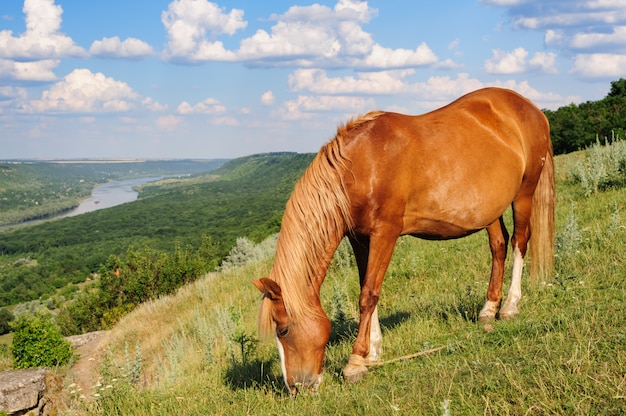
The reason 'red' is acceptable to describe the horse, despite the fact that it is clearly not red, is because the concept of orange only entered the English languange relatively recently. Before that it was described as red, and some vestiges of this remain (e.g. redhead).
Imagine a continuous colour wheel. Most people from the same culture today will draw the same boundaries between colors. Red, purple, blue, green, etc. What is to say these boundaries are objective? If in our own language red through orange was once referenced with a single word, why shouldn't red through blue have a single name in ancient Greek?
Red through blue covers a vast segment of your continuous colour wheel analogy, perhaps some two thirds. How likely is it that an ancient culture would have a single word for such a vast expanse of the natural world? Not impossible, just highly unlikely.
Wow, thank you. I'd always wondered about the whole theory of missing terms for colors, as it had seemed like something wasn't adding up.... but your explanation makes so much more sense. Much appreciated.
Reminds me of Gene Wolfe's use of language in Book of the New Sun. BOTNS is set on a far-future dying earth, and (unreliably) narrated by the protagonist Severian and translated into contemporary English.
Close readings reveal dramatic differences between the book's setting and our world that aren't at all apparent if you rush through the books. The protagonist refers to his pet as a dog, but reading his descriptions of the creature closely you might realize his definition of a dog is very different from our own. At another point in the story, the protagonist has a vision of a blue sky and describes it as incomprehensibly bright, indicating that the sun has dimmed and the planet is stuck in a sort of perpetual twilight.
Once the reader notices these things, they might start to realize just how different the setting of the book is. Suddenly everything in the text is open to interpretation. At one point you realize that people who operate spaceships in this setting are referred to as sailors. Does that mean all of the other 'sailors' that Severian encountered previously are actually interstellar travelers? What about the character who spoke with a sailor's accent? Was that horse that Severian rode an actual horse, or some far-future alien analog? Many of these moments are very brief and easy to miss - the book doesn't take time to explain or emphasize this divergent use of language. You can read this book over and over and still get something new out of it.
One of my favorite moments in this book that brought this concept to light for me, is when Severian describes a painting of a knight in a desert wearing a featureless orange helm. It's a painting of an astronaut on the moon.
What's odd is that there are many instances of odd use of color in descriptions but there is no normal (to us) usage, and from what I've read the same applies to other ancient sources. Honey is green (in Homer), but there's no green trees, green leaves, grass, etc; there is no blue sky or blue sea. The linguistic analysis of when separate colors were introduce into languages also shows they were added at very different times. William Gladstone wasn't very careful in his phrasing when he wrote on the topic and so it from the start got a bit of a reputation of a crazed theory, but there is something odd about the whole thing. I think it's not resolved because serious researches familiar with ancient egyptian and sumerian languages don't find this interesting enough to research it? Perhaps there's too few of them and too many other, more important and unresolved questions?
Isn’t “wine dark” used in Homer to describe the sea at dawn? I’ve associated it to mean dark with a hint of purple from the rising sun — not literally ruby-colored.
It seems odd that English-speaking people would get overly literal about this expression when English itself is full of similar exaggerative coloring: someone “ashen-faced” is presumably not light gray and devoid of hue all over their skin, etc.
It's not like bodies of water are always blue anyway. The ocean's not. I've seen the same broad stretch of the upper Mississippi appear anywhere from pale green to battleship grey, along with several shades of blue including almost sapphire. The lower part of the Missouri's mostly brown or grey. I'd assume anyone who described it as any kind of blue without apparent purpose or calling attention to how unusual that is had simply never seen it.
The later example in TFA of the Bible using the phrase "red horse" is an odd one. There are red horses. Hell Steinbeck wrote a novella titled "The Red Pony". They're pretty common. What's the big deal?
I think phrases like "yellow dog", "red cow", and "bluegrass" make sense if you understand them to mean relatively yellow, red, or blue. That is, a yellow dog is a dog that is yellow for a dog. A red cow is redder than you expect a cow to be even if relative to a bird, say, it is brown.
I don't know how you go from here to green honey, though.
Pale honey in a morning light can definitely have a tinge of green. I'm no good at photography, but an sure others have captured it. It might be environmentally related and isn't actually green.
Eg. green sky (ignoring northern lights) can happen just before dawn when there is a slight smog (bushfire perhaps). But it's more white than anything, but it's definitely a band between the red sunrise and the blue sky. The honey green is similar... It's definitely still a pale golden color.
I’d want to know why we are translating that word to mean green? Is is used to describe other green things, if so What? Did they have a word for yellow, and if so what was that used to describe?
Man, one of the teachers who has made the most significant impact upon me was my middle school Latin teacher back in Providence (we translated Homer from Latin). She had such a passion for the language, and for idioms like this, that it was infectious, even to a bunch of shithead middle schoolers. I still get a little pang of excitement when I read this phrase, such was the drama of translating the Iliad. Word-for-word it was an adventure.
I have similar memories of translating the Odyssey and the Anabasis from Greek at school!
There's a lovely line in the Anabasis about seeing an enemy army approaching from afar which describes "the flash of bronze". I always found that image so powerful; you can barely see these guys in the distance, just a smudge on the horizon, and then there's this flash of light as they lower their spears and the sun glints off them, and you know you're about to have a bad day.
There is a line in the Odyssey where someone (Telemachus?) puts an arrow on a table for the suitors to try and shoot from Odysseus's bow. The arrow is described as "naked", which i think is a poetic way of saying it was alone and conspicuous. This is the arrow with which Odysseus will soon begin his execution of the suitors, and you know that's coming, so this is a moment of real foreboding. The line ends "... γυμνός", and the feel of those syllables in my mouth is somehow incredibly heavy, like a gavel falling in judgment, or a tomb being sealed. I read that twenty years ago and the feeling is still with me.
Yes, the ancient Greeks knew about the color blue, as do most old world primates. Here is an linguistic explanation of color language around the world: https://www.youtube.com/watch?v=gMqZR3pqMjg
The sculpture reconstructions you've linked are rather imaginative -- German grad students with UV lights, not chemical reconstructions -- and are probably only vaguely like the original colors. Where original colors have actually survived, in frescoes, etc., the ancients display a reasonable eye for beauty in color.
Yea, I agree the coloring they present in what I linked is quite... ugly. But what I was trying to get at is that it does seem that, at that point, the Greeks could distinguish between the color of wine and the color blue. And that therefore Homer's "wine-dark" is in reference to something other than color.
(I had seen that video before, it's very enlightening.)
> I always considered that phrase in Homer as a poetic flourish, or maybe just something that was a figure of speech in his time period.
I'd say it's a worthy phrase—to put it mildly—whether or not you know what blue is. I wouldn't count it as evidence that they were unfamiliar with the concept of blue.
Then there are the Homeric epithets, which recur and are believed to be a mnemonic device...so "wine-dark sea" is not only a descriptor, but an anchor to remember the surrounding verse.
I believe this was a 20th-century discovery, no less, and even "ancient" texts have dimensions that are easily overlooked
It's a "formula". Kleos aphthiton I think was the first discovery, back in the 1790s, that's etymologically equivalent to sravas aksitam in the Sanskrit (hence, they are from an Indo-European language family), but you're dead on, it was only in the 1930s or so Milman and Parry documented oral composition of stories in Eastern Europe, with tape recorders of the time iirc
The Cal Watkins book "How To Kill A Dragon" is superb for a discussion of formulae in Indo-European languages
One of the proposed explanations is that the ancient Greeks didn't have a fully developed mental model of colors and used them more along on a light/dark axis than dividing the colors into strictly separate color terms (also remember that bright pure colors weren't a thing).
I can relate to this idea as my memories are not filled with vivid colors. They are also not completely colorless as I remember there being colors but pinpointing what color certain objects had is sometimes difficult if the color was not a significant property of the object.
For example, remembering/picturing that grass is green is not a problem. Or that the sea at the beach was of a vivid blue because this was the memorable impression. But remembering which exact color the dress somebody was wearing had, this might be difficult. I'll remembering that it was a brightly colored dress and therefore will be "seeing" in my mind a bright dress that is colored, but without "seeing" a specific color but also "seeing" it with some excluded colors (like dark gray, brown, jeans blue) that are not bright.
It might be significant that Homer's stories were told for a relatively long time before they were written down. Oral poetry has other requirements than written poetry as you have to keep everything in memory and can't rely on an external source.
There's been a lot of linguistic research into color naming across languages in general, specifically the claim that languages acquire more colors as they evolve, but it remains a controversial topic. Here's a primer:
Another thing to keep in mind is that until the advent of dyes most things were just their natural color. You don't need a separate word for green if unexpected things are never green. And even if they sometimes are, you can just say that the unexpected thing has the same color as something you expect to be green.
Curiously enough, people now think ancient Greek statues and architecture were painted in (if reconstructions are to be believed) rather vivid colours.
I remember that "On the Sublime" references the phrase wine-dark, and considers it prototypically sublime. I think the metaphor is inherently mysterious, as all good metaphors are.
How unlike to this the expression which is used of Sorrow by Hesiod, if indeed the Shield is to be attributed to Hesiod:
Rheum from her nostrils was trickling.
(Shield of Heracles 267)
The image he has suggested is not terrible but rather loathsome. Contrast the way in which Homer magnifies the higher powers:
And far as a man with his eyes through the sea-line haze may discern,
On a cliff as he sitteth and gazeth away o’er the wine-dark deep,
So far at a bound do the loud-neighing steeds of the Deathless leap. (Iliad 5. 770)
He makes the vastness of the world the measure of their leap. The sublimity is so overpowering as naturally to prompt the exclamation that if the divine steeds were to leap thus twice in succession they would pass beyond the confines of the world.
I will recommend, as I have before, the Lattimore translation of the Iliad which leaves in the wine dark sea, wine dark oxen, winged words (my favorite Homerism), and glancing eyed helmets.
It preserves the fact that you are reading something that comes from a world no one alive today truly understands, even at a vocabulary level.
I can wholeheartedly recommend the book Wikipedia mentions
Deutscher, Guy (Aug 4, 2016). Through the Language Glass: Why The World Looks Different In Other Languages. Random House.
Perhaps people didn't need a word for blue because they could say "the color of sky". For example the English word "green" comes from "grow" in PIE, meaning "the color of (plant) growth".
Even "yellow" comes from "grow" although the sound changes there are significant enough that it's not as obvious as "green" is.
Even between closely related cultures using the same language, there are color differences. Even though both the British and Americans have the words "pink", "magenta" and "purple", the British use the word "pink" over a larger range that includes colors most Americans would call "purple" or "magenta".
Every time this wanders across the front page of HN, I wonder:
What are the chances this is more a description of the murkiness or opacity of a dark sea (compared to water near the shore) rather than the literal color of the water?
As discussed previously, people are seriously overthinking this. Everyone who has been on a boat knows that the deep water is almost black. Like, you know, thick red wine in a ceramic container.
As someone having sailed on the Mediterranean Sea, I never questioned the comparison of the colour of deep sea with red wine. Also remember that Homer didn't drink wine in glass, but in earthenware, often glazed black. I'm pretty sure a red wine seen in a black crater is very dark indeed, like the deep sea.
This comment should be higher. That a poet should want to compare the viscosity and opacity of the sea to wine is a much more simple explanation -- and to my mind much more likely -- than exotic theories to explain why ancient Greeks didn't have the colour blue.
And the blue-was-perceived-differently theory has so much other evidence for it that is compelling besides this one metaphor. It's a beautiful choice of words that inspire, but people put too much weight on it as a riddle that can be or has been cracked.
Cultures with few color words are, generally, those without paints to choose among. You just don't need any particular precision about colors if you don't need to make decisions about them.
People from cultures we like to call "primitive" are routinely astonished at how blind most of us are to critical distinctions in their world. Imagine, we have only one kind of uncle! "We" doesn't say whether the listener is included, or whether the group are all blood relatives. There's no end to this stuff, including in ancient Greek, so quibbling about color distinctions when we have to wash out so much to translate is distinctly ... hick.
We might not have a particular word to call out those distinctions, but they’re hardly mysterious. They can be described in a couple or a few words, and everybody would understand. They just aren’t considered important enough to warrant a dedicated word.
Not drawing a distinction between blue and dark, however, is quite alien. And there isn’t anything hick about admitting that.


For some reason the English-speaking world thinks it has to be translated as a color word. Maybe because it was incorrectly translated as wine-dark? But it's not exclusively a color word, just like "metallic" is not exclusively a color word in English. It means exactly what it says: wine-faced, having a wine-like surface.
The Greeks didn't drink wine in glasses like we do today. They mixed wine in a giant mixing bowl called a κρατήρ (krater). It could be different colors and was sometimes cloudy, like natural wines are today. They often mixed in honey, herbs, and fruit. Wine was also seen as a god: we say that Dionysos was the god of wine, but to the Greeks, wine itself was commonly thought of as being Dionysos.
So when imagining an oinops pontos, instead of picturing of a glass of pinot noir, imagine a huge bowl sitting in a candle-lit room, filled with a dark cloudy liquid, still swirling and bubbling slightly, shapes occasionally surfacing, a sheen reflecting the flickering candle light, containing a mysterious divine power. That's what Homer's referencing when he says wine-faced. The surface of the sea is like the surface of that bowl of wine–probably with the implication of a mysterious divine power beneath.