Since I began studying Greek, the whole wine-dark thing has struck me as pretty silly. The actual phrase is οἶνοψ πόντος (oinops pontos) which means "wine-face sea." Pontos refers to the open sea, not the shallows or the sea near shore.
For some reason the English-speaking world thinks it has to be translated as a color word. Maybe because it was incorrectly translated as wine-dark? But it's not exclusively a color word, just like "metallic" is not exclusively a color word in English. It means exactly what it says: wine-faced, having a wine-like surface.
The Greeks didn't drink wine in glasses like we do today. They mixed wine in a giant mixing bowl called a κρατήρ (krater). It could be different colors and was sometimes cloudy, like natural wines are today. They often mixed in honey, herbs, and fruit. Wine was also seen as a god: we say that Dionysos was the god of wine, but to the Greeks, wine itself was commonly thought of as being Dionysos.
So when imagining an oinops pontos, instead of picturing of a glass of pinot noir, imagine a huge bowl sitting in a candle-lit room, filled with a dark cloudy liquid, still swirling and bubbling slightly, shapes occasionally surfacing, a sheen reflecting the flickering candle light, containing a mysterious divine power. That's what Homer's referencing when he says wine-faced. The surface of the sea is like the surface of that bowl of wine–probably with the implication of a mysterious divine power beneath.
The ancient Greek word purphureos, which comes into English as purple, meant something like "dark and shimmering", and described wine and blood and the sea as purphureos. Much like we describe many things as "iridescent" that aren't rainbow-y (Gk iris = rainbow)
It's a nice theory but how do the wine-face oxen fit into it? Is it suddenly a description of color there, or are they also a dark cloudy liquid, still swirling and bubbling sightly, etc.?
Because it can be a color term, it's just not always a color term. Just like in English I can use the word "metallic" to refer to a taste, color, smell, or feeling depending on context.
Translate it literally as "wine-face" and it usually makes sense in English. In the case of the sea, it's referring to its dark wine-like surface. In the case of the cows, it's their ruddy wine-like color. There's also an element of the cows being strong, since wine can create an invigorating feeling in the drinker.
Why not? This is poetry, not an exact science, so playing with the meaning of words is not only completely acceptable, but desirable. Why shouldn't 'wine-faced' relate to the surface texture of wine in one occasion, and to its color in another?
There certainly wasn't room for any confusion, because even if the ancient Greeks had a different understanding of colors than ours, they still knew that wine has another color than the sea (example: in our color system, wine is red, and a traffic light is red. Yet you distinctly know that a red traffic light does not have the color of wine). So it was perfectly clear that Homer meant the surface texture when referring to the sea. The Greeks also knew that there are no oxen which are liquid on the surface (as mentioned below, this may also relate to sweat), so it was perfectly clear Homer meant the color here.
> (example: in our color system, wine is red, and a traffic light is red. Yet you distinctly know that a red traffic light does not have the color of wine)
But would you call the green light blue? Because I know some Japanese who do. Green/Blue is not as clear cut in some colors. And for many in Japan, the shinto gates (The torii) is not red. It is of its own color, between red and orange. I see it is often translated into "vermillon", which, let's admit, we would just call red.
So is it possible that in the distant past, a civilization would consider dark red and dark blue the same color? That instead of one "blue" category they would mix several other unnamed colors?
I can believe it. I think most civilizations will differentiate between the color of the blood and the color of vegetation but apart from that, I can imagine a very different palette.
And while I consider it unlikely just given the elements we have, let's not be totally closed to the possibility that the biological color perception changed since then. Arguably, nowadays, color-blindness is a bigger handicap than a slight myopia. It hinders you in several artistic or design-oriented careers. Even had a classmate struggling with resistors color code (in the good old days of the DIP components). Myopia will just be a problem for pilots and is easily corrected. Has it been the case for long enough to apply a selective pressure? I doubt it but am opened to being proven wrong.
> But would you call the green light blue? Because I know some Japanese who do
But that was not my point. Obviously, color categories are not fixed and may differ from culture to culture, yet you still know that "wine" (classified as red in western culture) has a different color than a traffic light. It does not matter that Japanese would call the green light blue, the same color they would (probably) say a clear summer sky has, because just like you would recognize that a red traffic light has a different color than red wine, Japanese would recognize that a clear-blue sky has a different color than a "blue" traffic light.
Every time this color discussion comes up, I am surprised people find this so interesting. Of course there are different names for different things in different languages / cultures. Of course these names often have a wider or a narrower set of semantic meaning than in your native language / culture, and this will of course lead to some "strange" word / concept / category overlap. But this is just unavoidable if unrelated groups of people build a categorical representation of a continuous world in their brains.
If you have ever tried to learn a single foreign language, you instinctively know this, and these color category differences shouldn't come as any surprise to you.
I have learned French (native) then English and German without encountering that problem. My exposure to Japan is the first time that brought this up. I think it is not a very common knowledge.
And especially coming from a culture where some colors seem to be labeled as "objective" categories (we learn at school that magenta, yellow, cyan, are the core colors. Tech people learn the same for red green and blue) it is strange at first to realize that some cultures do not consider these categories so clear-cut.
But we have many terms that are not clear cut in most western languages either.
Ask people what they consider cyan vs.turquoise, and some will insist they are the same and some will insist they are distinct. Ask them to draw a boundary between either and blue or green, and the boundaries will be different.
Ask them what is magenta vs. purple vs violet or even pink and again some will insist two or more of them are the same,and some will have strong opinions of what falls on either side that may not match the ’objective' categorization.
These are all languages from the same spot n earth with lots of cultural exchange. I am not very surprised that you didn't encounter drastic differences.
I think though there are tiny ones that are interesting.
German "blaues Auge" - (blue eye) is a black eye in English (like one after a bar fight). This is because blue is associated with sadness in English and blue eyes (correct me if I am wrong, not an English native) are sad eyes. Blue in German is however rather overloaded with being drunk. And the blue eye doesn't seem to conflict with that. "Blau machen" is to call in sick to work while actually not being sick.
So who knows what associations were made with wine color? Maybe the lack of control, similar to being drunk..
For red, orange and yellow I think there is large variance in how people would classify a given color that is not really red or really yellow.
-------------
My personal guess would be that I could believe that Greeks did not really have a name for blue. I'd say it is implausible that they were biologically incapable of differentiating things, but it may just have been a different shade to them.
Bruises can be blue, also black. I don't see a problem.
Also I came across a study that suggested primary colours were distinct and absolute categories (not relative). They put babies in front of various colours and measured how long their attention was on the colour. Primary colours got more attention, from this they deduced what we called primaries were perceived as having a common reality. I can't find the study so this paragraph is an FYI, sorry.
> So is it possible that in the distant past, a civilization would consider dark red and dark blue the same color? That instead of one "blue" category they would mix several other unnamed colors?
> I can believe it.
Different cultures divide the color space differently, but they don't lay it out differently. For a civilization to consider dark red and dark blue to be the same color, those colors would need to show similar activation profiles, both for blue-yellow cones and for red-green cones.
Or they would have to attribute more importance to luminosity than hue. In the absence of artificial light, low-light vision is much more important than differences in color as humans would spend a huge part of their awaken time in luminosity insufficient to discern colors.
It's likely he meant the oxen had reflective wet-looking faces, like the surface of the ocean was wet-looking, as in the context it was used the oxen were sweating pretty hard:
> ...but as two wine-faced oxen both strain their utmost at the plow which they are drawing in a fallow field, and the sweat steams upwards from about the roots of their horns – nothing but the yoke divides them as they break up the ground till they reach the end of the field – even so did the two Ajaxes stand shoulder to shoulder by one another.
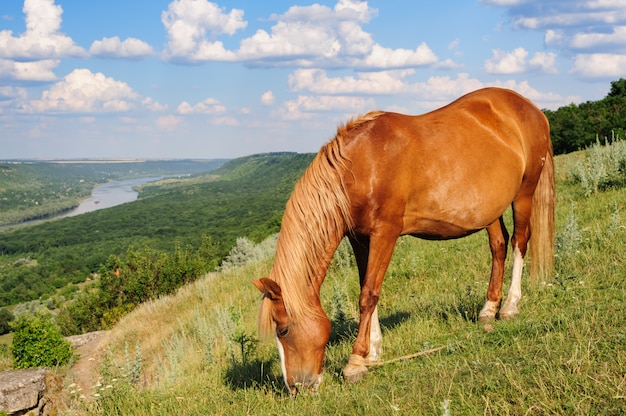
The reason 'red' is acceptable to describe the horse, despite the fact that it is clearly not red, is because the concept of orange only entered the English languange relatively recently. Before that it was described as red, and some vestiges of this remain (e.g. redhead).
Imagine a continuous colour wheel. Most people from the same culture today will draw the same boundaries between colors. Red, purple, blue, green, etc. What is to say these boundaries are objective? If in our own language red through orange was once referenced with a single word, why shouldn't red through blue have a single name in ancient Greek?
Red through blue covers a vast segment of your continuous colour wheel analogy, perhaps some two thirds. How likely is it that an ancient culture would have a single word for such a vast expanse of the natural world? Not impossible, just highly unlikely.
Wow, thank you. I'd always wondered about the whole theory of missing terms for colors, as it had seemed like something wasn't adding up.... but your explanation makes so much more sense. Much appreciated.


For some reason the English-speaking world thinks it has to be translated as a color word. Maybe because it was incorrectly translated as wine-dark? But it's not exclusively a color word, just like "metallic" is not exclusively a color word in English. It means exactly what it says: wine-faced, having a wine-like surface.
The Greeks didn't drink wine in glasses like we do today. They mixed wine in a giant mixing bowl called a κρατήρ (krater). It could be different colors and was sometimes cloudy, like natural wines are today. They often mixed in honey, herbs, and fruit. Wine was also seen as a god: we say that Dionysos was the god of wine, but to the Greeks, wine itself was commonly thought of as being Dionysos.
So when imagining an oinops pontos, instead of picturing of a glass of pinot noir, imagine a huge bowl sitting in a candle-lit room, filled with a dark cloudy liquid, still swirling and bubbling slightly, shapes occasionally surfacing, a sheen reflecting the flickering candle light, containing a mysterious divine power. That's what Homer's referencing when he says wine-faced. The surface of the sea is like the surface of that bowl of wine–probably with the implication of a mysterious divine power beneath.