Gonna be big changes if the outbreak continues for a longer time. Here in Vietnam, we're seeing what 2 months of school closures mean.
Children go to work with their parents now. My breakfast Pho place has a little dude who man's the register and is learning how the business works from his family.
Kids play in the park after morning studies at home.
It's not all sun and roses of course, but it's an interesting forced experiment that's happening under our very noses. The big losers are people who see the "school building" as the only way to learn. The winners are going to be those who embrace methods and technologies that help people learn without the rote of the traditional classroom.
I also live in Vietnam for 4 years now. The forced school closures have really impacted the economy.
All the school teachers are not getting paid and a lot are stiffed on their contracts. There is no viable actual recourse in Vietnm. Many have to leave the country as a result and now won't be back because they leave on bad terms. You see them posting constantly in the expat groups looking for help.
The teachers eat at all the expat places and tourism has been decimated... so all the non-local restaurants are suffering and will go out of business since they already operate on small margins. Viet landlords are more than happy (greedy) to have a place go empty than reduce rents... entire streets have shut down [1] literally over night.
Places like Halong Bay, who depend entirely on tourist revenue have stopped all cruises and those workers, who make tiny salaries, are now out of work.
What I'm trying to say is that the ripple effects are going to be huge in Vietnam... it isn't going to be pretty and it isn't going to magically fix itself over night. Especially as more cases keep cropping up.
This. If the organizations devoted to learning drop out then it is reasonable to expect that a great deal of learning will also drop out. This will be particularly pronounced among students of limited means.
Basically, poor people, and people struggling with disabilities and disadvantages, will get far less education. Overall, society will see drastically less education as a whole. This includes not just technical education in math, physical sciences, automotive tech, etc., but also in civil society areas such as social studies and literature.
Current education systems are very far from ideal. But abandoning them for an extended period of time under the belief that people will see it as in their best interest to learn to be good citizens on their own is potentially catastrophic.
People also seem to forget another factor for poor students in the US: Free school breakfast and lunch. For some low-income kids their school meals may be the only nutritious meals they get during the day. What happens to those kids if we shut down schools for months and take away that source of food?
Funny, I would say that's probably the most powerful and impactful thing a person could learn. Better then being force-fed every math concept in existence. And how would people learn to self-study without incentive and opertunity?
There's an assumption here that one can easily self-learn to self-study.
It might be true for some proportion of HN readers, but it's not clear that this generalizes. After all, those of us who self-study are often learning programming-related topics for which there is both abundant online documentation and clear, objective feedback on progress. We also tend, as a community, to have reliable access to the necessary technology, large amounts of disposable income (and security of leisure time that comes with it), a high level of prior expertise, and exposure to role models in self-learning. It's easy to take these things for granted, but they all certainly help in developing self-study habits.
As much as I might personally like to see everyone be more self-driven and self-reliant in learning, I share the concern expressed elsewhere in this thread as to what the impact of a sudden shift to remote learning would be on equitable access to education.
Purely online courses have huge failure rates - even when paid for and run through same university as in person variant. That is simply how humans work currently. The younger the kid, the worst it will be.
Incentive and opportunity is something quite different then "there is no other option".
There's the issue. What we need is complete automation, with fully automated machine-learning based students. This will help vendors attract more users and raise additional capital, and keep people employed.
If they learn it. Possible in a healthy family setting. But impossible if you already grow up in a dysfunctional family. It would make sure to keep kids from "low class" families right there for another generation.
"Healthy family setting" here means that one parent has to be the teacher. Even in middle and higher class, that still requires massive investment in time and effort, way more then when kid goes to school.
And it also requires not just resources, but also parent that could be good teacher. And even among richer people, not every parent would be good teacher, quite a lot would sux at it.
As all of these closures happen we're going to see a massive stress test of the modern economy. HN has already seen a lot of comments about the remote work experiment that's currently in-progress, but the other experiment is this: what are we going to do with kids when their schools are closed and both parents work?
A lot of moms work these days, and that's going to make things a lot harder for keeping kids at home. Not trying to pass any judgement on women in the workforce, just pointing out that in black swan events like this it makes reacting to it a lot harder from a social perspective. Consider for a moment if most women stayed at home: school being cancelled would be annoying, but manageable. I've already heard from friends (on the west coast) that they have no idea how to handle this (kids are grade school age, 2nd and 3rd grade) given that they're both expected to still do their jobs remotely.
The reasonable idea is of course is for any parent to be able to afford staying at home and raising their children, it need not be the mother. If living standards were higher I believe this would normally happen. The current divorce rate complicates matters, though, when it comes to deciding who stays home and who gets to advance their career.
It's normal here that kids aged 7-8 and up usually go to school on their own and come home on their own. Then they stay at home on (or go out to play) until their parents come home from work. So, can't you just leave the kid at home? I've heard anecdotes from the US and western Europe that this isn't done, but surely you can do that in cases like this?
Edit: I don't see how this doesn't cause a massive hit to the economy though. Some workplaces will be shut down and if stuff isn't produced then the economy isn't moving.
Even 35 years ago when I was in the 7-8 age range and still living in my childhood part of the US, being left at home all day without supervision would have resulted in a visit from Child Protective Services had anyone found out. Just being alone on weekend evenings while my (single, divorced) mom went to her second job was enough to tick off some folks. These days I'd be afraid they'd send in a SWAT team to arrest the parents and "rescue" the kids.
That practically amounts to having large redundancy in cheap backup workforce as part of your economic system. That redundant workforce is on standby most of time.
The trouble is that it simultaneously requires sacrificing interests of both the redundant workforce and leads to resentment of those pay for them in normal situation.
I think politics has to acknowledge that most jobs these days do not generate any economic output: They are parasitical jobs that feed on those with actual economic output.
So if a parent has a bullshit job, that parent should be put on paid leave to take care of the child.
The critical case is when both parents have real jobs.
I work out of UW, one of the theories going around was that other schools would be watching to see when UW would close, since we probably have it the worst right now (i.e. "UW isn't even closed yet so how could we close?"). I'm in one of the coworking spaces here and it was pretty empty yesterday and today. I expect it'll be even emptier next week - I won't know since my team has also decided to go remote for the rest of the month.
UW is on a quarter system so finals were supposed to be in two weeks, now professors are mostly making the exams online and some are just cancelling the finals entirely.
Two nearby community colleges also closed yesterday, Bellevue College and Everett Community College.
University of Washington at least had a single positive COVID case in an employee. Stanford seems to have canceled two weeks of classes and quarter-finals without even a single presumptive case on campus?
Presumably all these kids are still living in dorms together and eating together in dining halls...
Shall we close everything up then, just in case? Maybe then we should keep everything closed, as a precaution against other infectious diseases, including as-yet-unknown future ones?
No need to invent hypotheticals when we’re dealing with an actual, unfolding crisis.
The cost of closing schools, canceling events, etc, for several weeks would have been very disruptive and expensive. But it stood a chance of containing this.
Now we’re experiencing the beginning of the economic impact plus we’re allowing this to become a pandemic — and probably seasonal. It’s hard to see how the cost won’t be astronomically higher in choosing to react rather than take proactive steps.
And we chose this path with Italy and China already showing us the seriousness of this virus.
When UW's own researchers had shown that there were likely to be at least a few hundred cases in the Seattle area and only tens had been found, the probability that the outbreak would end without reaching campus was already slim.
Even if the starting number is low, as long as the growth rate is consistently exponential that won't last very long. And even if the majority of cases are mild, the hospitalization rate seems to be high enough to overwhelm our capacity (if growth is unchecked) at which point people don't get proper treatment and the statistics get worse.
I think the real measure of if this is under control is the growth rate and not the absolute numbers, since exponential growth will generate big numbers very quickly. If the growth is not under control, slowing it down at the beginning makes a lot of sense compared to later (and buys time for vaccine development).
I'm not an expert so I hope I haven't gotten any of this wrong, but the experts / authorities taking it seriously seems pretty justified.
Don’t have the link on hand but there was a study floating around showing something like a 10x difference in impact for every week early a school closes during a virus outbreak. Seems pretty obvious that closing before a positive case, at which point the cat is kind of out of the bag, is much better than reacting. Especially in the situation we’re in now where the trend is obvious.
The obvious concern is low income families. However, the calculus is whether they’ll be more devastated by the short term closures — or a much longer, much deeper recession if the virus spreads unchecked in the West.
I'm a student at Stanford currently -- not sure how much I could say with much confidence but there's most probably a case on campus. Students have been quarantined.
Alum here. Any special precautions taken at dining halls? At least the great majority of undergrads have to eat at large dining halls like Arrillaga and Lakeside, that seems to be an even greater problem than in-person classes, especially when people reuse dishes. I recall Ricker Dining’s manager occasionally patrolling the dining hall telling people not to reuse dishes back when I was a student living in GovCo. Apparently a lot of people do that.
Afaik all they've done is barred non-students/staff from the dining halls. There might be other precautions being taken that I'm not aware of, however.
With the CDC director saying that this thing is going to be a regular seasonal visitor[1], it makes me wonder what long-term impact this is going to have on society.
I don't think regular seasonal visitor has been called yet. In that article the CDC director is simply stating the one-off amount of time he expects the virus to be around for, not that it will recur every season.
The article doesn't have the full quote from the video. After mentioning community-based transmission, he goes on to say that "You can start to think of it like seasonal flu," which does suggest recurrence.
Is there any reason to believe we wouldn't have a vaccine in the next 12-18 months? Multiple vaccine candidates are already entering clinical trials. [0]
If there's a vaccine and a large sample of cases studies on treatment with antivirals, I'd assume its fatality rate would fall down to regular flu levels or somewhere near that. Therefore the spread wouldn't be treated like a pandemic as it is now.
According to [1] the likelihood of approval for a drug entering Phase 1 trials is about 12%. So that's one reason to not be too excited. Another reason is that coronaviruses are one of the causes of the common cold (rhinoviruses another one). People have been looking for a cure for the common cold for hundreds of years. It's been challenging. It's possible that the efforts were not that focused as the common cold is not very deadly. Now that Covid19 appears to be more deadly, maybe the efforts will redouble. But maybe there are some fundamental reasons it's difficult to come up with a cure/vaccine for coronaviruses (like they mutate too quickly). I personally don't take for granted that there will be a vaccine in the next few years.
Even with a vaccine, if it spreads enough and the mutation rate is high enough, new strains of the virus (that the vaccination doesn't protect against) will spread every season.
A working vaccine isn't guaranteed. Reminder that we haven't perfected the flu vaccine, it only applies to a few strains each year, and some years it misses more than hits
It will probably stay around for a long time, now that it spread through the whole world. But, and that is why currently every step taken to slow down its spread is so important, it will be less of a problem. Beyond a possible vaccine and a cure, there will be more and more people with immunity or partial immunity against it, as with every wave, there are more people around who have successfully fought the virus. With each seasons iteration, the society is less vulnerable against the virus. Especially, if we remember some good practices against viral infections, which would be of benefit against all common infections, ranging from the cold to the flu, which kills far to many people every year. Many of those deaths could be prevented.
That entirely depends on whether society decides to have the current panic wave every year, or deals with it in a more reasonable manner. Hopefully after people see how much they overreacted this time, they won't be inclined to next season.
There are good ways to do so. 4/17 2650 SPX puts are trading for around $6,000 in premium, 4/17 265 SPY puts are around $600 each if you want a more manageable sized contract.
Check out the option chains to shop around for different strikes and expirations to find options that suit your risk tolerance and time horizon.
The problem is determining for how long people will continue to overreact.
We're still at the point where a single confirmed case in a country that didn't have any before is international news and triggers more panic, as if the virus somehow cared about political constructs like country borders. You could easily have a long tail of these that can easily be spun into news about the continuing spread of the virus.
If you really believe what you're saying, don't worry about timing the bottom. You're arguing that the current state of the markets is already a huge overreaction. Just buy into an index tracking one of the hard-hit sectors, and hold through the panic. If this is an overreaction, there's no way the panic's going to last many years, so you won't risk insolvency.
> as if the virus somehow cared about political constructs like country borders
The virus may not care, but it doesn't fly planes, control customs, coordinate response or a bunch of other things. Borders and other political constructs have large effects on contagion.
I haven't looked recently, but when the first wave of travel restrictions was being implemented, WHO, CDC and other public health authorities were saying that travel restrictions were unnecessary and ineffective.
Which remains true. The only thing that would work is forced quarantine for all travelers for the hole incubation time so you could be absolutely certain they're not carrying that virus before letting them back into society.
That wasn't going to happen, and anything else doesn't stop the virus from entering in some way.
And even this could potentially be unsafe as the virus could potentially mutate.
Honestly, anything but herd immunity with vaccine isn't going to cut it with an easily spread virus such as this. (Still not a guarantee, just highly likely to work)
Wrong side of the trade, buying puts is like buying insurance; it's a bet that the price will go down further, while OP wants to bet that an overreaction has happened. You'd have to write puts (thereby earning the premium) or buy calls to bet in the other direction.
(Incidentally, it's not just about direction. Option bets require you to be also right about magnitude and timing.)
You could even sell puts or put spreads to pay for the calls. The volatility lately makes the timing and magnitude a lot less crucial for option trades.
I'd actually be curious. Is it the type of thing where a vaccine ends it? Or will it be like the flu where it's always mutating and so the vaccine helps but it's still always out there in some form.
Not an expert, but creating a perennial vaccine depends on the mutation rate and which highly-conserved regions can be targeted.
One of the potential vaccines enrolling trial patients is made of mRNA that codes for the spike protein needed for entry to cells. [0] If that spike protein turns out to be highly-conserved, then the vaccine will have sticking power. If it's not, but there turn out to be evolutionary trade-offs to adapting around it, it could push the virus to become less aggressive.
It is expected to be more stable than influenza. So regional eradication is conceivable in the long term and it's likely to eventually become one of those diseases that is limited to poorer/harder to reach parts of the world. But that is certainly years away. For now we all have zero immunity.
The relapses are a bit of a mystery but it's not uncommon with viruses e.g. various herpes viruses.
The problem with flu isn't tha the vaccine itself isn't effective, it actually protects you from the strains it's designed to just fine, it's just that the influenza virus is unstable and mutates, leading to new versions that you no longer are protected against. So yes, it depends on how stable COVID-19 is as mentioned below.
These types of measure are expected to slow down the propagation of the virus, which should at least help hospitals to manage the flow of patients, and overall save some time. The virus could decline naturally in the summer, or a treatment could be found.
But all these containment measures will also slow down the economy, which will have a cost too.
What I find interesting is that it seems a lot of people ask for greater containment (closing schools and borders, canceling events and conference), while at the same time, measures such as reducing speed limit, taxing junk food are hugely unpopular. I think it's similar in the sense that this would reduce mortality in exchange of loss of freedom and economic activity.
They’re just waiting on the county or federal government to provide a recommendation that they can duck under.
I know they are doing this for PAUSD’s response for sure.
For how long? A week? A month? If widespread infection is successfully avoided in a particular region, there's no herd immunity if it circles back again, so you'd have to cancel again and again and again. How long are you willing to keep kids out of school? They could easily lose half the school year or more.
Considering that serious complications seem to be confined to older adults and the elderly (as opposed to seasonal influenza, which is also dangerous for very small kids), perhaps it's better to let it burn through the population as quickly as possible. It might be easier to keep the vulnerable population confined for a short period during the burn; once there's herd immunity (assuming infection provides immunity, of course) they should be safe.
Stanford students can just do distance learning. The infrastructure for primary and secondary schools just isn't in place to provide that, so they're forced to make more difficult decisions about the needs of their students and the curriculum on the one hand, and the risks to students' families and the wider population on the other hand.
Many kids are cared for by older (60+) relatives. Losing their primary caregiver is going to negatively affect them way more than having to do school through the internet. Letting it burn through the population is exactly what we need to avoid.
> Considering that serious complications seem to be confined to older adults and the elderly
This is misinformation.
Its just way more likely to kill the elderly them the young. The same applies to the influenza however, and the preliminary numbers make this strain more deadly than influenza in both elderly and adults.
But nevertheless: we just don't know with the virus just taking hold outside of China. Give it 3 more weeks and realistic estimates are possible.
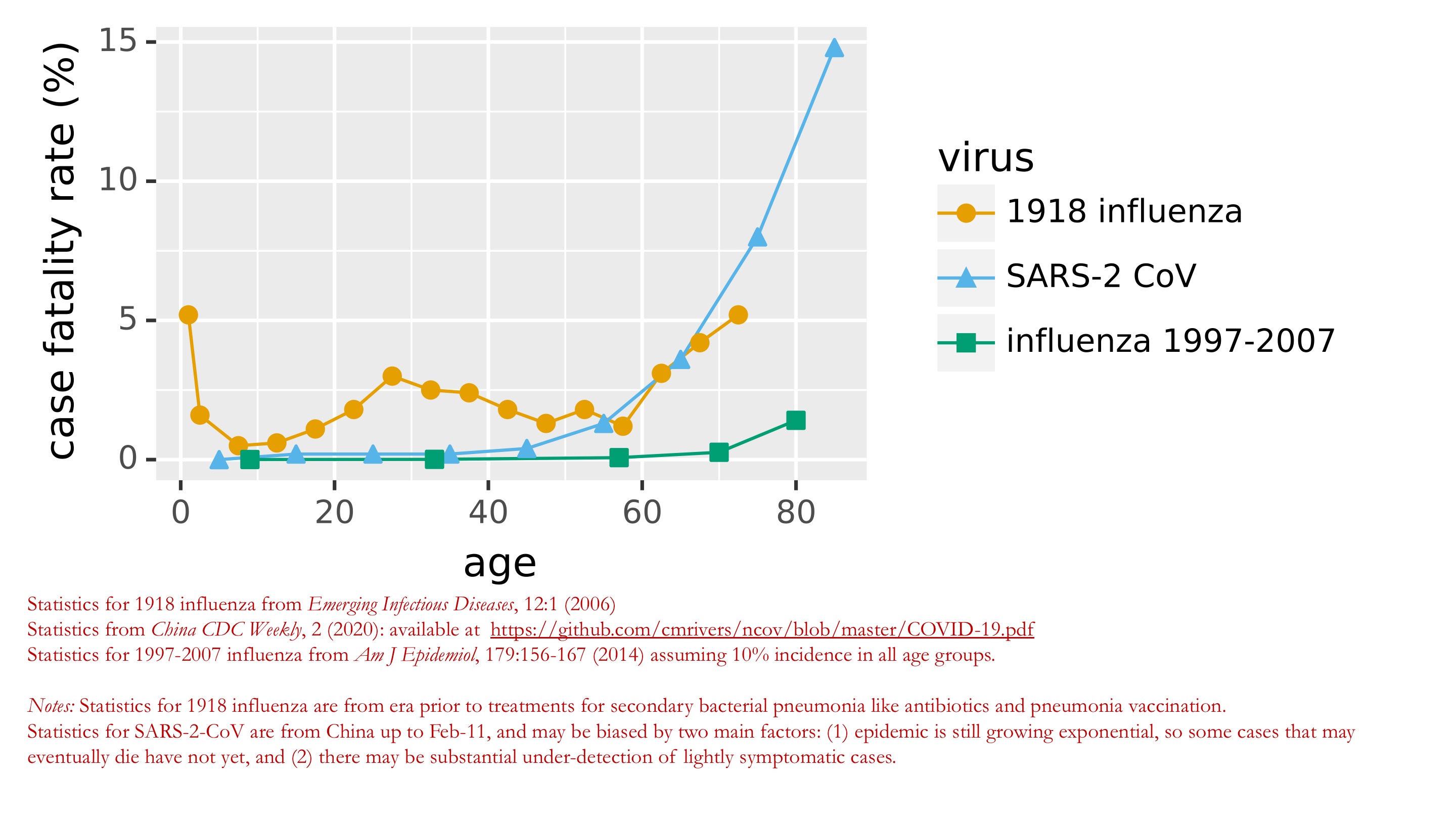
It's been widely reported that there were no deaths among children 10 or younger (at least until a few days ago) despite a not insignificant number of infections among that age group, and even the CDC says that young children are low risk (https://www.cdc.gov/coronavirus/2019-ncov/specific-groups/ch...). This was also the case with SARS-CoV and MERS-CoV. By contrast, children under 5 years old are at high risk for complications from seasonal influenza. (https://www.cdc.gov/flu/highrisk/children.htm). And there were quite a few deaths of children during the 2009 H1N1 influenza pandemic, both in absolute and relative terms. (https://www.cdc.gov/mmwr/preview/mmwrhtml/mm5834a1.htm)
This isn't surprising because influenza is a completely different virus from coronavirus.
Of course the elderly and sick are far more at risk for any of these. All of these viruses kill by causing pneumonia--primary viral pneumonia in the case of SARS and MERS, secondary bacterial pneumonia in the case of seasonal influenza, and a seeming mix of primary and secondary pneumonia in the case of 2009 H1N1. People with cardiopulmonary problems are far more likely to succumb to pneumonia if only because their lungs are already compromised.
Yes, corvid doesn't seem to be dangerous to children. I'm not sure how that's relevant for it's danger to adults and elderly however. I did only mention these age groups for a reason ;)
Nope. This kind of shock is how you determine which companies are robust or antifragile to reality. You don't sacrifice humanity for the companies, its the other way around.
The problem is less discovering the vaccine - though corona viruses seem to be a quite challenge in this respect - but to get it to the point where it can be used. For that it needs to be proven:
- that it is harmless. As vaccines are to be used on healthy people, it needs to be very safe. And of course
- it needs to be shown to be effective.
So even if we find a vaccine right now, it will take at least a year until it can be deployed. Though in this case, everything will be tried to cut the time short.
They proved us wrong. Schools closed while prisons didnt. Maybe there is hope for the future of an option to study from home for K-12 students just like the modern worker when their task can be done from home.
Ignore the title and read the article. Within it is claimed that children are equally likely to catch the disease, but do not show symptoms. COVID-19 is the showing of symptoms.
It is the infection. If it were literally just the showing of symptoms, then anyone with the symptoms would have COVID-19, but a variety of diseases cause these symptoms.
It requires the showing of some symptoms, otherwise it is not a disease. As an example, people with HIV don't necessarily have AIDS--the latter is the name of the auto-immune disease that typically shows up eventually in patients who test positive for HIV and don't get treatment.
Likewise, COVID-19 is the disease which has symptoms including severe coughing, fever, and shortness of breath. But if you have absolutely no symptoms whatsoever, but your blood tests positive, you do not have COVID-19. The positive result, if it isn't a false positive, indicates that your blood contains the SARS-CoV-2 virus, and therefore you are presumably fighting an asymptomatic infection. But by the terminology used by pathologists, you wouldn't have COVID-19.
So back to the original point, children generally don't get COVID-19. They may get infected by the virus, but without showing any symptoms. No symptoms, no disease, no COVID-19 classification.
I look forward to HN's resident statistics gurus to explain how the traditional flu and drunk driving kill more people per year than the paltry 14 deaths in the US and therefore everyone is overreacting.
Edit: Apparently my sarcasm wasn't thick enough so let me make my point crystal: COVID-19 is a real, genuine threat that's just getting started, but HN is filled with armchair fuckwits [1][2] who dismiss it because they lack simple math skills.
Nobody is overreacting drinking or driving causes death through the year, while covid19 is like a DDOS to the health system. Expect to be neglected if you get caught by a huge outbreak, thus the fear.
Not to mention if the outbreak escalated it will become Spanish-flu V2 then we are talking about 10 of millions people dying, and hundreds of thousands dying in US alone.
COVID19 is probably the most disastrous disease in our lives, assuming most of us haven’t been through Spanish flu. It almost felt like this virus is tailored to live with us.
I will take no chance and do the protections from my part as careful as possible
How would you characterize the current public response to COVID-19? What aspects do you think indicate under-preparation? What aspects do you think are hysterical or overly cautious? To what extent do you believe it is prudent and reasonable to shut down businesses, schools, and other public places to prevent the spread of the disease? How do you weigh the cost of constricting economic and social activity compared to the cost of the disease itself?
Anybody who is willing to pass (IMHO) bad-faith judgments on well-intentioned users should be also willing to answer these sorts of questions.
There are well over 3000 deaths worldwide. The point is to stop the death toll from getting worse. For example, the death toll from smoking is very low in a population of people that don't smoke. The number of dead people killed by coronavirus is also low in the US because most people don't have it yet. The whole point is to keep it that way. And given the enormous amount of investment we as a society put into mitigating deaths from car accidents and the flu (safety features and testing, vaccinations, etc), cancelling classes to stop the spread of a disease more deadly than the flu without a vaccine is not an overreaction.
We have a major testing kit shortage right now. China and Iran have been covering up how bad the case was and suppressed information about it's spread early on. We haven't been reacting enough. What we need right now is a clear eyed understanding of the risks this causes for the health of the populace (just because it's only so far proving a particularly dangerous concern in the elderly and people with pre-existing conditions doesn't mean those deaths count any less and that reactions should be any less strong). We're already seeing the economic impacts as work and exports grind to a halt as people are staying in quarantine if they are sick to avoid putting the vulnerable in danger. And these testing shortages mean we don't know the full extent of the disease spread.
So no, we aren't overreacting. If the response is successful, then we'll max out at a couple dozen dead. That doesn't mean the disease wasn't a big deal, that means that the reaction worked to contain it.
This while "not that many people have died stop overreacting" stuff makes no sense to me. The whole point is to stop it before more people die. We have testing shortages and world leaders such as in China and Iran buried need about the disease, which has led to thousands of deaths. If we wait for 1-3% of the world population to die before deciding it meets some statistical threshold to start reacting - then that just makes no sense. We're trying to stop people from dying - we can't bring people back after they're gone.
> All of the coronavirus deaths have been people that were going to die anyway.
Yes, all the doctors in China in their 20s, 30s, and 40s who died were just gonna die anyways, so who cares? For that matter, everyone's going to die, so it really doesn't matter, right? I'm hoping my sarcasm is apparent in my tone here, but if not; your argument is both counter-factual and full of fallacy.
> The vast majority of them have been people that were going to die soon, if not of coronavirus then of something else.
Again, this is BS.
> Is the mass panic really sensible in the face of this?
Panic isn't, but taking quick, decisive, and committed action is the only way that a crisis can be averted. If you don't understand this, I imagine you haven't had to deal with life or death decisions before. This all may blow over, but the facts DO NOT support that outlook. They all point to a bend in the hockey stick, and if we don't have a strong plan of action to mitigate this, people you know, and people I know, will die.
> The first sentence you quoted is irrefutably correct, and will remain so as long as immortality is not achieved.
Glad you agree. I imagine most of those doctors in their 20s-40s had at least 40 years of life left. Really interesting to hear that half a lifetime fits in your definition of "soon".
> If you believe the second sentence is BS, please provide evidence.
See my statement above, which extrapolates on a fact that you agree is "irrefutable".
Feel free to respond to my third paragraph as well, so as not to avoid the most important issue in this argument.
I try not to lose sleep over aspects of HN that are true of humans in general.
He had reason to believe the stercoraceous flavour, condemned by prejudice as a stink, was, in fact, most agreeable to the organs of smelling; for, that every person who pretended to nauseate the smell of another’s excretions, snuffed up his own with particular complacency; for the truth of which he appealed to all the ladies and gentlemen then present.
It is true of every cause of death, but I don't think it's meaningless. Some people's lives are being shortened, and in response we're making a much, much larger number of people's lives significantly worse.
I disagree. When someone looks at an epidemic that just made landfall a month ago and compares those numbers on an absolute basis to a virus (seasonal flu) that's completely embedded in the fabric of the entire US, and concludes that since A<B, it's not a threat, they are indeed a complete fuckwit.
To make your argument convincing, you should explain the difference between the coronavirus and the seasonal flu, and why is it invalid to compare the mortality rates of the two.
"The national health institute said the average age of those who have died was 81, with the majority suffering from underlying health problems. An estimated 72% of all those who have died were men.
According to government data, 4.25% of individuals confirmed to have the coronavirus have died, the highest rate in the world."
It is really really important for people to understand the risk group and take that into account in their lives and interactions. For those that are young and health the risk is still low.
The panic level of the general populous does not fit the facts at this point.
>For those that are young and health the risk is still low
I don't want to be the grandson who killed his grandma, I don't want to be the guy who pulled the trigger on a sufferer of another illness.
Are the people who paddle this argument of "you are too young and healthy to die from NCOV-19" are disconnected from their elderly and have no contact at all with people who are suffering some illness?
Please explain to me because I do not understand your angle here.
Do you know how many old people die every day from respiratory problems similar to Corona symptoms? But until the corona showed up no one cared. Coming to work sick with a flu was a common thing everywhere I worked. Sending sick kids to school etc. People stay at home now because there are too many unknowns. Once it's treated as another flu things will go back to normal.
You're forgetting that we spend considerable time and effort tackling flu with national programmes of vaccination every year, and multi-national coordinated monitoring programmes -- the Global Influenza Surveillance & Response System.
Also, the choice is not "deal with flu or coronavirus", it's "deal with flu and coronavirus as well". We already see winter pressure in most health care systems because of flu season, and adding coronavirus on top is going to be pretty devastating.
I don't think panic is the correct term, and it's an over used term.
People are simply hedging their bets. A bit of isolation won't harm anyone, not isolating might. Organisations are running various scenarios and calculating what the least amount of business disruption will be.
I strongly disagree. Some containment measures will be extremely costly. A lot of business are suffering now.
I'm not saying they shouldn't be taken, but the measures can turn out more costly than the virus itself. I'd hope we leave experts take these decisions based on facts and projections, rather than fear alone.
That's true for flu and others. Instead of closing schools people at risk should be very cautious. The question is how much more contegious it is than flu. Unless it's order of magnitude higher, there is no reason to close schools and ban travel.
Schools already close regularly every year if enough kids are getting sick, Happens all the time. With outcomes for COVID-19 potentially an order of magnitude worse school closures make at least as much sense for this too.
Not quite. Its not going to be ok if this is 'just as contagious', because outcomes are likely much worse. We'll want to be 10x more careful; closing schools is then a reasonable strategy.
Maybe. Saying the outcome is much worse is too early. There are many numbers reported that are likely incorrect. The Corona ship had around 700 people infected and less than one precent died (six people). All were 70+. We don't know if they had any pre-existing conditions but at least two of the people who died were close to 90. That's much lower than some of the numbers coming from China and Italy. But at least we can trust the numbers from the ship since it was a "controlled experiment".
If mostly older people go on cruises as you say then it's even better news. If less that 1% died on that ship then the general population mortality rate should be even lower.
Fit? That's a funny assumption to make. If it was something like a hiking trip then it would've been a fair assumption. Wealthy? Probably. Healthy? To a certain degree makes sense too. I just read somewhere that at least 1000 people on the ship were 70+. I'd take a young person's immune system over any 70+ year old any day.
Any way you look at it, the numbers on the ship are much more positive than a lot of what's reported in the media. More importantly, they are also more trustworthy in my opinion. The main reason is that there are fewer unknowns.
I don't think you want to be making guesses when you're dealing with something where there may be no modern medicine to fall back on. You're talking about a 19th century situation here.
I find it strange that I received down votes for posting a quote from the BBC and facts. I think what I shared was important so I am going to say it again.
The panic level of the general populous does not fit the facts at this point. The fact that there is no toilet paper, wipes or hand sanitizer on the store shelves in the Bay Area is panic buying. The fact that eBay band their sale is proof of panic.
Wash your hands people with lots of soap for 20 seconds. Do not touch your face absentmindedly like we all do. If you have a cold like symptoms do not go out.


Children go to work with their parents now. My breakfast Pho place has a little dude who man's the register and is learning how the business works from his family.
Kids play in the park after morning studies at home.
It's not all sun and roses of course, but it's an interesting forced experiment that's happening under our very noses. The big losers are people who see the "school building" as the only way to learn. The winners are going to be those who embrace methods and technologies that help people learn without the rote of the traditional classroom.