Current WHO advice: "If you are healthy, you only need to wear a mask if you are taking care of a person with COVID-19." [0]
Where we live, due to local laws, we are now obliged to wear a mask to go shopping. Can one discuss that on YouTube, or would one be contradicting the WHO?
I fear there isn't "one truth" out there, despite the content providers' and fact-checkers' attempts :(
We keep trying to encourage our kids to ask good questions, then I see what's happening out there in the world, and I wonder when the grown-ups are going to start asking good questions...
I fear there isn't "one truth" out there, despite the content providers' and fact-checkers' attempts :(
The idea is: "We are the decent, good, people who know the truth. Now we control the platforms, so it's only well and good we control the information, and we tell the deplorable others what they can and can't say."
Almost everyone in the history books as a horrible oppressor has told themselves that narrative. Many of them were brave, noble, and well meaning, and had an ideology that told them they were in the right.
How are the employees of YouTube or any tech company exempt from those forces? What makes them somehow wiser or smarter than everyone else in history?
This is how all news media operated before the internet created mouthpieces for non-professionals. In addition to suppressing some inconvenient truths they filtered out crackpot ideas that have become a plague in modern times.
What exactly qualifies someone to be a "professional" who is allowed to speak?
The vast majority of content I watch on Youtube is produced by independent creators covering a variety of topics with much more detail, expertise, and truth than any mainstream program.
There isn’t “qualified” and “unqualified”. It’s not that black-and-white, and I wish people would accept that more. Basically what we should be asking ourselves is “What’s the likelihood that what this person is telling me is correct?” which is much more useful, because it immediately puts the focus on what factors contribute to that.
We aren’t going to conclude anything useful until we can agree that there are good and bad tradeoffs between central information control and decentralized, and that the optimum at any given point in time probably lies somewhere in between and depends on the context in which the communication takes place.
It is not a given that there exists an optimal middle ground when it comes to central information control. Similar arguments have been done in regard to encryption controls where the arguments are in favor of backdoors, escrows, export control. But it has been mostly rejected that we need to find a optimal middle ground between giving government access to information and providing encryption for e-commerce depending on the context in which the communication takes place. We either have strong encryption or we don't.
I would also look to inspiration from the past, and here I will copy loosely from a talk by Eben Moglen. Government wants to control communication. Sometimes in a claim of some civilizing mission on the belief that government and only government can really artfully determine who ought to speak to the masses, and sometimes quite explicitly for the purpose of remaining itself in power. But whatever the reason may be, a lust for power or a misguided belief in the superiority of government wisdom about who should speak to many, central information control is an evil whose time has come.
Right now Google is not seen as an essential part of the infrastructure of society. Google can shutdown email, maps, search and Youtube today and we the citizens have no voice to dictate otherwise. No matter how much people rely on Google maps for driving, or have information stored in the cloud that impact their lives, for now those systems are not considered essential. That view however is starting to change as people's lives start to get unseparable from their use of those services. At that point we get the same discussion. Who ought to speak to the masses, and what will that decision be based on? A lust for power, or the belief in the superiority of government wisdom?
> central information control is an evil whose time has come.
It depends on the context. If your city is being invaded by a civilian-slaughtering army, I doubt many of the civilians would refer to a coordinated military defense as "evil", even though it would rely heavily on centralized information control.
In war time we accept the kind of government control that we would never do in peace time. Law is suspended. Freedom is removed. Elections is historically often put on hold.
During war time people genuinely believe in the superiority of government wisdom. It is sad aspect of how people work during a crisis, and it has enabled many atrocities which we in peace time can't image a human being could commit. Thankfully in peace time people tend to build up some resistance and recognize government wisdom for what it is. Sometimes it is right, sometimes it is not, and only through open dialog and free communication can we determine which is which.
I think part of the trouble is, our society is built on the radical decentralization of information control during the enlightenment. Our most basic propaganda is based around the idea that we are the successful society because we allow more decentralised information control. The central powers who would like to now have more control over our information are also the primary sources of propaganda which justifies our way of life by saying everyone can make up their own mind.
If I had the skills I would build a strategy game that deals with the new reality - that tribes are nonlocal but often ideologically quite cohesive. Exploring the idea that one's ideological affiliations, rather than one's government or search engine, controls one's thought seems like it would lend itself to the medium rather well.
Tribes are non local? That's a pipe dream. Every minute 23 girls younger than 18 married in a pre-arrangement. If a 35 year old man would trade a goat for a 13 year old girl in the developed world than the tribe would hang this man before midnight when the news reports on this extreme form of child abuse. When it these things happen outside the Dunbar number in developing countries we don't give a fuck.
Today 600 million women are alive that were sold before they were 18 to the highest bid, around 200 million also received a physical downgrade by butchering & cutting out a part of their vagina.
When I say 'tribes', I am referring to any ideological monoculture. Obviously some tribes are more adapted to local conditions. I would bet even the tribes you are referring to prioritise access to communications technology that allows them to co-ordinate their activities over distances that would have been unmanageable to them two generations ago.
Makes total sense. The black and white thing always seemed so weird. It's a false dichotomy.
Even if censorship is good in the particular context (which seems to be the case here), but bad in general and bad in principle, it seems that the real issue is that there should be one unaccountable entity who gets to make that decision. Why is Youtube big enough to have such an impact without being accountable in any way to the public?
It's not just Youtube, it's also Twitter[1] and Facebook[2]. When they all act in concert with each other, it's much harder to hold them accountable.
I think censorship can be dangerous in this context so I'm working on a decentralised fact-checker. I think it could be a more constructive solution to fake news that isn't subject to these problems: https://blog.verifact.io/2020/04/20/A-decentralised-fact-che...
I believe that you, and I, have a robust filter to identify trustworthy content. But would you agree that most people consume only reliable content on YouTube, or Facebook? There is plenty of evidence that is not the case, and these platforms are being actively attacked by bad actors.
IMHO it is better to start from a point of humility and recognize that we all have our own particular blind spots. Technocratic management and epistemology would be prime examples in this case.
Who cares if people consume incorrect information? Who decides what is correct?
The WHO has been wrong throughout this pandemic. Accusations of misconduct and a pro-CCP bias are still playing out. The establishment sources have similarly been wrong. At the end of the day, man is still fallible and 'fact-check' is a deceptive misnomer.
No. Not vaccinating children get people killed. Therefore, the reasonable response is to mandate child vaccinations (together with fines and other punishments for non-compliance). With such mandates (that are already in many countries), non-compliance is limited to very tiny segment of population.
> The "5G causes coronavirus" conspiracy theory is causing people to burn down mobile phone masts.
The "5G causes coronavirus" is an obvious nonsense, but lets assume for the purpose of an argument that it is true. Even in such case a reasonable response is to petition your MP or do mass demonstrations, not burning mobile phone masts (as violent vigilantism is generally unacceptable approach).
As violent vigilantism is completely unacceptable reaction regardless of truthness of such statements, it does not make sense to blame that statements for such reaction based on being false (unless that statements also contain calls to violence, but in that case even truthfull statements would be responsible for that).
RE: 'YouTube bans coronavirus-related content that directly contradicts WHO advice'
WHO advice is the standard being proposed. Adults should be capable of consuming and evaluating information. The solution is not to regard everyone as a child who needs to be coddled.
>'So .. we should give up on all informational hygiene standards and just let people tell their followers to inject bleach or whatever'
Let individual consumers determine their own standards. It is absurd to suggest that there would be no standards without platforms or supranational organizations determining them. When you choose to take a politically charged interpretation of a presser as your own standard, you establish this.
Individuals can disagree. We can't make the world safe for everyone. If based upon your informational standards you think that the president told someone to inject bleach, that's fine. Reasonable people can disagree.
> a question that probably some of you are thinking of if you’re totally into that world, which I find to be very interesting. So, supposedly when we hit the body with a tremendous, whether it’s ultraviolet or just very powerful light, and I think you said that hasn’t been checked, but you’re going to test it. And then I said supposing you brought the light inside the body, which you can do either through the skin or in some other way. And I think you said you’re going to test that too. Sounds interesting, right? And then I see the disinfectant, where it knocks it out in one minute. And is there a way we can do something like that by injection inside or almost a cleaning because you see it gets in the lungs and it does a tremendous number on the lungs, so it’d be interesting to check that so that you’re going to have to use medical doctors with, but it sounds interesting to me. So, we’ll see, but the whole concept of the light, the way it kills it in one minute. That’s pretty powerful. Steve, please.
What is your interpretation of "And then I see the disinfectant, where it knocks it out in one minute. And is there a way we can do something like that by injection inside"? I mean, it's kind of gibberish, not full sentences where one concept is logically related to another, but what do you think it means? Do you think it's a responsible thing to say after the deaths of people from self-administered chloroquine? Do you not think it refers to injections of disinfectant?
Of course, part of how this tactic works is that for any interpretation I can offer you can say "that's not what he said/meant", because what he said is incoherent.
Here is a more enlightening as well as fuller quote from the president:
"And I then I see the disinfectant, where it knocks it out in one minute, and is there a way you can do something like that by injection inside, or almost a cleaning. Because you see it gets in the lungs, and it does a tremendous number on the lungs. So it'd be interesting to check that. So you're going to have to use medical doctors, but it sounds interesting to me, so we'll see."
The point being he is talking about doctors investigating and employing his "technique".
Don't get me wrong, it is disappointing that someone who doesn't appear to be able to formulate long, coherent thoughts is our president, but I am sick to death of the way some of the things he says are twisted simply because people hate on him. It is a deep level of bias.
I mean there are medical textbooks that recommended injecting disinfectant for treating viruses, and there are no shortage of doctors who do it already in their practices. And if people are already doing it anyway, and as far as anyone can tell not immediately dying, then why shouldn't it be tested?
(the first talks about ozone, which is a disinfectant but fundamentally cannot be taken internally as it's a gas, and it's slightly toxic https://www.epa.gov/indoor-air-quality-iaq/ozone-generators-... ; the book mentions "Oxygen-Ozone therapy is a complementary approach less known than homeopathy and acupuncture" so that's obviously quackery as well)
Do you not see how it's ironic that you're calling other people quacks, in the context of literally lobbying against using empirical evidence to decide whether or not something is safe and effective?
You're engaging with someone who has endeavored to derail a discussion into partisan interpretations of Trump's statements. This after sidestepping logic in the original thread, bodes poorly for any further responses.
Mainstream is not professional.. just look at Fox news if you need convincing.
that say that if you cannot make the difference between an professional (or informed) opinion, and some redneck with the deep belief that the Earth is flat then I cannot do anything for you
Mainstream news, by all standard definitions, is professional. Fox News is the same as CNN and all the other channels in between, with countless examples of misinformation and outright false stories by every station.
Nobody is asking you to do anything for them, in fact they're asking for the opposite; to let them decide for themselves. And most people can do that just fine. Just because some extremist views exist does not mean the majority believes in them.
Indeed. In many fields, especially applied or related to life, only the less "professional" are assertive. Experts profess very nuanced thoughts.
Countering assertions which are proven false is good (pointing to a FAQ is sufficient). Censoring, on the other hand, seems counterproductive to me and nourishes the usual "they censor us because they cannot produce a valid counter-argument".
This statement is exactly the bollocks that got us here. Just because you have a social media account, or fucking "likes", does not qualify you to speak about pandemics, or vaccinations, or gravity, etc.
Yeah but not all " independent creators covering a variety of topics " are that experienced, and certainly not all the retards in the Covid facebook groups giving their opinion.
I'm not sure the point you wanted to make on the first place but you seemed to oppose the fact that some people should stfu a little on the internet because they know nothing.
Before the web was in every house we had professional media often pushing crackpot theories and news agents had a whole section of monthly crackpot magazines, one of mine had them right next to the comic section to get picked up by impressionable young people.
Long before all this "5g causes corona virus" in the early 90's my local paper would often have stories about cell phones causing cancer. Long before "china to blame for coronavirus" we had "legitimate" media pushing the link between Iraq and 911. Long before any WHO was at the center of conspiracy theories the UN was.
Let's not even go into things like current affairs shows and fox news. The internet may have made you more aware of the amount of crazy out there, but it was always there.
you mean like the NYT's Judith Miller, ostensibly a professional, who sabre rattled for the 2nd iraq war based on aluminum tubes which .gov leadership immediately cited after being published? because that was fairly crackpotty.
I'm not saying your example is wrong, but the fact that it's from nearly 20 years ago is very telling. Even the most credible of sources will get something very wrong on occasion.
>I'm not saying your example is wrong, but the fact that it's from nearly 20 years ago is very telling.
telling in what way? This behavior hasn't really slowed down, and was persistent through the Obama administration, too.
Many, including myself, feel as if that behavior is par for the course with regards to NYT. Chomsky refers to it as the NYT's special role of 'creating history'[0].
That's why they have some strange ability to be cited realistically by serious people, even when they're entirely wrong about something.
I think what's needed is a measurement of how many times a source was later proven to be wrong, and then issued a correction to state as much. Or even better, a percentage comparing the # of times they got wrong with the percentage of times they admitted as much. A sort of "batting average" for admitting their mistakes.
All sources will get it wrong from time to time. A reporter's primary loyalty should be to the truth, regardless of whether it aligns with their pre-conceived notions. Coming up with a way to quantify that loyalty would be a service to society.
The thing is most lies and manipulation do not happen by stating false facts. They happen by ignoring (and never mentioning) the facts that do not fit the narrative and by pushing the ones that do. Or by presenting facts in a misleading way (like confusing CFR with IFR, or eliminating context).
And I am afraid I do not know a mainstream media that doesn’t do that on a massive scale. The WSJ perhaps. Certainly not the NYT.
> In addition to suppressing some inconvenient truths they filtered out crackpot ideas that have become a plague in modern times.
Every idea starts out as some fringe crackpot idea relative to the status quo. Government recognized marriage of a same sex couple comes to mind as a recent example. Some ideas (e.g. "the general public should wear a mask in public to reduce the spread of coronavirus") make it from crazy to accepted faster than others.
You're right. We're so much better off when a significant segment of the population believes that the Secretary of State is pimping out children from a pizza restaurant.
Yes, because the idea of rich, influential men pimping out children in modern America is simply unthinkable and certainly hasn't happened recently. https://en.wikipedia.org/wiki/Jeffrey_Epstein
The conspiracy theory stuff is seemingly always exactly wrong about this. Not only does it magnify unsubstantiated allegations, it often helps suppress the genuine ones; look at how badly the Weinstein accusers have been treated.
This is a well-known issue, but what is your solution? Ban internet and go back to the 90s? It's pointless to gripe about this without a good alternative.
> crackpot ideas that have become a plague in modern times.
It's especially fascinating to read this after we have literal viral pandemic, about which WHO told us it's not transmissible human to human, government told us go and enjoy restaurants and parades, CDC banned third-party tests and then completely bungled their own tests, same CDC advised people not to wear masks, and so on, and so on... yeah sure, "crackpot ideas" have become a plague. That's where the problem is. I am sitting a month in a quarantine while watching the economy slowly turning to dust - because some crackpot dude made a video about his ideas on Youtube, right?
This sort of weird slippery slope argument that banning obviously bad advice somehow leads to youtube becoming a "horrible oppressor" doesn't pass the smell test.
By this reasoning, _any_ platform that features _any form of moderation at all_ will devolve into oppression. Is HN at risk of becoming oppressive due to banning flamebait and spam comments?
One of the youtube series I watch normally features pork ribs. Like, the shrinkwrapped package you get from the grocery store. Well that video the creator couldn't get pork ribs because of coronavirus and so had used beef ribs instead - and couldn't even plainly say the reason why. Instead he had to hold up a bottle of corona beer and say "Well, it's due to beer, if you get my drift."
Is Youtube actually in the right here? The guy just wanted to say he couldn't find pork ribs. He wasn't telling anyone to inject bleach or chug quinine.
That isn't just clamping down on the conspiracy nutters. This has repeatedly become an issue in multiple videos from videogame commentary to cooking shows I watch. Youtube and other large corporates often see themselves as leading the dumb cattle that is the general population and frankly it's outright insulting and their handling of this situation is abysmal.
But also it's going to get worse. The more Youtube can get away with these things, the more they'll do them. Don't be surprised when this extends even more to protected political speech (Israel BDS, free HK, Taiwanese independence, etc) because it's happened before and it will happen again.
I'm not arguing that youtube is doing a good job, or that youtube's brand of corona-related censorship is in any way making a positive impact.
I'm arguing against the parent comment that essentially makes the argument that _all forms_ of censorship/moderation are bad and inherently lead to oppression.
If you instead want to argue that youtube's specific policies regarding coronavirus are bad/harmful/etc, go ahead, I won't stop you.
Hn is a moderated community, and it's value partially comes from it's moderation. It's restricted to a set of topics, and if things get too out of hand whether it's a personal attack or just insanity, the comment is going to get removed.
Except you can view the dead comments. You can still see the removed stories. You have to opt-in to that, but it's just a checkbox in your profile. HN is moderated, but there is no censorship.
The issue with censorship is that it has to grow. You can't defend taking down say, videos about the Israel BDS movement, and not also take down videos about Free HK. Either the platform openly admits that it's biased or it has to keep growing what can't be discussed and inevitably that's going to start including content that everyone feels shouldn't be censored.
This is the same with your example though? Anyone can upload a video talking about the coronavirus, they just might not receive money for it (they'll be demonetized). Youtube only seems to be taking an active 'censorship' approach for comments spreading bad information about the virus. Whether or not "against WHO advice" is a good metric for this is debatable, but the goal seems worthwhile.
> The issue with censorship is that it has to grow. You can't defend taking down say, videos about the Israel BDS movement, and not also take down videos about Free HK.
I fail to see how this property, if it exists, is any less present in a "moderated but without explicit censhorship" system.
Youtube only seems to be taking an active 'censorship' approach
Edward S. Herman and Noam Chomsky wrote an entire book about 'censorship' that's not technically censorship, titled Manufacturing Consent. Rather, what happens in the industrialized west uses soft influence and economic power to achieve the same ends. Media in such a "propaganda model" of operation does technically disseminate information, but does it in such a way as to reduce visibility, reduce emotional impact, and economically discourage.
Actually, the power to engage in a "propaganda model" of operation enjoyed by YouTube is in many ways much more immediate and absolute than that exercised by the western governments in the 20th century.
Demonetization is a form of censorship when Youtube is your paycheck.
If your employer threatened to not pay you because you took a political position that would be abhorrent and oppressive treatment. Youtube is not a direct employee and it's more of a business partner, but it's wielding it's power to control speech - which is oppressive.
I'm arguing against the parent comment that essentially makes the argument that _all forms_ of censorship/moderation are bad and inherently lead to oppression.
This is "basic straw-manning 101." Of course, if you put an absolute re-framing into the mouth of another, it's going to break. Let's try this: Any censorship/moderation of sufficient scope and power, combined with too little accountability, is probably going to produce bad outcomes.
Is YouTube possessed of great scope and power? Check.
Is YouTube transparent and accountable in the way it uses this power? Many, many people don't see it this way. To the point, that people write innumerable articles and make innumerable videos about it. In fact, people have even established at least one union around this issue.
Look, the whole principle of "Power Corrupts" is based upon the same underlying forces as, "You can't convince someone of a fact, if their paycheck depends on it." Everyone is subject to such biases. No one is possessed of all the relevant facts and perspectives. This, in fact, is the true principle behind such phrases as "check your privilege."
We are all human beings. We are all fallible. We all have the potential to make mistakes and even carry out miscarriages of justice and unfairness, if we are given enough power with too little accountability. It's thinking one is somehow immune, or somehow justified by circumstances, which is the key ingredient to the very worst evils in history.
Scope for self doubt and transparency work, and when people lack self doubt and exercise power without transparency, bad things happen. It's not some "weird slippery slope." It's an established part of the human conditions, going back thousands of years, valid in all times, all cultures, and all places.
(P.S. A key historical indicator that such corruption is happening: When a group of highly educated people start to work against transparency and the openness of information, one is in this regime of "Too much power, too little transparency." Heck, these highly educated, smart people might even pull some middle-school shenanigans, like "refutations" that leave out the sources.)
(P.P.S. One thing younger people don't understand, is how in past decades the ethos of Free Speech used to suffuse society. People wouldn't just accede to the letter of the law, they would enact the ethos in their everyday lives. There is an obvious epistemological wisdom in such practice. Really, wanting to hang out with people with such an ethos is really just an extension of wanting to hang out with honest people. Seems to me, this changed in the early days of the Internet, with electronically implemented forms of near-censorship, and that the ethos of regular life has shifted to accepting such practice of near-censorship.)
One of the things that's important when we discuss any kind of censorship and freedom of speech is what we call "Chilling Effects". If you know taking a political position is going to result in your family being arrested and put in prison, then your speech is being curbed even without being punished and it's one of the insidious wrongs of censorship.
When a grown man who was in the marines for several years is afraid he's going to lose his youtube channel talking about why he can't find pork ribs, that's a chilling effect. When a multi-million dollar videogame streamer is afraid he's going to be demonetized if he talks about why he's filming from home instead of his studio, that's a chilling effect.
The goal of a good censor is not to enforce censorship. It's to get the people to enforce it themselves.
Tim Pool has talked about it regularly, how if independent Youtubers even speak the word their video will be instantly demonetized, but bigger YT channels (those with millions of subs) as well as mainstream media outlets can use the term with no ill effects. He's such a prolific content creator across three channels I can't single out an exact video from the past ~90 days of material for you though.
If the telephone system had the same moderation as HN then I would suspect that indeed it would seen as oppressive if they were listening on all telephone calls and banned users who they deemed inappropriate citizens.
We only have one telephone system so being banned has a rather large impact as it is an essential service. So maybe we should ask what platforms are like other essential services. Radio is an essential service. What about Youtube? The telephone system is an essential service. What about Skype? I think libraries are also seen as an essential service, so what about Wikipedia? And then we have HN. How essential is HN?
I think there is a big difference between content moderation (based on published and reasonably objective rules) and an outright ban on contradicting the stance of an organisation that is highly political.
If this rule was implemented earlier, you’d be banned for saying there is human-to-human transmission, proposing flight restrictions, or advocating for the general public to use masks. The W.H.O. has explicitly advised against each of those measures, despite significant disagreement on every one of those claims. It’s absurd that dissenting against the W.H.O. has been banned, although it’s predictable of course.
I've been very surprised, and I guess I shouldn't be, that so many folks are taking such a hard black or white stance on this. There's folks who've literally pushing ingestion of Chlorine Dioxide to eliminate coronavirus, or conflating HBOT with inhaling ozone to "clean" the lungs. I 100% believe that transparency and understanding when and why things are taken down can help, but there's a _lot_ of slippery-slope arguments being made that here that actually surprised me, when we're talking about actually trying to prevent people from spreading information that can actually lead other to harming themselves, rather than seeking treatment.
Moderation is not necessarily censorship. It is only censorship if the content is removed based on the content itself.
For example, shutting down a flamewar for simply being aggressive is not censorship, as long as the same discussion would have been permitted if held in good spirit.
Censoring "wrong" content likely has bad outcomes, the worst being that with only "good" content, critical thinking may get even sloppier.
HN has plenty of rules that remove content "based on the content itself". For example, HN bans job ads (outside of 'who is hiring' threads). There are no circumstances where a job ad post is allowed outside of 'who is hiring' and YC-funded companies, not even "in good spirit". Similarly, the HN FAQ says not to post comments complaining about paywalls, and there is no 'unless you are civil' exception.
Again, does banning content from an internet forum inevitably lead to "oppression" or "bad outcomes"? If so, why hasn't this happened to HN/Reddit/Twitter/etc?
As someone who did a lot of moderation in the past, people forget any platform is more akin to a cafe, instead of a public square. A cafe has rules that keep a pleasant atmosphere. A public square has a public function and needs rules to allow for a broad discourse or protests. One could argue if there is a certain size where a platform like youtube becomes a public square. But on the whole its their room, their rules.
I disagree. Aggression in the sense of language style, is very much in the eye of the beholder. As is assigning value to a ‘flamewar’. One person’s meaningless flamewar is another person’s valuable but heated argument.
Sure, if you stop something early you may have overstepped, but no one questions violence taking place when rocks are being thrown. Same goes for once a discussion degrades to ad hominem attacks/insults.
I think it's obviously bad advice for you to suggest that censorship isn't a slippery slope. Under section 239-C of the Obviously Bad Advice Act, I have dispatched the police to your location. Please be ready to comply when they arrive.
Sorry, but history is overwhelmingly against you. The historical precedents are legion. We're not talking about some "weird slippery slope argument." This is well established human nature. In fact, many of the items in the Bill of Rights are based around this principle.
In fact, the principle has a much shorter, snappier version: Power Corrupts.
Thanks to Google, Facebook and the others this is the golden era of being able to widely disseminate your alternate theories on everything. If that is your definition of freedom then you are less oppressed then any other humans in history.
Some people would like freedom to discuss the coronavirus without being oppressed. They can't on YouTube if this policy takes hold.
The sort of people who contradict the WHO happened to be right on this one; they predicted a problem early and tended to pre-empt the WHO on upcoming problems. This was also expected, because the WHO only advises stuff that is already obvious to everyone. Interested parties can offer better advice than the WHO because they can move with news while the WHO has to wait.
Case in point, Chris Martenson of Peak Prosperity runs a prepper/doomsday style channel. He is also a very smart bloke with an honest-to-goodness PhD in a virus-related field. Who are YouTube to say his opinions are less valid than an organisation that can't say "Taiwan" in a sentence and can only say things that are politically palatable to China and the US?
Chris' advice on the coronavirus has been consistently high quality, accurate, sourced and early compared to the WHO. His only fault is his standards for safety are a lot higher than are reasonable. This policy will be aimed at exactly people like him. He has been contradicting the authorities all the way.
"There is no specific evidence to suggest that the wearing of masks by the mass population has any potential benefit."
That is completely and totally wrong. It is INSANE to suggest something so horrifyingly stupid and dangerous with a virus that has a two week asymptomatic, contagious incubation period. All the infected but don't know it yet people would lower the number of people they infect massively if they work masks. Every single country where mask wearing in public is the norm has a much lower fatality rate than every single country where it is not the norm.
Does that say it's harmful to wear masks? The WHO's guidance has been that it isn't necessary for individuals to wear medical PPE. There are valid concerns about this, both related to shortages and improper care.
Yes, it does. "In fact, there's some evidence to suggest the opposite". But that is irrelevant, since that is not what I claimed. I said the WHO says masks don't work. I quoted them saying it to CNN for you, and linked it. How much more in denial can you get?
>The WHO's guidance has been that it isn't necessary for individuals to wear medical PPE
I just showed you their guidance, which says they will not help. The overwhelming evidence unanimously says that it does help.
>There are valid concerns about this, both related to shortages and improper care.
There are not. There is no shortage of cotton fabric. Improper use of masks is still superior to no masks.
There is, as far as I know little to no scientific evidence that cloth masks are effective at reducing the spread of covid-19
This would make the who's statement factual.
There's conjecture, and maybe some empirical evidence about cloth masks, but it's weak.
There is overwhelming evidence. Dozens of studies, all show significant reduction the spread of viral diseases simply by tying a folded piece of cotton over your face. And if you need to back peddle this hard, maybe you should be so quick to snark in the first place?
The sort of people who contradict the WHO happened to be right on this one; they predicted a problem early...
Suggesting YouTubers were correct a form of survivorship bias. You're only paying attention to the ones that were right. Plenty of other YouTubers said things along the lines of it being a hoax, or it'd die off, or that it'd be thousands of times worse long before, and long after, the WHO reacted.
YouTube is big and covers all opinions, so of course some would be correct.
> a very smart bloke with an honest-to-goodness PhD in a virus-related field
How do I embolden text on HN? When a person with a PhD is talking about something related to their PhD it is imprudent policy to ban their content because it disagrees with a body who are (a) political, (b) purposefully slow to recommend things and (c) have covered themselves with something a lot less pleasant than glory with their response to the worst pandemic we've seen in a century. Turns out he has a biological Nature publication too [0]. I want to hear his opinion even and especially if it contradicts the WHO on coronavirus. I like to live dangerously; I'll take the risk that he isn't a specialist in respiratory infections and viruses.
YouTube has picked a policy that bans good advice if they don't like the tone or word choice on behalf of an organisation I believe the US government is trying to defund for incompetence. This is not a move that should inspire confidence in their fact-checking abilities. I'd bet they don't have doctors or nurses enforcing this policy either but it'd be nice to be wrong.
Your original statement was "The sort of people who contradict the WHO happened to be right on this one;" Now you're saying that one specific person might be right, and because of that YouTube should let any crackpot broadcast potentially lethal videos on their platform. That's idiotic.
Also, there are plenty of cases of respectable scientists throwing away their credentials to make a ton of money making completely unscientific social media posts. I'm not saying this guy is doing that, but YouTube certainly need to do more than just look as someone's history and whether they're published. The article you cite is from 27 years ago. He will certainly have changed a great deal in that much time.
I'm saying that the WHO was literally a mouthpiece for a Chinese propaganda operation in the early stages of this pandemic. Not maliciously, not intentionally, but the facts of the matter are not really an open question. The WHO were communicating based on Chinese claims that had very little basis in fact. That isn't a strange situation for UN bodies, who are buffeted by strong political winds from all directions and reliant on reporting from their member nations.
The sort of people who are happy to contradict authority were totally correct to contradict the WHO. The WHO weren't communicating best known evidence; they were communicating best known evidence that was acceptable to the Chinese.
YouTube removing people who disagree with the WHO is YouTube setting up a system that will amplify Chinese (or other large state sponsored) propaganda. And I can give an excellent example of a credentialed person who was correctly applying his credentials to warn people about an outcome that has, in fact, emerged. People like that will be targeted under YouTube's policy, which is not interested in correctness but in authority. It is enacting a policy that would have made this crisis even worse for me, because it would have removed the channel that I found out about it from. I am very thankful for having 45 days early notice.
Maybe those Youtubers were less popular because their predictions are less accurate and their logic is flawed, and people are able to see the difference? Why is biasing information the role of Youtube, shouldn’t USA and other countries educate their citizen to be resilient to inaccurate predictions, rather than cut any information at the root and only ever expose citizen to “true information”, which inevitably makes your citizen more gullible?
Saying the population can be misled is an admission that our school system creates naive dumbasses. MAYBE we should fix that first.
Yes, let's go fix people's entire educational upbringing (often tied to income and scenarios outside one's control) in the middle of a crisis so that way they can be your flavor of 'smart enough' to discern fact from fiction. This stance is absurd given the immediacy of the crisis all hinging on some slippery-slope argument that if they ban one video they can ban them all.
I think you are right, and that this is one of the more helpful comments in this thread. But maybe even this gives Youtubers too much credit.
I suspect that even those hailed as 'survivors' weren't necessarily more correct. Nobody remembers who was wrong. Nobody remembers anything, ever. Youtubers pay no price with their audience for outrageous false claims. Those were made in the past, which was a month ago. There's 30 new videos up.
Meanwhile, they reap rewards by fanning the flames of whatever subset of claims they've made that haven't proved false, and can claim they knew it all along.
Unfortunately platforms that reach billions must prioritize the danger of misinformation spreading that far and wide over allowing for every dangerous and wrong opinion.
The complete and total censorship you fear never emerges, Youtube if anything is far too lenient on allowing terrible opinions to linger on their platform. They never do away with anything besides the most harmful, hate filled rhetoric.
> They never do away with anything besides the most harmful, hate filled rhetoric.
who decides what speech is "hate filled"? this is free speech 101. what is the point of a publicly accessible social platform if people can't express themselves freely?
Free speech applies to the government, not businesses. Which is good because if it didn't there wouldn't be spam filters. Don't like their rules? Host it yourself.
Is there any reason to believe the dangers of the presumed misinformation being censored are actually significant? Is it killing more people than the Tide pod challenge for example? The article mentions taking vitamin C, and turmeric, but that just seems harmless to me. If it was just that, it’s clearly not worth banning the masks or origin discussion.
They are making a calculation that a global run on masks would hurt efforts to contain spread due to shortages for medical professionals confronting the virus everyday, as opposed to general public confrontation which is more sporadic.
Should they just come out and say that? Probably. Would it be effective? No people are irrational in crisis and their words wouldn't prevent the above scenario.
They made a calculated choice with their language which is misleading, but necessarily so. You can disagree with it, but it's far from "spreading misinformation for political reasons".
FWIW I agree re masks but withholding information from Taiwan to appease the CCP is inexcusable. Luckily the Taiwanese are far more competent than their counterparts in this farce.
> Unfortunately platforms that reach billions must prioritize the danger of misinformation spreading
No, they don't. See, this is the core problem, that premise: that's the job of governments. And in the US, the law says the government doesn't get to do that.
Arguing that entities who are arguably more powerful than the government should be doing it is literally arguing for the dictionary definition of fascism.
Actually in the US it's explicitly not the job of government, hence the bill of rights.
Individuals, and collections thereof, however, are free to censor whomever they want. This misguided idea that your protection from government censorship affects your contractual agreement with me needs to stop.
> Actually in the US it's explicitly not the job of government, hence the bill of rights.
You need to read my comment again.
In the US, it is NOBODY'S JOB.
> This misguided idea that your protection from government censorship affects your contractual agreement with me needs to stop.
Repeat after me: "I am not Google. I am not Google. I am not Google. I don't affect the lives of billions of people. I don't affect the lives of billions of people."
I did. Are you suggesting that legally, Google is unable to do this, or that ethically there is some principle that says that large collections of people should have fewer rights than individuals? And therefore that the government should restrict the speech rights of those groups?
"Some people would like freedom to discuss the coronavirus without being oppressed. They can't on YouTube if this policy takes hold." so find another platform. YouTube has no obligation whatsoever to continue to disseminate disinformation, or theories. They've had a hard enough time banning and preventing the spread of chlorine dioxide-based "protocol" information, let alone the flimflam that's being discussed right now.
The market won't sort them out, but the courts will. Wait until they are deemed a publisher, and no longer exempt from liability[0] for all of the content that they publish. Unfortunately they hire a lot of lobbyists so it might be a long wait.
Revoking 230 won't make the executives at YouTube go "gosh darn, guess we'll have to start taking a loss by employing hundreds of thousands of moderators to literally watch every video uploaded", they'll constrain and limit the platform in any way which still guarantees similar or greater ad revenue. That is, if there isn't any legal loophole like requiring creators sign legal paperwork which makes creators their own "publisher" or something along those lines.
They'll probably cull everything that doesn't earn them ad revenue, to minimize the fallout. The content will trend toward sanitized garbage and the viewers will start leaking to somewhere else.
Yep, kill any content an ML model has predicted of high risk or unprofitable. Classic example of a regulation second order effects resulting in the opposite outcome of what was intended.
maybe they wouldn't, but would you like to live in a world where a single company has a literal stranglehold on video (or search, or social network) until the end of time?
I'd rather have many companies competing with one another.
that's the problem... the same handful of companies have dominated the space for the past decade and mostly monopolized the attention. we need more competitors.
Any fun theories on how we ended up replicating the same issue of consolidated TV broadcasters and traditional media companies with internet media platforms and content outlets?
We’ve had such a long time between the passage of things like the Fairness Doctrine and now to turn the boat (not to mention countless critiques of the consolidation of local news and syndicated television networks for examples), maybe learn a few lessons along the way that I wonder if this isn’t an emergent outcome and is in reality an inherent one.
No, it's the environment that the media platforms exist in. It's our laws, our economic system, our way of governing, and who has power to influence those things: all fairly consistent due to inertia but not really fated to be what they are, IMO. People seem to think present reality was destined. I think there are other viable ways we could have developed that would look much different and have fewer, more, or just different problems than the ones we take for inevitable.
How are you going to best network effects and the race to the bottom?
It happened with news (the cable news cycle) and it’s happening with social media.
The bare, sad truth is that any private or public societal scale information sharing function eventually gets captured - driven to relentlessly pound away at subconscious fight or flight routines so that they keep their cut of the audience.
Eventually the need to keep the network alive (advertising) overcomes its ostensible mission of carrying valuable signal.
As long as the two are not divorced - the advantage will lie in exploiting the vulnerability of our neurological systems over investing in carrying more in depth, boring but accurate news articles.
At some level we must recognize that we need to get the best of a central source of truth while also ensuring that this source of truth is not captured by the governing bodies of a country.
And then they become a constrained platform worried more about litigation than enabling voices, and the disenfranchised move somewhere to hear the message. It’s already headed there.
We can't wait for markets to sort themselves out while a few executives and their well connected friends control and decide the information we get to see and hear. The stakes are too high to wait for a market solution here.
How are police, judges, jurors, etc. exempt from this narrative? Or do you believe that the entire legal system simply should not exist at all, given that it clearly needs to determine the truth value of important statements?
So, people who are tasked with determining truths like whether someone committed murder is okay, but it’s not okay to determine whether an online advertisement about a medical treatment is medically accurate?
I'm so glad we're discussing it on HN, so I can use better analogies: it's feature creep. Imagine a product wich was originally elegant and perfomant, almost in a unix way - but then dozens of product managers, each with best of intentions, started adding features to it. Oh, and the product itself was something akin to operating system kernel in terms of security - having monopoly on violence and able to literally kill people - but all those product managers wouldn't hear about moving all these shiny new features into userland, because of perfomance and ease of development.
There doesn't have to be one truth, there can be a landscape of truths and that's fine. Imagine a youtube personality with a large following made some absurd claim like "drinking bleach will help." You don't need to be a self proclaimed silicone prophet and be wiser and smarter than everyone else in history to censor that video, it's possible to stop stupid people from influencing other stupid people into doing serious damage without oppressing anybody. Imagine if the claim wasn't just inflicting self harm, but encouraging a bad meme that will spread the virus.
To me a lot that's bad with Google's politics is epitomised by the move from "don't be evil" to "do the right thing". The first was a neutral stance: just abstain from behaving so as to cause harm; the second is an active position, where the company is encouraged to act in pursuit of whatever it thinks might be good. Thus mixing its role of technological medium with that of publisher and of political advocate.
How exactly do you figure? Google has built a company around it deciding what information gets to be seen. They’ve done this for decades. Apple sells computer hardware. Even if Apple has recently started curating information, they still only curate a fraction of a percent of what Google does.
Suggesting that Apple has historically been at fault here and that Google is now just joining them sounds incredibly biased.
K but that isn’t the issue. The issue is Google choosing what information people get to know. They are the ones in the position of power to control that.
WHO is the _world health organization_ dude. We're in the midst of a pandemic. You're using a moralistic argument to respond to the form while ignoring the substance.
In the meantime, Trump advocates injecting disinfectant, what argument have you got for him?
welcome to the list of hacker news commenters I am extremely disappointed in then. I cannot logically argue you into caring about human life. though personally i don’t think conspiracy theory videos and slippery slope arguments are more important.
I'd argue you care about human life less than you think I do. Lockdowns are not about saving lives, you know that right? It's about making it take longer to kill who it is going to kill -- not overwhelming the hospitals.
It doesn't change the actual number of people killed by the virus, at all. That is to say, regardless of the shape of the curve, the area under the curve remains the same.
And economic depressions kill people too, in fact in far greater numbers than this virus has, yet. You don't seem to care about those lives either.
That's the problem with having a comfortable life. You don't see the consequences of your choices. I live in a place where I see people suffering and starving because they live hand to mouth and can no longer make the $2-$3 dollars a day it takes to keep them alive. They can't go out on the street to sell food. They can't make their few cents helping cars in and out of parking lots. They can't open their "shop" the size of a porta-potty in order to sell a few shirts. And when these conditions spread, crime and death spread with them. I've started to give away what food I can just to try to help whoever I can.
All the while, cozy HN commenters who earn $250,000 USD a year pontificating about whether we should shut off the entire planet for 18 months or more because it doesn't affect them one tiny little damn.
Nobody arguing for that point of view gives a shit about human life, they want control, plain and simple.
Do you even understand how insulting it is to deny other people agency? That's the most insulting thing you can do or say, worse than racism, sexism or whatever else, it is plain denying that the other person is a human with their own free will.
Except people who decide out of their own free will to watch and follow a specific advice and they end up dying due to it are responsible for their own deaths. You can't blame the medium though which said advice propagated. Regardless, as is and by your own belief youtube should be held responsible for the people that end up dying due to following the WHO recommendations instead of what the experts suggest.
by all means inject yourself with bleach as your “expert” suggests but don’t pretend that people deciding to spread covid19 around because they believe it’s caused from miasmas are only hurting themselves.
> but don’t pretend that people deciding to spread covid19 around because they believe it’s caused from miasmas are only hurting themselves.
Indeed, asymptotic carriers (as well as healthy people that are going to become asymptotic carriers) following the political crackpot pseudoscience advice from WHO and end up not wearing masks do not harm only themselves but everyone around them as well.
I am not referring to the tweet that you think that I am referring to.
(plus there was plenty of evidence for said X but this is irrelevant for the discussion)
For the next time I would suggest to confirm if you haven't misunderstood something before hurrying to insult the one that you are talking to.
Almost no one in previous history had an ability to directly target poor, uneducated masses which their own content created in their own bedroom.
Also let’s be honest - the likes of Hitler actually came from the likes of people who would tell you to stop listening to WHO advice and to go start fires in 5G towers.
Don’t get me wrong, freedom of speech et. al., and we’re probably also going to get burnt by the freedom with which today’s global platforms invent the rules - but the laws are being written now; and we’re obviously not dealing with an easy, black-and-white answer.
> Also let’s be honest - the likes of Hitler actually came from the likes of people who would tell you to stop listening to WHO advice and to go start fires in 5G towers.
This is not true. The rise of the Third Reich is fascinating because of its populism rooted in hard-working citizens who believed in their country.
The most well known Fascists, were not anarchists. That is accurate enough. I think going so far as to characterize Hitler's motives (as if there was a singular motive) is a bit reductive.
Would you please stop posting ideological flamewar comments to HN? It's not what this site is for, we ban accounts that do it, and we've already had to ask you.
I think we are all familiar considering your response is the de facto standard propaganda that is posted all over social media in defense of censorship.
> and the fact that you can absolutely be "censored" on a private platform.
Yes. That's the point. Otherwise, we wouldn't be having this conversation.
Nothing emboldens racists like pointing to government oppression of their ideas. The KKK has free reign in the USA and they've experienced plummeting membership.
Nothing kills bad ideas like sunlight and scrutiny, you don't need to ban it and make them martyrs.
Sure - anecdotally- you could perhaps convince one person by highlighting information.
But the plural of anecdote is not data.
At scale - sunlight and exposure increases dissemination of bad ideas.
Designing ideas to sound appealing in a viral sense means that even their dismissal and refutation by authority sources only increases their spread in the target population.
“Of course the governments going to deny they made the corona virus! They aren’t stupid.”
“Of course scientists would say that, they need grant money.”
All the ideas that grow from the root of this tree fail at scale.
Malicious actors are beyond the scope of this axiom for example - they don’t care about being defeated in argument- they just want to let vulnerable people know they exist, and then have them fall into their ideological orbit.
Competition over information networks only drives the news cycle effect - a market adapting to target the weakest link the human Fight or flight response, over giving better quality news.
To the point where the ACLU actively defended KKK members' First Amendment rights multiple times.
Second, and more directly related to the events of this weekend, there are important reasons for our long history of defending freedom of speech — including speech we abhor. We fundamentally believe that our democracy will be better and stronger for engaging and hearing divergent views. Racism and bigotry will not be eradicated if we merely force them underground. Equality and justice will only be achieved if society looks such bigotry squarely in the eyes and renounces it. Not all speech is morally equivalent, but the airing of hateful speech allows people of good will to confront the implications of such speech and reject bigotry, discrimination and hate. This contestation of values can only happen if the exchange of ideas is out in the open.
There is another practical reason that we have defended the free speech rights of Nazis and the Ku Klux Klan. Today, as much as ever, the forces of white supremacy and the forces for equality and justice are locked in fierce battles, not only in Washington but in state houses and city councils around the country. Some government decision-makers are deeply opposed to the speech we support. We simply never want government to be in a position to favor or disfavor particular viewpoints. And the fact is, government officials — from the local to the national — are more apt to suppress the speech of individuals or groups who disagree with government positions. Many of the landmark First Amendment cases, such as NAACP v. Claiborne Hardware and New York Times v. Sullivan, have been fought by African-American civil rights activists. Preventing the government from controlling speech is absolutely necessary to the promotion of equality.
That's not what I said, but it is according to empirical data. America is a long way from segregation and the LA riots.
In 1990, nearly 50% of white respondents to a survey indicated they'd oppose living in a neighborhood where half the residents were black. In 2014, under 20% would oppose it and over 80% are indifferent or would favor it.
Going back further than 1990 only serves to bolster that fact.
What explains the disconnect between public opinion surveys and real life segregation?
"Throughout the 20th Century, racial discrimination was deliberate and intentional. Today, racial segregation and division result from policies and institutions that are no longer explicitly designed to discriminate. Yet the outcomes of those policies and beliefs have negative, racial impacts, namely with segregation."
Maybe? Don't confused the increase in media coverage with it actually getting worse.
If you go by the number of hate crimes reported to the FBI (which has reporting bias), it has gone up, but it's still lower than it was during the late 90's.
The LA riots were in 1992. People were getting arrested for marching for civil rights in the 1960s.
Things have improved quite a bit. There was just a period where things were brushed under the rug and not acknowledged, but giving internet access to everyone has made us aware of what's been ignored for so long. There are clear bumps of race-motivated crimes or discrimination sometimes, but there's a pretty obvious downward trend in acceptance of it.
There remain many dark corners, where these pathologies flourish.
Social media just changed the landscape. Engagement maximizing algos birthed outrage cancel culture. It lets people find each other. It accelerates radicalization, both left and especially right leaning.
And the filter bubble keeps these things out of the public sphere.
In my home country Sweden, I used to think that the rise of the "sweden democrats" (a right wing populist party) was a sign of growing support for their views. I have recently reconsidered that view. I think what we see today are things that never went away. I may be alone in this, by I regard the right wing populism as a democratisation of society. Not because I like the views voiced by the people representing that part of the spectrum, but because it introduces a large part of the population to the public debate.
I think that we, in 30 years, will look back at the rise of right wing populism as a symptom of a positive development. The populist parties do get a lot of votes, and if anything I believe that is a sign that the voters have not felt represented by the power. Which, in turn, I also believe is why the populist party supporters are so loud. If I actually believed that the government did not represent the people, I would be loud as well.
When the "anti establishment" has become the establishment I think the democratic process will end up being stronger with a discussion climate that better represents the population.
As a German, I certainly don't want the governments of the world to generalize this. As the country who (arguably) started two world wars that killed probably low three-digit millions of people, we are in a special position to assure the world that we're not gonna launch a third. Part of that is being honest about the consequences of fascist governments. The relevant ban has decades of history as being specific and limited. Frankly, at this point I trust our government to not try and balloon it into a general suppression of free speech. I don't have the same trust for Youtube.
The devil is always in the details. What does “denial of X” even mean? Can you dispute certain facts, like numbers and dates? Who gets to decide the ultimate truth?
It takes a long time for the details of history to settle. For example, nobody knew most dinosaurs had feathers until the last decade.
So would you support banning everyone on YouTube who went against WHO’s tweet[1] saying there’s no evidence of human to human transmission? That was only in January.
First of all, this is about “YouTube banning 'medically unsubstantiated' content.” as well as content that “would go against World Health Organization recommendations,” which (if those guidelines are followed) doesn’t mean banning of people or discourse, but rather disinformation. Secondly, the WHO tweeted that, but had actually already acknowledged human-to-human transmission multiple times[1][2] in the days before the tweet, so no, I wouldn’t support banning discussion around a tweet.
I agree. That being said, I think getting more definition and transparency around all this on YouTube/Google's part is going to be really important, though I don't expect it, sadly. There's a fair amount of flimflam being pushed on YouTube right now--everything from literally ingesting chlorine dioxide, to other "holistic" cures that _appear_ to be benign.
No, the idea is "there is a massive coordinated disinformation campaign designed to make the pandemic worse, what, if anything should we do to address it?"
There are two obvious options (and lots of options in between).
(1) Do nothing. Pros: the propaganda gets clicks, which means revenue. The armchair libertarians are happy because nation states continue to have the freedom to saturate all communication channels with lies. Cons: The pandemic gets worse, mass graves continue to fill up, the US continues to destabilize politically and economically.
(2) Learn from past mistakes and address the propaganda with some sort of restrictions. Pros: limits the spread of deadly misinformation, greater chance the US remains economically and politically stable. Cons: Lost revenue. The restrictions will never be perfect. The armchair libertarians get riled up because it reminds them of a Hayek fairy tale they once read.
YouTube is part of a private company. They're under no obligation to give a platform to the propaganda arms of every world's intelligence agency.
Sure my tone could have been much better. You have a good point.
But political dogmatism is also noxious. Personally I think HN is at its worst when discussions get derailed into a dogmatic recital of political cliches.
> This is the free-market, libertarian position
Right, I'm deliberately framing the issue that way.
> How are the employees of YouTube or any tech company exempt from those forces? What makes them somehow wiser or smarter than everyone else in history?
Forget history (it's popular) what about technical ability to do this? We can probably share information about "my sharona" after all.
Also, does youtube really want viewers it constantly has to protect from bad information?
>Where we live, due to local laws, we are now obliged to wear a mask to go shopping. Can one discuss that on YouTube, or would one be contradicting the WHO?
Examples like these are frivolous. There's a heartland of obvious, flagrant misinformation that is indisputably worth banning and for which a moral case exists to ban immediately: '5g caused corona, this home remedy will cure it!' etc.
The go-to move of internet commenters craving debates is to look past the 99.9999% of cases that will get taken down and to tie everyone up in debates about hypotheticals.
Instead of telling me about your special what-if edge case, tell me whether you think the example you are bringing forward represents the heartland of content that is being targeted by this policy. Be clear about what percentage of cases you think are represented by your special example.
I agree with the conclusion that you should be clear about what percentage of content is on the side of reasonable, and which is not.
Let me however disagree strongly with your claims that this concerns 99.99999% of cases, and that the other commenter was talking about "what ifs" and "hypotheticals". That last claim seems to me to just be untrue: we know in fact that local laws, for example several american states, contradict WHO. Their point is valid. This could be a problem.
Now you have done well to state your belief of proportion clearly: only 1 in a million of the cases that will be removed should not have been removed, the rest are indisputably worth of banning.
I think you now need to go a step further: Why do you think that all but one out of a million cases will be justified? And do you really think that a discussion about edge cases is so unnecessary? Given YouTube's history with copyright trigger happiness, I wouldn't be so sure of these proportions, myself.
And I think that it is actually very healthy that the introduction of (increased) censoring should go hand in hand with public scrutiny and discussion, in fact I'd be very worried if we'd all just accept all of it uncritically.
Your point is, in general, well taken. I think you're right to point out commentators can blow fringe issues out of proportions. I am however unconvinced in this particular case.
The 99.99999% case scenario concerns videos that are saying '5g caused coronavirus', and meanwhile you're trying to tie up everybodies attention with special cases that don't represent the majority of cases. People get disoriented with special cases and trick questions.
Let me put it this way. If you're not just pointing to the mask example as a tentative, academic exercise, and sincerely believe that they constitute some non-trivial percentage of videos that will really get taken down, you should come out and say so. And if you don't want to commit to that, I have a hard time understanding what, other than frivolous internet contrarianism, motivates you to emphasize those examples.
>do you really think that a discussion about edge cases is so unnecessary?
Might has something to with it being easier to come up with new crackpot theories than announcing policy changes. Kind of like "then debunk the conspiracy" doesn't really work, since this requires a disproportional amount of effort. Society might be able to handle this additional effort in a "low noise" environment, but hardly when motivated actors got their foot in the door already.
Yes, I agree. My point in that comment was not to debate the merits of a general policy vs specific policy, but to dispell the idea that the general policy would only be used for the specific case of corona virus and 5G. It seems that you agree.
The technical correctness of your comment isn't of practical significance when you argue as follows:
>The 99.99999% case scenario concerns videos that are saying '5g caused coronavirus', and meanwhile you're trying to tie up everybodies attention with special cases that don't represent the majority of cases. People get disoriented with special cases and trick questions.
The example of 5g is used here to illustrate a whole vast range of conspiracy theories that can be expressed in nearly infinite permutations. If you really can't understand the role that the 5g example is playing to illustrate a class of examples and insist on arguing against just that example specially, you are completely, and boy do I mean completely missing the point and wasting both my time and yours.
Well, than I don't know what to say to you. I have already explained my view on the proportions, I have already given argument and explanation for it, and you seem to be intent on not supporting your own conclusions apart from a rather lame "you're a contrarianist" argument.
Why not actually defend your arguments and attack mine instead of circling about the issue with "this actual real life example is a what if hypothetical" and hastily drawn up dichotomies?
(Particularly this hammering that these are contrived examples is bordering on the ridiculous: we know this is true!)
You've lost your benefit of the doubt with this comment.
>(Particularly this hammering that these are contrived examples is bordering on the ridiculous: we know this is true!)
I'm just going to note you agree that these examples are contrived yet nevertheless want to debate them, apparently to performatively exhibit your appreciation for the values open-mindedness and free speech.
That's a not a constructive use of anybody's time. It's a frivolous distraction. Youtube is doing what they can to save lives by stopping misinformation in the face of a global pandemic. If you're more interested in turning this into a navel gazing exercise, I'd say you're suffering from a serious lack of perspective.
More like youtube is doing what they can to support a certain political position with disregard for human lives. If anything the WHO recommendations themselves are misinformation.
What do you think their real motivation is? Take advantage of this event to take their place as the Ministry of Truth and censor their way into being at the top of the New World Order? Or maybe they really just weren't happy with airing content at their scale that's practically guaranteed to help cause a lot of people to hurt themselves. (Or they think their advertisers aren't happy with doing that... which I think is pretty equivalent, because it involves people feeling the same thing leading to the same result.)
I try not to engage with people who go directly to snarky extremist characterization, as above. But yes, political agendas are a factor here, as is simple appeasement.
Who are they trying to appease? Trump? What agenda are they pushing specifically? "Don't get yourself infected or do ridiculous dangerous things to try to cure yourself"? Is that specific agenda bad?
That law is not contradicting the WHO, it’s just setting a stricter standard. It would be contradicting if the WHO said masks made things worse and the governments forced people to wear them anyway, endangering public health against the advice of the WHO. That’s not the case.
> Given YouTube's history with copyright trigger happiness, I wouldn't be so sure of these proportions, myself.
Exactly. There's absolutely no reason to trust Google about anything. This is a totally CYA move. That is, Google's only concern is avoiding controversy, whether it's about copyrights and trademarks, non-mainstream politics, non-traditional medicine, or whatever.
Even so, it's their platform, and they have the right to do whatever they like with it. I avoid it, and I recommend that others avoid it, but we're all free to choose.
The WHO has been spreading misinformation from the start, including claims that covid does not spread from human to human after it was abundantly clear that it does[0], claims that travel bans would be unnecessary to halt its spread[1], and claims that people should not wear masks[2].
These are not mere edge cases. We have structured our public organizations in a way that gives credentialed "experts" enormous amounts of power, but without making sure they are _actually good at what they do_. This move by youtube further enshrines credentials on top of the grave of competence. This is how you end up with the FDA banning covid tests for more than a month, how you end up with a completely ineffective CDC, or (to return to the topic at hand) the WHO spreading nonsense.
The fact of the matter is that the twitter shitposters I follow were far ahead of all the major health organizations on this topic, but if they mention covid in a tweet they'll get their account suspended now. This censorship is not about censoring bad info, it's about censoring any "non-official" info regardless of its veracity.
So far as I can tell, your extremely confident, categorical interpretations of your own citations are basically mistaken, across the board. As I read [0] it is not, in fact, a blanket declaration about transmissibility. As I read [1] it is not in any way an inaccurate statement (see [3]). When read [2] it's clear that it is not a blanket declaration not to wear masks.
Meanwhile Youtube is going to take down videos claiming 5g caused the coronavirus, which are obviously wrong and obviously causing harm. And instead of looking at cases of obvious misinformation the policy targets, you would rather we go down a rabbit hole of idiosyncratic disputes about the the meaning of WHO statements, all while keeping up blatantly inaccurate misinformation.
Tying ourselves up in that frivolous debate would let misinformation flourish.
Geeks, more than most, should be savvy about scientific progress.
Coronavirus is still very new. We're learning new things every day. eg Today it's risks from blood clots.
I'd only be worried if the experts (WHO, CDC) failed to update their position over time.
Aside: Retric's comment earlier about AIDS killing 770k every year reminded me how long it took to understand anything about HIV, much less cope. And all the senseless unnecessary misinformation and backlash which thwarted progress.
Is it appropriate to flag HN comments that are so blatantly wrong like the one you replied to? If YouTube is taking down misinformation, is HN doing the same?
There's an endless flood of these bad comments. I'm just going through them (a new one posted every 2 minutes) and making the same rebuttal. People are stupid -- especially people who think they're smart contrarians.
As I mentioned in a few posts elsewhere in this page, 4chan was a better source of information than the WHO back in January.
You might be in earnest, but you're behaving like a contrarian who thinks they know more than they do. "You have become the very thing you sought to destroy."
I've never seen anyone be consistent in their kneejerk cries of "but free speech!" They still want moderation, banning, and silencing, especially of their critics. They want ideas removed from the spotlight they don't agree with. They say that the moderation that every platform needs to thrive is a "slippery slope" while already sliding down it
> As I read [0] it is not, in fact, a blanket declaration about transmissibility.
It's still misinformation, and it's specifically misinformation that makes the WHO complicit in 187,420 deaths and counting. There had been plenty of indications by that point that - even if human-to-human transmission had not yet been confirmed - it was still evidently spreading beyond people at ground zero.
That is, I ain't sure how you're able to read it as anything but a blanket declaration. The WHO outright said that there's no evidence of human-to-human transmission; this is an outright lie, given that the sheer number of people by that point who were hospitalized with the virus without ever having visited the Huanan Seafood Wholesale Market would be, I would argue, evidence.
> When read [2] it's clear that it is not a blanket declaration not to wear masks.
No, but it's advice that - if followed - would make any asymptomatic carrier dangerous. The point of wearing masks is not to prevent yourself from being infected (no mask is sufficient for that), but rather to minimize the risk of you spreading SARS-CoV-2 to other people by breathing on them.
The WHO seems to have a chronic pattern of being one or more weeks behind the curve on its assessment of COVID-19 and the mitigation thereof. Needless to say, I trust them about as far as I can throw them (which is 0 meters, given the impossibility of throwing an entire organization), and that YouTube is putting them on any kind of authoritative pedestal despite these blatant missteps is ignorant of that behavioral pattern.
> Oh yes, the random programmer who know public health better than actual public health experts.
Apparently yes, given that it's a bit of a smoking gun. Namely because:
> the Huanan Seafood Market was suspected as a source of the virus but it could have come from somewhere else too.
It was (to my knowledge) the only suspected source for quite a while (up until the later discovery that the currently-known "patient zero" had no connection to it, and even then it's still considered ground zero for the outbreak). If there was any indication that "it could have come from somewhere else", and that "somewhere else" is evidently a place where even fewer patients in common visited ("evidently" because if it was a common factor it would've been mentioned instead of or alongside the seafood market, and yet... no such location was mentioned), then that serves as even stronger evidence that it's somehow spreading between humans, even if the mechanism is unknown.
If even a "random programmer" on Hacker News can point this out, then I strongly suspect there were a number of doctors and nurses and other personnel on the front lines who could have and did point this out, too.
Plus, China knew as early as 31 December that the "novel coronavirus" was related to SARS (leaking that info is what got Dr. Li Wenliang in trouble), which was already known to spread human-to-human. Seems like "it looks like SARS and probably has similar spreading mechanisms" would be a reasonable assumption when information is limited: better safe than sorry (and in this case, 180,000+ deaths later, "sorry" indeed). I obviously don't blame the WHO for the entirety of that (or even necessarily China; my government dragged its feet, too, like most governments), but the WHO is certainly not blameless, either, and that it continues to spread misinformation like how not everyone should be wearing masks doesn't leave a whole lot of room for me to give them the benefit of the doubt.
>It was (to my knowledge) the only suspected source for quite a while
Yes, but the only suspect does not mean conclusive evidence.
>Plus, China knew as early as 31 December that the "novel coronavirus" was related to SARS (leaking that info is what got Dr. Li Wenliang in trouble),
This is untrue, Li Wenliang said it was SARS, and it's actually another virus. He did not know it was related to SARS but assumed it was SARS due to the symptoms.
edit: secondly he did not leak the information, he send it in a private chat to friends, one of whom leaked it.
> Yes, but the only suspect does not mean conclusive evidence.
That's... exactly my point. The evidence pointed in favor of human-to-human transmission specifically because there was no definitive common source.
> Li Wenliang said it was SARS
SARS-CoV-2 is literally a different strain of the virus that caused the original SARS (SARS-CoV; now called SARS-CoV-1). "It's SARS" is reasonably accurate (especially given the information available at the time), even if not quite specific; it's like calling Ebola, well, "Ebola" without knowing if it's specifically Zaire ebolavirus or Sudan ebolavirus or Reston ebolavirus or what have you. Regardless, if the public and Chinese authorities had treated it like how said authorities should've treated SARS two decades ago, the world would very likely be in a much better position than it is now. And likewise, if foreign governments (including my own) believed it to be SARS instead of just some weird flu, they might very well have restricted travel earlier and imposed stronger quarantines early instead of waiting until it was too late to be effective.
How you read them is irrelevant. What's relevant is that hundreds of thousands of people read the first one, took it at face value, and decided that the coronavirus is not a threat. The WHO definitely misled people with that first one, the only thing up for debate is whether it was deliberately or due to incompetent messaging.
GP comment is a bit too categorical but it's not even a contested fact that WHO initially downplayed the epidemic, put out recommendations to keep borders open, and still continues to spread disinformation e.g. about not needing to wear masks.
I won't even say anything about the string of corruption allegations and ties to China.
And then the fact that WHO basically pretended Taiwan doesn't exist[1] and is clearly aligned with Chinese political interests over even its primary mission.
Giving absolute authority over 'truth' to an entity with such a shitty track record is insane.
Can you explain how the WHO is given "absolute authority"?
The WHO has a list of medical guidance. I've yet to see anyone in this thread complain about any of the medical guidance the WHO has provided. The most relevant is likely this page: https://www.who.int/emergencies/diseases/novel-coronavirus-2.... None of this is controversial.
> put out recommendations to keep borders open
This is incorrect. The WHO recommended against banning travel from certain parts of the world. Completely closing you borders (to non-citizens) was not covered. You can read the WHO's actual statement[1], and it's well reasoned. The value of unrestricted travel for emergency equipment and personnel outweighs the value of restricted travel from certain areas. But short term restrictions are alright if necessary to build up infrastructure (iow, to flatten the curve temporarily).
> about not needing to wear masks.
They recommend against random everyday people using medical masks. Given the PPE shortage, this is not unreasonable advice. They defer to local authorities for more stringent recommendations.
> And then the fact that WHO basically pretended Taiwan doesn't exist
> The WHO has been spreading misinformation from the start, including claims that covid does not spread from human to human
Go back and actually read the full set of WHO statements in mid-January. They have a bunch of statements saying that nations should get prepared, one saying that specific studies haven’t yet found hard evidence for person-to-person transmission (because at that point most of the cases they’d managed to find were tied to the market). The WHO never, ever said that it can’t be transmitted, and they absolutely never said that people should do nothing about COVID-19. They were urging nations to act for months before they actually did.
They did say though that flying to China was still okay in as late as February. For what? Fear of CCP?
If this virus had come in some African country, they would have no problem in closing everything out - as anyone that understands tail risks would. But because it's China, then the recommendations for actions come after the evidence can not be hidden anymore. It is immoral.
No, that's wrong. WHO essentially never encourages travel restrictions, their whole philosophy is that open international collaboration is crucial (that's why the W stands for "world"!). At the height of the Ebola epidemic, they didn't call for travel restrictions to Africa either.
There are legitimate arguments that travel restrictions are counterproductive, so you should argue against those, not against some perceived double standard that doesn't actually exist.
The fact that WHO made the same claim and the fact that it's disputed by most actual experts around the world, hence ongoing travel restrictions, is a pretty good example of why there can't ever be one arbiter of 'truth' in a free society.
Do you see the asymetry here? It makes no sense to "argue" for travel restrictions after the genie is out of the bottle. There is no "going back" to a restricted state.
If they had started with the strong restrictions and then loosened it up after more information/debate/evidence of safety, then things would be better. But instead they let it go and claimed that "absence of evidence" is the same as "evidence of absence". Completely irresponsible. This is why the WHO's response to it is so infuriating.
There are constant new outbreaks, at the rate of several per year. (If you want to try to keep up, see here: https://promedmail.org/ ) The vast majority fizzle out, and for the rest, travel restrictions are not often useful or necessary. Recent examples of this include SARS, MERS, swine flu, Zika, several hemorrhagic fevers, and resurgences of diseases like measles and plague. If the WHO responded to all of these with a call for a global travel ban, travel would never be allowed.
> responded to all of these with a call for a global travel ban
No. There is no call for a "global travel ban". Are you deliberately misunderstanding what I am saying?
The call is (or better, it was, now is too late) for a restriction of mobility in the place of an outbreak, until they either "fizzle out" or are controlled/understood/resolved by development of treatment and/or vaccine.
If an outbreak is likely to "fizzle out", then the restriction will be for a short time and localized to the source and chances of spreading around the globe is reduced. And in case the outbreak is highly contagious like this one, an early and swift restriction would prevent the pandemic in the first place, or at the very least slow down things as much as possible to avoid exponential explosion of cases.
THAT IS THE KEY POINT! The WHO should be asking for an early local lockdown so that we wouldn't have to act later in a global one.
How many pandemics did we have since WHO was founded, not originated in China, with such speed of contagion and long incubation period which allows for infected people to get infected in one city and be on a plane to infect the other side of the world in less than 24 hours?
Hard to find a counterexample when n=0.
My "being rude" is due to the fact that the WHO's actions and directions have been mostly politics washed up in science instead of properly looking for guidance for the well-being of people. It has cost hundreds of thousands of lives.
They should've asked for restrictions. They should tell people "wearing a mask may not help you, but not wearing is certainly worse, so go ahead and get masks." All we get instead is CYA and bureaucratic responses. They need to be held responsible for their part in this mess.
You could surely find recommendations (should they exist) for unilateral imposition of rules in relation to recent epidemics like Ebola. After all your argument above was:
If this virus had come in some African country, they would have no problem in closing everything out - as anyone that understands tail risks would. But because it's China, then the recommendations for actions come after the evidence can not be hidden anymore. It is immoral.
Now I agree the coronavirus situation is without precedent, but if you're going to make assertions that they would have done X here while only doing Y there, you need to back it up with some evidence for your claims about X.
So your objection to what I am saying is that I claim some double standard when there is no instance where they applied one of these standards? Is that it?
Ok, fine. Never mind the fact that this is also a mistake of conflating absence of evidence for evidence of absence. Your objection does not invalidate what I am saying regarding the biggest problem with the WHO: their failure in defending early action and in showing themselves to be a political-bureaucratic organization more preoccupied with its own existence than in achieving the goals it was supposed to.
Swine Flu originated in the US, right? Wouldn't that be another case of an outbreak starting in a country that is rich and powerful enough to make the WHO look the other way instead of doing its job to mitigate the risk of a pandemic?
Flying to non-Wuhan China in mid-February was about as okay as driving to the next town over in the US, in early-March. An incredible majority of cases were in Wuhan.
I would add that WHO requires nations to inform them of the measures they are intending to take so that WHO can do some coordination, and nations don’t tell them and WHO has to do catch up by reading the newspapers.
Yes, that's how I interpret 'no clear evidence from preliminary investigations'.
The relevant timeline: Li Wenliang (a doctor in Wuhan) blew the whistle on Dec 30. 4 days later he was harassed by the Chinese police for "spreading rumors". On Jan 8 Li Wenliang was infected. On Jan 12 he was put in the ICU. On Jan 14 WHO denied human-to-human transmission.
December 25: Wuhan Municipal Health Committee posted on social media, “An Urgent Notice on the Treatment of Pneumonia of Unknown Cause.”
December 31: China contacts WHO and informs them of “cases of pneumonia of unknown etymology detected in Wuhan.”
January 1: Huanan Seafood Market is closed.
January 3: China informs US CDC and other countries
January 10: The gene sequencing data of COVID-19 is posted online and shared with other researchers.
January 23: China goes into lockdown.
Taiwan, themselves, had a press conference where they showed the email they sent the WHO and it did not say human-to-human transmission.
> As there were no confirmed cases in Taiwan at the time, the [Taiwan] CDC could not definitively state that there had been human-to-human transmission of the disease, he added.
> “We would really be giving a misleading message if we firmly stated that there was human-to-human transmission, so we clearly alerted the IHR about the information we received,” he said.
Just regarding your first statement: isn't 'no evidence of X' entirely different than 'evidence of no X'? Seems to me they were saying the first, but you're interpreting it as the second?
The vast majority of laypeople (inclusive of people who would be getting their information from the WHO's Twitter account) would readily interpret "no evidence of X" to be equivalent to "we shouldn't be worried about X". To pretend otherwise betrays a misunderstanding of how laypeople think.
If the WHO had a more nuanced stance, they should've made that clear - e.g. "We don't have evidence yet that the #coronavirus spreads human-to-human, but it's possible".
But the thing is, that was their stance. I agree that their tweet might show a lack of scientific communication skills or scientific education of the general public, the official recommendations have been very clear. Countries and public health organisations don't base decisions on a tweet. They go to the official guidance.
"The primary objectives of surveillance are to:
1. Detect confirmed cases/clusters of nCoV infection and
any evidence of amplified or sustained human-to-human
transmission;"
Then on Jan 10th:
https://apps.who.int/iris/bitstream/handle/10665/330374/WHO-...
"As information about the etiology, clinical manifestations and transmission of disease in the cluster of respiratory disease patients identified in Wuhan is limited, WHO continues to monitor developments and will revise these recommendations as necessary."
Neither of those directly say "it's possible that the novel coronavirus, like other coronaviruses, is capable of human-to-human transmission", with the sole exception (to your credit) of one quote buried in a header in that second document: "route of transmission unknown but suspected to be respiratory".
Also, those documents seem to be focused entirely on laboratory testing and surveillance, not on, you know, treatment or prevention (beyond one section on preventing infection among medical/laboratory personnel, whence I pulled that quote) or risk assessment.
If these are the documents used for policymaking, then it seems their lack of communication skills extends even here. They'd benefit from a more bottom-line-up-front approach and making these suspicions more explicit; the documents as they stand read as a wishy-washy "well we don't quite know how this spreads and don't want to jump to any conclusions...", and it should be entirely unsurprising that policymakers interpreted that as "aight, WHO hasn't said it spreads between humans so nothing to worry about".
>Yes, that's how I interpret 'no clear evidence from preliminary investigations'.
If that is true, then you are just categorically not competent to be making interpretations of scientific statements. In a separate comment you cited a handful of sources that, on my reading you had clearly not interpreted accurately, and now you're advancing an argument that depends on a fallacy so obvious that would be dispensed with by a JV debate team.
Yes Dr. Li contracted the virus on January 8 when he returned to the hospital in Wuhan where the first patients were identified in December 2019.
Dr. Li made social media posts about the virus which Chinese authorities forced him to take down and sign a written confession and promise not to do it again.
Now the question is do you have a source that shows the exact steps, if any, the WHO took to verify the “preliminary investigation” as reported by the Chinese authorities? Because from the sound of it, Chinese authorities reported these claims to WHO and WHO turned around and published the Chinese claims without performing any independent investigation (they certainly didn’t know about Dr. Li at the time).
This is a huge non sequitur from my question on "spread from human to human after it was _abundantly clear_ that it does"
But I will respond to your goalpost shift as well in defense of Li Wenliang who's a celebrated individual in China but turned into a cartoon meme in the west.
Li, an ophthalmologist, has no first hand knowledge of the virus nor was he trying to "whistleblow". He received a private group message within the hospital from ER department director and he simply re-shared the message to other private groups with his classmates.
The ER director, Ai Fen, was the source of the hypothesis that some patients in the hospital had, incorrectly, SARS and she was the right channel to escalate in the first place. And her escalation was successful when 1 nurse was observed to have been infected on January 11th.
The only piece of new information Li brought to the world was on January 30th when he tested positive.
-why did Chinese police get involved and force Dr. Li to remove social media posts about the virus and sick patients?
-who were the Chinese Authorities, by name, who represented their “preliminary investigation”
-what steps did WHO take to independently verify what they were told by Chinese Authorities about person to person transmission before posting this information to the public on Twitter?
Edit:
No offense but you seem like one of China’s paid trolls, throughout this thread you are accusing everyone who mentions facts of “moving the goal posts” and otherwise attacking “the West”. The West didn’t give the WHO knowingly false information and use their political power to have the WHO tweet the falsehoods to the public with #TheWest
'There is no clear evidence from the preliminary investigation' and 'the preliminary investigation finds that human-to-human transmission is not taking place' are two quite different propositions. The WHO opted for an excess of scientific caution - partly to avoid pissing off China, partly out of fears of being accused of alarmism, which have since been validated in spades.
Now while I agree that WHO is a poor yardstick of scientific truth, that is a long way from saying it's useless. With all its faults I prefer to the disinformation and quackery that are flying about, and indeed pouring out of the White House.
> There is no clear evidence from the preliminary investigation' and 'the preliminary investigation finds that human-to-human transmission is not taking place' are two quite different propositions.
Everyone understands the difference.
>The WHO opted for an excess of scientific caution
No scientific caution would have been independently verifying China’s representations and throughly reviewing their claims before retweeting it to the public.
The commenter who spawned the thread may have worded it that way, but the point is much bigger, the point is the WHO was responsible for spreading misinformation.
So even assuming the commenter worded it properly “no clear evidence” WHO tweet is still misinformation to the public because they Tweeted on 01/14/20 but as early as 12/30/19 China had evidence the virus was was being transmitted person to person in the Wuhan hospital, and on 01/08/20 the a Dr. had contracted it.
So we agree that not everyone understood the difference. The commenter who made that observation was right and you were wrong to brush it away. The loss of that distinction was the basis for at least one person in this thread to wrongly assert the WHO was spreading misinformation.
You can't dispute that, so you want to shift to a broader question. I think xster already answered the claims that you are repeating now, and your reply to xster was to expand the conversation even further with even more non-sequiturs and to suggest they were a paid troll.
This is the pattern that keeps repeating itself. Someone confidently declares the WHO is spreading misinformation for reasons that turn out to be inaccurate, but take lots of time to refute. And those efforts to focus on previously made statements are met with meandering replies constantly seeking to 'broaden' the conversation.
Stuff like this is what really annoys me with Hacker News, imagine a public health official reading programming recommendations, not understanding half and making declarations that it's misinformation.
You claim they claimed it does not spread from human to human, but the tweet talks about preliminary research. If you don't understand how science works, don't make such rash opinions on it.
The problem is they give one body the ultimate authority on what is truth. Science, epidemiology & politics is more complex than that.
For example some in the Chinese government think coronavirus was released by the US Army while some in the US intelligence community think coronavirus leaked from a Chinese government lab in Wuhan. Another example, some US government officials think chloroquine is a COVID cure, while others disagree or remain undecided.
Google should instead have a list of allowed sources (e.g. WHO, CDC, NHS, etc) and explicitly disallowed sources (states owned media organizations, politicians and intelligence agencies).
> The problem is they give one body the ultimate authority on what is truth. Science, epidemiology & politics is more complex than that.
That's an excellent point.
> Google should instead have a list of allowed sources (e.g. WHO, CDC, NHS, etc) and explicitly disallowed sources (states owned media organizations, politicians and intelligence agencies).
Well, isn't the BBC at least government affiliated? And yes, I'm aware that it's supposedly entirely independent.
And about intelligence agencies, the NSA has contributed hugely to computer security. It's true that they're arguably the world's greatest hackers, but that actually increases their credibility. Except for the backdoors that they hide ;)
do you think someone at google is saying: 'hmmm, I analyzed all the points and did fact checking and this video should be flagged'.
They'll have some lazily built ML algorithm that flags the whole channel with a video that mention 'corona' and demonitize them so they can collect money and benefit from the videos but not have to do any payout.
Your scenario has already been playing out for about two months, except it's completely per-video and just a mention of corona seems to no longer cause a demonetization.
> so they can collect money and benefit from the videos but not have to do any payout.
As far as I know, free content costs Youtube. I remember reading their profit margins aren't great even on monetized content, and hosting and bandwidth isn't free.
>There's a heartland of obvious, flagrant misinformation
If it is obvious, why does it need banning?
The bigger problem is that many people haven't learned how to process information properly. It's frivolous to just demand banning. Banning should only be a first step among many to spread media competence. How can google ban corona misinformation but just recently has made ads and links almost indistinguishable on its result page?
Since when am I beholden to the WHO? I don't remember voting for any of them or agreeing for them to represent me in any way. They are not my elected government, why should I give the slightest fuck what they tell me to do?
Since its establishment by treaty and your sovereign nation of origin becoming a signatory to said treaty. Surely you can make the same point about your skepticism of transnational organizations without all the emotional theatrics, perhaps by researching the topic you aver to care about and highlighting what you believe to be its constitutional inadequacies.
>Now we need to go and look in families to find those people who may be sick and remove
them and isolate them in a safe and dignified manner so that's what I was saying previously;
the transition from movement restrictions and shut-downs
I believe unlawfully removing people from their homes and restricting their movement is against the constitutions of several countries, mine for sure. According to this transcript directly from the WHO, this is what they advocate and recommend. Speaking out against this falls under directly contradicting the WHO.
I hate to be the one to have to explain this to you. A private entity is deciding what content is and is not allowed to be hosted on their private servers using their private services. This is very different from government officials that you vote for censoring free speech.
Anyone who doesn't like YouTube's policies are welcome to post their content on Facebook to share with their friends, on Twitter, stream it live on Twitch, or, host it themselves on their own servers.
> I hate to be the one to have to explain this to you. A private entity is deciding...
YouTube is part of a gigantic, public company with more power than many world governments. In a very real sense, Alphabet is more powerful than a hypothetical Standard Oil that also owned one of the most popular two newspapers in every single city in the US.
Their ability to shape markets, public opinion and even elections in 100+ countries is unprecedented and very easy to use with plausible deniability. Facebook is a similar sort of entity. In aggregate, the two control more personal communications than the postal service.
The notion that only a government can be a threat to free speech is outdated and naive.
Anyone who doesn't like YouTube's policies are welcome to post their content on Facebook to share with their friends, on Twitter, stream it live on Twitch, or, host it themselves on their own servers
You mean the Facebook that just banned WhatsApp message forwarding, despite their service supposedly being end-to-end encrypted? It didn't take long for that little sham to collapse did it? Sure, go self publish and watch as the self appointed guardians of the galaxy do everything in their power to stop you speaking.
We're not debating Google here. Not really. We're debating the whole ethos of Silicon Valley liberals which has become, "we're smarter than you and will ensure you think what we want you to think". Except they're not smarter. Having worked there for years I can confidently say that whilst there might have been some merit to that argument a long time ago within the scope of computer science, but years of endless hiring has now made them distinctly average groups of people with no edge over the rest of the world. Yet they continue to believe merely being a part of a particular organisation allows them to instantaneously decide the correctness of any argument.
Perhaps because their mission is to keep the world's inhabitants healthy? Of course, they have no legal authority over you, but listening to them is generally a good idea.
That's a strange way of framing the fact that the WHO is explicitly siding with China in denying the very existence of Taiwan. Especially considering that Taiwan had data that would have saved lives, had the World Health Organization acknowledged their existence.
The next time someone who has nothing to do with congressional politics refers to President Trump, are you going to get on their case for failing to acknowledge the existence of the impeachment issue? Will you accuse them of explicitly supporting one side of that conflict?
After all, it is crystal-clear to all right-thinking people that if the world were just, he would currently be in jail. Referring to him as a president is explicitly taking a political position on the subject...
This is where a person less concerned with the correct use of the terms designating logical fallacies might accuse you of a "false equivalence". Regardless, trying to reason by analogy on topics like this invites errors of oversimplification and generalization.
Staying on topic, you grossly misrepresented the situation by characterizing WHO's implicit endorsement of Taiwan's non-existance as a state as a matter of mere "argument over borders".
I feel that it is a gross representation to interpret the WHO's ''NEXT QUESTION PLEASE'' dodge to be an implicit endorsement of... A state of the world that doesn't exist?
Why do you think I feel that way? Why do you not feel that way about the example I outlined? Is it because one topic (Trump's criminality) is controversial in the Western world, while the other one (Taiwan's independence) is not?
Since when is science about consensus? I seem to recall learning more about falsification being the primary driver behind the scientific method, which tends to revolve around a rigorous process of trying to prove everything wrong until you just can't any more. Sure haven't seen a whole lot of that. Sure have seen a whole lot of, listen to us because this is what we say, without a whole lot of correctly collected data (emphasis on the correctly collected because data are worthless unless correctly collected, i've personally had to throw out hours of work because of sampling errors)to back anything up. Yet, I'm being told to accept lockdowns, police searches of homes and a whole host of human rights violations on the whims of some vague international appointed entity in the name of public safety. Any voice speaking against this is to be silenced on the public platforms of the day.
Yes, ignore all the overwhelmed hospitals and the sudden jump in mortality in Italy and Spain that made them decide to lock everything down after they already had a crisis on their hands. Rail more about a transnational organization with a long though often imperfect record of epidemiological expertise. Those bureaucrats in Geneva are personally ruining your life.
>Yes, ignore all the overwhelmed hospitals and the sudden jump in mortality in Italy and Spain that made them decide to lock everything down after they already had a crisis on their hands. Rail more about a transnational organization with a long though often imperfect record of epidemiological expertise. Those bureaucrats in Geneva are personally ruining your life.
Not one of these statements reflects any stated positions of the parent. All are hyperbolic mis-characterizations.
> without a whole lot of correctly collected data (emphasis on the correctly collected because data are worthless unless correctly collected, i've personally had to throw out hours of work because of sampling errors)to back anything up.
"Deaths: 191,081" would beg to differ with their conclusion that there isn't a whole lot of correctly collected data. Further, we have incredibly good evidence that social distancing works. We could see it on a state by state and week by week basis in the US, as well as in other nations when they implemented similar policies. There's a whole lot of data backing up lockdowns.
There's also literally hundreds of academic papers on the subject would also disagree. I'm not sure what they expect, but you don't generally get to run longitudinal double blind studies in the midst of a pandemic (although now we're finally getting to the point that you can, with, for example, evidence that things like cloroquine don't improve outcomes).
I'm also not sure what home invasions and human rights violations they're talking about, I haven't heard of any, so I'm curious to see if that's substantiated. I doubt it is.
If you want to discuss that with the GGP, and think you can do so fairly, in good faith, go right ahead. I'm just tired of the absolute degradation of quality dialogue on this site, which has accelerated during this period of mass unemployment and sheltering in place. Extreme misrepresentations have become the norm. It's tiresome and is no way to attempt dialectic.
Did you actually read the advice? It explicitly provides advice addressing your concern.
"In some countries masks are worn in accordance with local customs or in accordance with advice by national authorities in the context of COVID-19. In these situations, best practices should be followed about how to wear, remove, and dispose of them, and for hand hygiene after removal".
It then goes on to say ...
"Advice to decision makers on the use of masks for healthy people in community settings.
As described above, the wide use of masks by healthy people in the community setting is not supported by current evidence and carries uncertainties and critical risks. WHO offers the following advice to decision makers so they apply a risk-based approach."
"However, the following potential risks should be carefully taken into account in any decision-making process:
• self-contamination that can occur by touching and reusing contaminated mask
• depending on type of mask used, potential breathing difficulties
• false sense of security, leading to potentially less adherence to other preventive measures such as physical distancing and hand hygiene
• diversion of mask supplies and consequent shortage of mask for health care workers
• diversion of resources from effective public health measures, such as hand hygiene"
This advice seems to be directed at wearing masks to prevent oneself from becoming infected, but that ain't the point of having as many people as possible wear masks while out and about; rather, it's that you can be infectious without ever knowing it (i.e. you're asymptomatic) and wearing a mask (and gloves if you've got 'em) helps significantly mitigate the risk of you spreading it to people around you. That the WHO would advise against the widespread wearing of masks goes to show how behind-the-curve they continue to be throughout this pandemic; this has been widely recommended by pretty much every other authority for weeks now.
Also, "diversion of mask supplies" is a ridiculous excuse. Even an improvised mask (bandana, something handmade, etc.) is better than nothing at all. And if you already have full-blown N95s, might as well use 'em, taking steps¹ to sterilize them and maximize their reusability (I have two N95s, one previously used long before the COVID-19 outbreak, and one new one from my grandpa who found a box of 'em with his tools; I cycle between them, giving each at least 72 hours between uses per the rule of thumb that SARS-CoV-2 won't survive longer than that on an N95 mask, and if I ever need to reuse one sooner I'm content with sacrificing my oven for decontamination purposes. I also have some work gloves that I similarly cycle through, but I also recognize that these ain't designed to resist much contamination so I still take care to avoid needlessly touching things.).
Three of those points can be addressed by proper education by the authorities. And last two points have nothing to do with risks of wearing a mask and more to do with how authorities in a country are addressing the situation.
It's pretty easy to find official answers to that question. This is from the bccdc.ca website:
> Masks may give a person a false sense of security and are likely to increase the number of times a person will touch their own face (e.g., to adjust the mask).
This argument makes about as much sense as saying seatbelts may give a false sense of security and cause people to drive recklessly. The WHOs mask advice is all outdated and from the perspective of stopping people from trying to catch the virus, whereas in Asia masks are worn to stop spreading your own virus. It's total crap that we can't question WHOs advice here - especially when they've been so behind the curve in other areas - when it could save lives.
I don't know who you're arguing with. I was simply responding to the parent's statement "I dare to ask the question", as if the contra arguments were some sort of mystery, or that they didn't exist, when pretty much any official site I've seen offers that information.
I didn't make any statement about whether I thought non-medical masks were a good idea for everyone to wear or not...
And I think it makes sense to be doubtful about this. It’s as if you’re saying wearing a helmet gives you a false sense of security. Wearing a mask may give some people a false sense of security. But at the end of the day the question is if mask-wearing populations have less infections than non-mask wearing populations.
Yeah, I just don't understand how in a thread of such important stuff, this comment that's so low-hanging, so based on a non-issue is the top, with dozens of responses to it. It's really bordering on the conspiratorial, it's a bummer to see HN embracing that.
It doesn't really make sense. You've got generic advice and then laws, WHO's statement was not in any way a contradiction of the law and it's grade school logic to see that. What's up HN?
If HN has trouble with it though, Google is not going to do much better. They are not known for having a masterful grasp of subtleties. Examples? Look at the abysmal quality of their translations, their repetitive and off target ad personalization, their weak and spotty voicemail transcriptions that miss even the name of the caller when it’s in the address book with the number, their dead or dying OSS hosting, their (lack of) care for their own products, their clunky bloat-feel mobile apps, their spam filters that even send Google Alerts to the spam box, their no fucks given customer service, their takedowns... Even their search results which have not seen any innovation for the last decade as far as I can tell. (I mean you can’t filter out or coalesce useless bad copies of stack overflow posts from site scraping copycat sites that appear alongside the original SO search hit? Really? That’s too hard for you, Google?) I don’t think they are any more capable of parsing WHO statements then a crowd of HN posters. Probably worse.
Not a huge Google fan, I've gotten downvoted more times than you can count for criticizing them, but the thread we're talking about isn't genuine criticism, it's a twisting of something easily explainable into something it isn't, which detracts from the conversation.
I agree, if techies at the heart of this can't discusses this rationally, then those that don't do this for a living are going to struggle to, which is why there should be a higher standard for discussion.
I think there's just a pretty narrow range of opinions that you're allowed to express or the regulars that have invested so much time getting karma will make sure you aren't heard.
That does stifle discussion. I dunno if HN users realize how many people just refuse to touch the site because of these dynamics.
But this, I dunno what it's about. There's a really important issue here, and it's not "WHO said you only need a mask while caretaking and local laws say you need to wear a mask ergo contradiction/we're failing the children" ain't it. HN's too smart for takes like that, I don't get it.
I don't think that's contradicting. Directly contradicting would be "Don't wear a mask if you are taking care of a person with COVID-19". What you described sounds more like extending the current WHO recommendations.
I think "You need to wear a mask when you go out of the house" directly contradicts "you only need to wear a mask when taking care of someone with COVID-19"
No they're definitely saying not to wear masks because they think it's net harmful. For example
> WHO also said community masking could lead to a "false sense of security" and cause people to ignore other evidence-based measures like handwashing and self-isolation.
That still doesn't seem like a contradiction to me since they are not explicitly recommending not to do it, only suggesting to be aware of the possible downsides.
That said, they also don't explicitly recommend to not take vitamin C or turmeric so the examples given by YouTube are already in conflict
And so continues this disgustingly paternal approach of "nudging" people to do things instead of presenting clear information and empowering citizens to take correct action.
because it is true, the N95 mask don't protect you from the virus completely, and the masks that city advocate to use (non N95) don't do anything to protect you, they are there to protect others from you. If you sneeze or talk those masks will restrict most of the droplets from traveling far.
This is the heart of the issue. Just because legitimate and identifiably bad advice exists doesn't mean this is suddenly widely applicable to all health information. Youtube isn't banning content that the WHO is "absolutely certain is true" either, they are using any of the (frequently changing) general advice coming out of WHO.
There's always tons of grey area on what is true or good advice. No matter how much 'science' is thrown around, or credentialism ("they have a PhD!"), or credibility some international organization has, that does not make this any less true. Especially when it comes the speech of the general public - not some advice via some formal expert forum or government body.
Even Snopes.com is littered with incorrect and politicized positions, and unlike the WHO, their actual stated goal is trying to determine what is true or not. WHO has a million different incentives beyond this.
What is useful advice for governments to disseminate, given tons of competing interests (which is what WHO specializes in), doesn't automatically translate to what regular people should be allowed or not allowed to discuss in an open forum.
Additionally, we're not being asked to just trust WHO to have good advice and good intentions, Youtube is telling everyone to trust WHO information proxied via an Youtube moderation teams interpretation of it, via an opaque no-appeals process.
Anyone who has used any major platform before (Reddit, Paypal, etc) knows how stupid moderation teams can be. And the vast majority of moderation teams haven't been stupid enough to try to determine what is 'true' or not. Because that's crazy.
The only way I might support this is if it helps bring about the demise of Youtube.
That doesn’t really imply that you cannot or should not. The “only” there means they aren’t necessarily recommending you to do so but it is not forbidden.
So requiring you to wear masks in other situations does not contradict, because otherwise “doctors should wear masks at all times in hospital” would also contradict that (assuming the doctor isn’t taking care of just Covid-19 patients).
> "There is no specific evidence to suggest that the wearing of masks by the mass population has any potential benefit. In fact, there's some evidence to suggest the opposite in the misuse of wearing a mask properly or fitting it properly," WHO executive director of health emergencies Mike Ryan said Monday.
- https://www.voanews.com/science-health/coronavirus-outbreak/...
WHO has been saying "uninfected" people should not wear masks from the beginning. That's bad advice unless you're trying to save masks for medical works which makes it a well-intentioned untruth. Either way I don't like YouTube deleting a video that contradicts this WHO "advice".
Only in the same sense that "take vitamin C" is an extension of the WHO recommendations, and Wojcicki explicitly mentioned that as an example of what's banned.
My understanding here, from the quote in the article, is that one is ok to say 'Take vitamin C', but it is not ok to say 'Take vitamin C, it will cure you [of x]'.
Sure it is. Only means exclusively, one, no more. They're saying, "You exclusively need to wear a mask if you're taking care of a person with C-19". This action, excluding all others.
"Only" qualifies "need". "you only need to wear a seat belt on public roads" and "you should wear a seat belt on private roads" are not contradictions.
Also for a long time the medias were quoting 5-10% death rates when we have now evidence that it will be well under 1%, which infectious disease specialists were saying all along.
Also treatments evolve. We were told that ventilators were absolute critical and it appears now that there may better solutions [1]. My point is you can’t enforce a single truth on a topic like that where our understanding of the virus and what to do is changing. And this understanding drives policy.
>Evidence from China is that only 1% of reported cases do not have symptoms, and most of those cases develop symptoms within 2 days.
That assumes China is finding almost all cases and is able to track almost all cases. If they only report cases that are serious enough to require medical attention that statement is worthless. Of course, that line of thinking would require questioning China's data which the WHO would never politically do.
I think what YouTube is doing is with the best intentions - but I hate it. Silencing speech you don't agree with is a dangerous road littered with totalitarian regimes. Doing so at YouTube's scale underlines how much unchecked power corporations have in our society. I think they should not have the power to decide what voice deserves a platform and what does not. They should be regulated as a utility given their market share. You should be able to challenge YouTube in court with the first amendment. This currently isn't possible with private companies.
The central kind of thing that this ban is meant to prevent is people posting on Youtube to drink bleach as a COVID cure and laughing over the ensuing deaths. We've disapproved of that kind of speech for centuries -- this slope isn't nearly as slippery as you think it is.
Why not just base it on US law? It’s illegal to get someone to kill themselves, but not to preach exceptional philosophies. In the real world, the best way to refute a quack idea is with facts and a strong argument.
He's saying you're misunderstanding your rights regarding free speech, which sounds accurate as you seem to think you have rights on YouTube's platform. (You don't.)
Free speech only protects you from the government, there are many places that saying dumb or offensive things will get you kicked out or censored.
So yes I agree with OP, the fact that you don't understand these rights but sit at your desk and yell "but my free speech!" or "un-American!" when YouTube is trying to combat disinformation during a global health crisis could likely be a precursor to a collapse of your society. While it won't be a direct cause of the collapse, if an educated programmer on HN doesn't get it, I don't favor the prospects for the rest of the society.
I literally said you can't challenge YouTube on first amendment grounds, because it doesn't work that way. I'm not sure how that is me misunderstanding anything. More like you both misunderstood me.
What I'm saying is YouTube is a monopoly. So if you say something on there that they don't like, and they censor you, you've been effectively silenced. What other video platform will you use to get your message out? Whatever you choose you won't reach nearly as many people. Should Google have that kind of power? I don't think so. They should be regulated and the government (and by extension the people who vote for it) should make those decisions, not a corporation.
In practice this will mean "YouTube is taking down obvious contrarian theory vids which convince followers to burn 5g towers and the like". No one is actually interested in censoring your nuanced criticisms of the WHO. Your form of objection doesn't risk inciting idiots to violence.
WHO is giving medical advice, not legal advice. There isn't a contradiction here; if, because of local conditions, local government has prescribed you to wear masks when you go shopping, it isn't because your local government is making a medical diagnosis about you. It's because they want to stop the spread and they can't know that you are healthy or not.
This isn't a hard call. Neither is restricting people promoting miracle cures that lead people to swallow fish antibiotics in the name of "free speech".
Big companies have a responsibility to fight misinformation. Letting the public "figure it out on their own" is simply social darwinism, and it's cruel.
Perhaps, but given Google's track record of banning users without explanation for strange reasons I somehow doubt YouTube is able to perceive that daylight.
In some countries like India, it is mandatory to wear masks. And you could be beaten up by the police, punished, penalized, arrested and jailed for not doing so. That goes completely against the WHO guidelines. Can they ban the country's government?
The mixed messages did leave me confused in the initial stages until major TV channels broadcasted what the government wanted. Until then I thought the news was a rumor.
"Are you surprised to hear WHO saying that healthy skydivers don't need to and shouldn't use parachutes? This is backed up by a systematic review of randomized controlled trials, published in the British Medical Journal, cited more than 1000 times: https://www.bmj.com/content/327/7429/1459"
> Interpretation: Although there is widespread interest regarding the BMJ paper arguing that randomized trials are not necessary for practices of clear benefit, there are few analogies in medicine. Most parachute analogies in medicine are inappropriate, incorrect or misused.
The idea is not to stop you from spreading the information that you should wear q mask everywhere. They want you to stop spreading dangerous false information like the idea of injecting hand sanitiser to your lungs, oh, wait...
I don't think we need to declare "One truth", in order to remove the worst layer of misinformation. It's a false dichotomy.
What is the effectivness of (homemade) masks? Disbuted, so here information should be free
Should you inject disinfectives into you bloodstream to cure Covid-19? No. This is misinformation, is easily identified.
If there is doubt, it should be allowed. There will obviously always be a grey area, but for the time being, a lot of good can be done, without any harm.
First, people are, in general, really bad at navigating traumatic events and situations. Now if you've been through some real Sh!tty situations in your past, you're better able to navigate new ones, but don't make the assumption if you are able to navigate them, they can as well. Giving them 10 different sources of information including things like 5G being to blame and other disinformation can create more problems than its worth including riots.
Second, The WHO has been flogged thoroughly by the US government in the States and rightfully so given the misleading statements that were made at the onset about the ability of china to keep the virus contained. You look at the WHO ARCGIS webpage for Covid and it's got outbreaks with 30 people in a circle the same size as the US outbreak; there's some degree of obvious derision by the WHO for the west in general and the US in particular which in my estimation, factored into what they communicated. At this point it's hitting every country, so every country is going to request a reform and furthermore every country is going to be look for other trade partners aside from china.
Youtube at this point is an international utility so they are siding with an international firm; in the short term this is wise. Long-term, you can expect a US institution to take over as the authority as the vast majority of medical research worldwide is done in the US.
I think that would only be contradictory if the WHO advice said strictly don't wear a mask otherwise. In this case you're still free to choose to wear a mask even if the WHO doesn't say you should, or if local laws require it so it's not a contradiction even though it's not the exact same advice/requirement.
Do the WHO tell you not to drink disinfectant? I guess that means it would be fine to release a video saying that this will provide you with protection.
The WHO advice you are referring to is pertaining to medical masks (clearly stated in the section title of that page "When and how to wear medical masks to protect against coronavirus?")
Medical masks need to be used only if you have a proper reason to prevent the unavailability of stock to healthcare people.
Well, there's certainly truth, just WHO is not exactly the best way to it. And, as it appears, Youtube is certainly not the place one would look for a discussion that would reveal the truth. For them, whatever the official position of minitrue is this moment is the truth.
> Can one discuss that on YouTube, or would one be contradicting the WHO?
It's not contradicting the WHO to say "local laws say to wear a mask". That's also a statement of fact. And I can't imagine YT taking down a video saying "follow the law".
This is precisely why this sort of "helpful" censorship is not helpful. The WHO is wrong, plain and simple. There's dozens of studies that very clearly show even home made masks are highly effective in spreading viral diseases.
Of course there is one truth. We may not know it now or ever, and might be really nuanced. That doesn't excuse the institutions we ask to guard our health from dispensing obvious misinformation. The WHO and CDC are lying for different reasons about masks. The WHO downplayed the virus against evidence in January when it should have been letting the world know of the threat. This virus is mild compared to what will (probably) eventually happen.
Rumour on the street is that the advice is in place because local governments don't want people hoarding face masks, because there's a massive shortage of it in most Western countries, [1] so much so that several hospitals have eveb asked for private donations of face masks, and even the Directorate of Health. [2] This is half admitted at least by my own health authorities in Norway.
The advice from the Norwegian "CDC", the NIPH/FHI, was that you shouldn't wear a mask! [3] The claim, as it was broadcast in an interview, was that there is no evidence that wearing a mask protects you from contagion. This again springs out of the advice from the WHO. But they also claimed that it's in fact a danger of spreading the disease by wearing a mask! [4] [5] Except it's pretty controversial, and there are studies that directly contradict the official advice, for instance the now infamous bus study from Wuhan (now retracted),[6] but there are others. FHI has since relaxed this verdict, and there are news stories of them even turning 180 and advicing the use of face masks.[7]
What WHO is saying is that there is no solid proof that wearing a mask will do much to protect you. And they are correct in saying that.
They do not say that masks offer no protection. They also don't say that you shouldn't wear masks.
Actual scientists give advice based on available evidence. When there is no evidence, or available evidence is too weak, they don't give that advice and they also don't fall in the trap of considering a lack of evidence as being evidence of absence.
Thats why you shouldnt hear scientists for advice and use your brain. Absence of evidence is not evidence of absence. If you wear a mask and doesnt have effect, nothing happens, if it does, thats a benefit, so you can only win by wearing one.
You can be rational and completly dumb at the same time.
If you wear masks, but there aren't enough on sale, you end up exposing medical personnel. Viral load matters. Exposure to high viral loads has killed young and healthy doctors. For medics masks save lives.
Wearing masks in a situation in which medics don't have enough masks is a textbook tragedy of the commons.
Yes, you can be rational and completely dumb at the same time, I agree.
Theres clearly a difference in the magnitude of probabilities between masks and tinfoil hats actually working, and we are not in a global electromagnetic disaster right now.
No, because while the CDC did incorrectly dismiss the value of masks and recommended that people focus on hand washing and distancing, they never said you must not wear a mask.
To add to this: just because you're not coughing or sneezing when you leave the house doesn't mean you'll stay that way throughout your quarantine-breaking excursion among the public. This is especially relevant for seasonal allergy sufferers like myself.
Might as well just assume that you'll probably end up needing to cough or sneeze at some point and just wear the mask.
Spam, scams, misinformation, etc. is why we can't have nice things. Every open service ends up becoming locked down because of abuse once it reaches a certain size. The choice is between censoring YouTube or allowing it to become a cesspool of garbage in which the bad drives out the good. It's just like any other Internet forum.
All our politicians around the world were so reactionary, many knew it has a 1-2 week incubation period, but no one was willing to make an order saying "WEAR MASKS" when no one was testing positive yet. They could have gotten ahead of this thing and prevented the outbreaks. The quarantines are a last resort because PUBLIC POLICY FAILED to contain the outbreaks.
WE WILL FACE THIS SITUATION AGAIN when the quarantines are lifted and everyone re-emerges. We must have a clear framework: compulsory wearing of masks and using sanitizer when entering buildings. Fines for anyone caught on camera removing their masks. They have to understand the masks aren't to protect the person wearing them, but the others. It has to be done en masse, and that's what government should be coordinating.
Obviously it's good advice to wear masks in public when confronted with a respiratory disease capable of asymptomatic transmission for days after infection. The masks don't make any one person safer, but widespread usage makes us all safer.
Trouble is, there weren't enough masks at first. It's not clear that there are now, for that matter.
One of the few things Trump is correct about is that the WHO has bungled this situation at pretty much every step of the way. So no, it's not OK for YouTube to tie their policies to WHO directives. They're a US company, so they should be referring to CDC guidelines (1) instead.
The CDC guidelines you’ve linked to continue to say surgical masks should be for medical personnel.
This is ridiculous!! A mask is a cloth on a string. We are how many months into this thing... why hasn’t our private industry created enough cloths on strings???? What is the shortage? Is it the cloth?
It’s because the politicians were reactionary and behind on the most basic things every step of the way. Why not order American companies to produce a billion masks and mail them to every building in bulk?? Save trillions of dollars later.
FWIW I found reading about the process of making respirators quite fascinating. It opened up a whole world of reading about nanofibers and the melt blown process that I'd not previously stumbled upon. Turns out good masks aren't just any old fabric - producing unwoven sub-micron nanofiber fabric is quite involved and that fabric is in short supply.
Exactly this. Parent to your comment has no firm grasp on how difficult and expensive it is to place and maintain a melt-blown-fiber shop outside of a crisis, let alone during one.
That said : cotton DIY masks can be quite effective. I recommend buying a box of shop towels, which are made with a similar blowing mechanism that creates a random fiber orientation.
The CDC is making a distinction between surgical masks and non-medical grade masks, which is fine. They will both reduce the likelihood that an asymptomatic person will transmit the disease, but the former should be reserved for medical personnel when possible.
The WHO doesn't appear to be drawing any such distinction, at least at first glance.


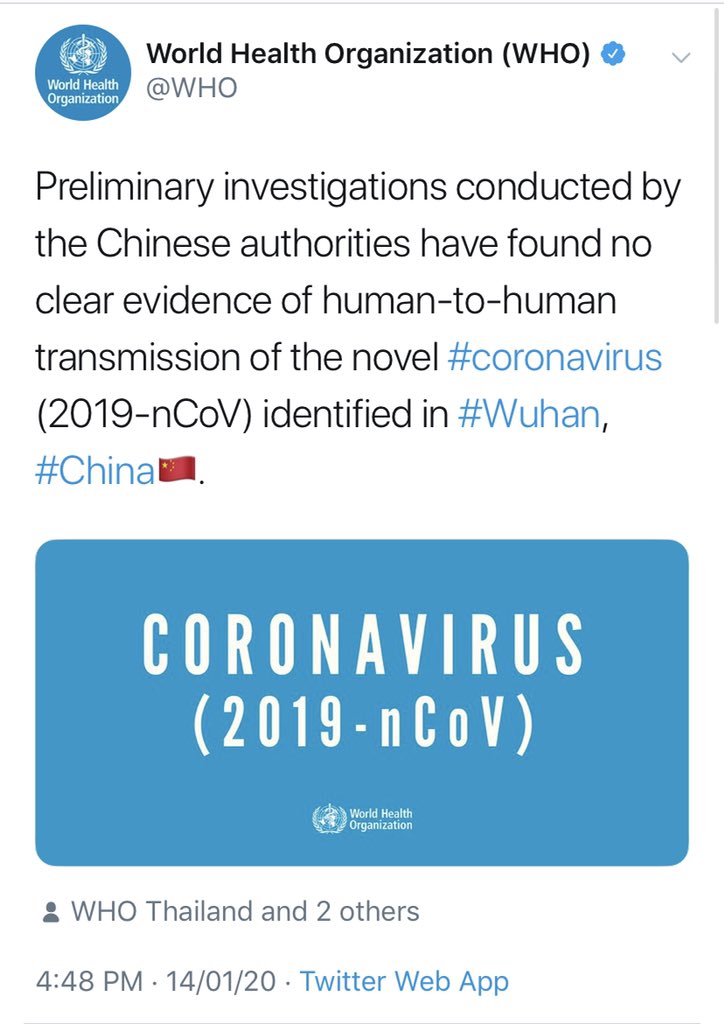


Where we live, due to local laws, we are now obliged to wear a mask to go shopping. Can one discuss that on YouTube, or would one be contradicting the WHO?
I fear there isn't "one truth" out there, despite the content providers' and fact-checkers' attempts :(
We keep trying to encourage our kids to ask good questions, then I see what's happening out there in the world, and I wonder when the grown-ups are going to start asking good questions...
[0] https://www.who.int/emergencies/diseases/novel-coronavirus-2...