His argument about digital watches did not age well.
My kids have known how to understand a digital clock since they were toddlers, but even now, in elementary school, they require entire lesson units in school on telling time from a clock face.
Beyond that, he argues that pie charts tell us more about the relationship between things than tables of numbers, and a clock face is "the world's most perfect pie chart." But a clock face is not really a pie chart. It does not indicate distribution among categories, as a pie chart does. The arms are not delimiters; they merely indicate position.
> His argument about digital watches did not age well.
Didn't it? I think it remains true. Time is a continuum, not discrete; analogue watches demonstrate that, while digital ones do not.
And yes, schools have to teach one how to use a clock, but at the end of the process one actually has enhanced one's understanding of time. Much like using a slide rule teaches one far more about numbers and maths than using a calculator.
Even if you're right that analog watches are better tools that's not what Adams was saying. "We all know, really, that [analog clock face] is a lot more instantly meaningful to us than 15:39" which is just wrong. Plenty of people, myself included, get more instant meaning from a digital readout.
> Plenty of people, myself included, get more instant meaning from a digital readout.
More from outside knowledge than from the digital readout itself. There's no way to tell from a digital readout there are 60 minutes in an hour or seconds in a minute, or that there's a 12-hour period that means something (and no hints to guess.) There's no evidence that the time represented on a digital readout changes at a constant rate or is sequential and doesn't jump around or go faster sometimes and slower others. Everything on an analog clockface is just there.
If you found an alien digital clock written in alien language, it would take you forever to figure out anything about it; it would take a while to figure out anything useful even if you knew it was a clock. If you found an alien analog clock, it would be immediately obvious what it was and what it was doing, and you could use it to help you understand the alien digital clock.
edit: also, when your alien digital watch did the equivalent of jumping from 12 to 1, it would throw everything off, especially if there were a different symbol for 1 second or 1 minute that there was for 1 hour. An analog clock visually explains the transition between 12 and 1.
I think all this stuff is obvious, I'm confused about the argument being made that it's not. There's just less information on a digital readout. I feel like I'm trying to explain that movies have more information than movie scripts, but Kolmogorov would say to compress them both and compare the filesizes.
> If you found an alien digital clock written in alien language, it would take you forever to figure out anything about it; it would take a while to figure out anything useful even if you knew it was a clock. If you found an alien analog clock, it would be immediately obvious what it was and what it was doing, and you could use it to help you understand the alien digital clock.
I disagree with this. This seems to assume that an alien analog clock would look/function more like our analog clocks than an alien digital clock would look/function like our digital clocks. I'm not sure there's any reason to make that assumption.
The only assumption is that analog means a gauge of some sort with a pointer or pointers moving between symbols, rather than a series of symbols that change for digital. I wouldn't have any problem with assuming a circular gauge (because we calculate periodic things using circle math), but it's not necessary.
That's kind of a big assumption, IMO. Why does it need symbols? Perhaps a hypothetical alien species has an analog clock that keeps track of times with shades of color. Or audio tones. Or it uses a gauge, but the gauge vibrates and the vibrations mean something.
Combine that with the fact that their time system might not be based on a fairly regular rotation of the planet. Perhaps they value some other less regular measurement more. Or perhaps their planet does not have regular rotation. How might a time system evolve and be portrayed in those cases? How can you be sure that an analog display would be easier to interpret than a digital one?
Similar to how a 12-hour analogue clock does not necessarily imply that we actually have 24 hours in our days, an alien analog clock could potentially be vastly different than the same alien's digital clock.
> I'm not sure there's any reason to make that assumption.
analog clocks are modeled around the idea that the time is circular because that's the natural cycle of day and night (same concept of the meridian, plus dark hours, when there is no shadow).
I imagine that any alien civilization that lives on a planet that rotates around its star and has a light/dark cycle would measure time in a similar fashion.
> analog clocks are modeled around the idea that the time is circular because that's the natural cycle of day and night
This is not supported by evidence. For one, it would make a 24 hour dial make more sense than a 12 hour one. For two, many early non-discrete clocks took the form of parallax observation or liquid flows and were not inherently circular.
hourglasses and other similar devices are for keeping discrete times, not continuous times like in
"it cooks in half of that"
but they are circular inherently, when the top half falls to the bottom, we flip them and the cycle restarts.
analog clocks started as 24 hours historically [1]. the division of days in 24 equal segments was well know since ancient history, we still use base 60 to measure time because that's what babylonians used when they invented time keeping and started counting days in a year (360 of them, in base 60)
If you limit the set of "analog clocks" to 24-hour dials, then yes, you have proven a tautology. If you look at the overall history of time device user interfaces then circular displays don't seem like such a slam dunk. I'll point you to Al Muradi of 1200's Spain again who often uses little doors or other time indicators.
there are bizarre incantations of everything throughout history
Almuradi clock is still a *solar* clock hence it only works when the light rays hit it, so like a meridian, it can't show the full 24 hours rotation. in fact it's an half circle, because the earth rotates around the sun, the only approximation you can get is circular, of course there are meridians that do not display hours on an arc of circumference, but that's simply a design choice.
But at that time the fact that a day was of 24 hours was a long well known fact.
the point is that if your planet rotates around a star, the first thing beings living there would notice are the repeating patterns generated by light rays. Which are most probably shadows creating something like a circle (or an oval)
>Almuradi clock is still a solar clock hence it only works when the light rays hit it
No, Almuradi's works are powered by water and moved by gears. At least one used light to illuminate particular numbers, but the optical aperture was moved by gears.
>Which are most probably shadows creating something like a circle (or an oval)
During the course of the day the shadows make a half circle at best. Over the course of a year the end point at the same time of day makes an uneven figure eight, known as the analemma. At no point is there a circle or an ellipse.
Passive solar timekeeping has its limitations and the next phase of development was the water clock.
These simple water clocks, which were of the outflow type, were stone vessels with sloping sides that allowed water to drip at a nearly constant rate from a small hole near the bottom. There were twelve separate columns with consistently spaced markings on the inside to measure the passage of "hours" as the water level reached them. The columns were for each of the twelve months to allow for the variations of the seasonal hours. These clocks were used by priests to determine the time at night so that the temple rites and sacrifices could be performed at the correct hour. [0]
If anything the circular three hand clock is a pragmatic method of indictors based on the method of power control. Looking at the Antikytheria mechanism for example, the back side shows a deep understanding of how the different cycles of time measures interact.
Going back to the original topic of "an alien digital clock written in alien language," to the degree that we could comprehend on what basis they kept time a time communication rooted in a sidereal period cannot be a given since the aliens might come from a tidally locked planet or one like Mercury which "rotates on its axis exactly three times for every two revolutions it makes around the Sun."[2] Even if they just used the Unix epoch time would look linear and relative; not circular.
Iirc historically the day was first split into 12 parts with sundials, and only later was the night also split into 12 parts. Maybe thats where the 2x12 comes from. I guess another benefit is that it's simply less cluttered with 12 divisions.
I don't think you're getting how important the word instant is in this context. An analog clock might be better for decoding an unfamiliar time system. It might be better for teaching children how we count time. It might implicitly contain more information. It might be better in a thousand ways. None of that matters.
For whatever reason I get a faster and more accurate sense of what time it is from a digital watch. I am not alone in this. Therefor the assertion that an analog readout is more instantly meaningful for everyone is wrong.
When I am at the train station I can have an immediate idea of what time is it just looking at the analog clocks around (they are digital displays mimicking analog clocks) even if I can't read the numbers from afar.
Digital clocks are harder for me because I have to parse the information: is that a 6, 8, 9, or zero?
It doesn't make much difference in the end, bit having to actually read the number forces me to be precise and I can't rely on intuition.
The more I age, the more my vision deteriorate, the more I find analog clocks easier to read.
Oh absolutely. Your experience is in line with what Douglas Adams was originally saying. Plenty of people get a better sense of time from analog displays.
I'm not saying digital works better for everyone. I'm not even saying digital works better for most. It could easily be the case that I'm in the 1% of weirdos who have an easier time with digital. My only point is that it isn't universal either way. Adams said digital watches are silly because everyone gets a better sense of time from analog. It is a funny joke. But he is wrong about the facts.
I think "faster" and "more accurate" are getting inappropriately conflated in this discussion.
It is faster to visually parse two hands of an analog watch than it is to parse four digits of a digital watch. But the price you pay for this is accuracy, and if you wanted to parse the analog watch face as accurately as digital, it'd take you more time than just reading the digits.
> Therefor the assertion that an analog readout is more instantly meaningful for everyone is wrong.
Maybe I'm confused about the assertion. The sentence "A picture with a bird in it" is more quickly recognized by very fluent English speakers than an actual picture of a bird. But it conveys far less information to a far narrower audience.
The problem with the original statement is the phrase "more instantly meaningful". It might be correct if it said "more meaningful", but I doubt it's more `instantly` meaningful for someone who can read numbers quickly.
I don't think there's anything more inherently meaningful about a digital vs analog readout, or vice-versa. They're both highly abstract representations of time, it really just depends on what you're used to.
That said, every single event on my calendar, and every single communication about time I have with other people is expressed as a written (or spoken) number, not as a position on a clock face. That makes digital clocks far more useful for me personally; it saves me the extra step of having to mentally convert to digital time before being able to reason about how the time on my watch relates to other events or significant times throughout my day.
To those who prefer analogue watches I have to ask; how does that process work for you? Do you find it easier to mentally convert written times to a visualization of a position on a watch, and then do whatever mental reasoning you need to do in that space? Or are you doing the same thing I would be doing if I had an analog watch; converting it to digital and then reasoning from there? If the latter, why does skipping that extra conversion step by using a digital watch feel worse from your perspective?
Digital easier to read, but I personally think analog is easier to “feel”. I get a much more visceral sense of urgency when the minute hand approaches an anticipated position. And same goes for when the hour hand crawls downward to signal the end of the work day. Seeing it physically close the distance to the 6 o’clock position gives me a much better feel for how much of the day I have left than “3:24”. It really is like a pie chart in that sense.
At this point in my life I am definitely much more used to reading a digital clock so I don’t think you can attribute this to familiarity.
Communications with others are expressed as a written or spoken number. But then calculations with that number (eg. "how long do I have?") have to be done with arithmetic. It's fairly rare that I wear a watch, but when I do, such as at a conference or similar, I prefer an analogue face. In this kind of case I prefer to visualise the time on the clock face. Then I can "see" the time remaining without doing arithmetic.
> If the latter, why does skipping that extra conversion step by using a digital watch feel worse from your perspective?
I'm quite capable of doing it either way, but my preference is to do the single required conversion to "analogue" so that repeated comparisons are visual and do not require repeated arithmetic. I also find it easier to remember a time visually, whereas single-digit errors in remembering a digital time can result in a greater error.
An analog clock is abstract in that it doesn’t show all the details of a globe with oceans and mountains and valleys and trees and lizards rotating and circling a distant light source with massive gravitation that appears to be arcing across the sky.
But it is a reasonable low resolution drawing of it, with some squiggly lines for reference, and arrows pointing in the approximate direction of the light source.
Having witnessed kids learning time: they will happily give "15:39" as an answer. But if you ask them when it'll be 4 o'clock, they literally have no idea - not even of yhe direction (forward or back).
I think this is Adams' point: digital watches pretend to give you information but only give you data. That's a reason to consider them silly: they make you work (translating their data to something with meaning) while pretending to do the work for you.
Note: analogue watches also require interpretation. But they support coarse- as well as fine-grained interpretation: is it before or after a whole hour? Closer to half than to whole? Or to a quarter? 10 past or to? Etc.
That's not a fair comparison because you're comparing 24 hour time with 12 hour time.
Granted, a digital clock won't tell you there are 60 minutes in an hour, but teaching analog time involves much more than that. For starters, you have to explain that for minutes, the numbers are in increments of 5.
I find the translation I have to do from 15:39 to 3:39 pm to have much more friction than reading a digital or analog clock in the first place, both of which I can do with equal ease.
The problem of course is that I'm not used to 24-hour times, so I don't equate 15 with any particular time of day. Similar to how I have to translate C to F to make sense of C temperatures.
Now, a 24-hour analog clock with an embedded digital temperature read-out in C, that would really hurt.
Counter example: I grew up using 12-hour time and still do to this day, with plenty of analog clocks all around, and yet I find it much easier and faster to convert between 24-hour and 12-hour time (just remove the leading 1 and subtract 2, if the hour is more than 12) than to parse an analog clock (identify which hand is which, convert the minutes to get an approximation, even more work if it's a stylized clock that might use roman numerals or not have any labels at all).
I didn't pick 15:39 that's the quote from Douglas Adams. He pretty clearly went with a hard to read digital time to emphasize the point that he (and according to him everyone else) can more readily get useful information from an analog readout. My own watch is a digital 12 hour display and that is more useful to me.
They may capture your concept of time, but I agree with the parent. I always have to translate "5 minutes before the hour" to "3:55" in my head before I really understand what was said.
In this age of digital displays, what people don’t realize is that 3:55 is “just a little bit” before the hour — which is immediately obvious on a circular display.
I don't think that analogue watches demonstrate the continuous nature of time. They tick. That's discretizing time. Sure you can omit the seconds hand or even make it run smoothly, and some do, but that's not reflective of the nature of the timepiece. You could just as well make a digital clock that fades out the unit seconds digit as the new one fades in. Or show digits until a blurby hundredth of a second, which some do.
That’s why the continuous motion ones are so sought after and pricy. The mechanical continuous motion watches are really marvelous feats of engineering
It's still continuous, as even when fully ticking, it still goes from point a to b passing through all the in between points... well, up to planck length at least...
Ticking just makes the motion jerky/abrupt, not discontinuous/discreet...
Ooh, alright, you win this one, but only on a technicality. I won't mention the fact that liquid crystals are also in a constant state of motion while under power ;-)
>Time is a continuum, not discrete; analogue watches demonstrate that, while digital ones do not
While obviously true, we often treat time as discrete to an appropriate level of precision. Timekeeping in sports is essentially all digital these days for example. And generally speaking (at least for some contexts), 10am really does mean 10am, not 10ish.
I actually normally use an analog display on my Apple Watch but I think it's mostly to have something different as pretty much all the other clocks I use, including the watch I usually wear, are digital.
The issue is 10AM has real meaning but you’re only actually at 10AM for an instant mostly you want to know how long until something happens.
Think of a meeting at 10AM with an analog clock you can get an intuitive feel for how long you have to finish what your working on. With a digital clock it’s easy to do the calculation but that distracts from the task at hand.
It’s most noticeable with a seconds. Many analog clocks include a second hand because it’s actually useful, while few digital clocks do so.
I find it much easier to judge how urgent it is to finish given the information that it's 9:54 than by looking at an analog clock. I wore an analog watch from age ~5-20 out of stubbornness and never got to the point where it conveyed useful information to me without actively stopping to think.
I think much like reading is abstracted to a point where the "shape" of the words conveys the meaning (and you can muddle up the inner letters without much loss of information), when you use digital clocks enough the subconscious meaning of the shape of the numbers is what you see. I don't have to do a manual conversion to understand from the 16:54 on my phone screen that I have 5 minutes until 5pm - I just "know" that from a single glance.
Ultimately both digital and analog clocks are abstractions which convey meaning to whatever our internal sense of time is. I suspect the internal concept of time is quite different for everyone (hence why my mum is always late for everything...)
I can't say I've ever taken the second hand into account when looking at an analogue clock to check the time, nor do I usually find myself reading the minute hand more precisely than 5 minute intervals. I've certainly watched it slowly approach 12 when waiting to get out of class or something like that, but I could just as easily watch a number count up toward 60.
It’s a useful skill. Anyway, you don’t actually need a second hand to get sub minute precision as a minute hand should be continually sweeping through the range.
Which is why people in the thread are talking about the feel of time. You can get an intuitive feel of how much you need to speed up etc.
I was aware I had poor eyesight, but I'm kind of amazed to hear that there's anyone who can clearly see the position of a minute hand between two tick marks on a clock from any reasonable distance.
How many analogue clocks do you have which you trust to be that accurate? One huge advantage of a digital clock (on a phone, anyway) is that it's NTP synced with an atomic clock - so it's highly accurate and will remain that way.
I know that when I'm running for a train, I rely on my phone more than my analogue wristwatch - because the analogue clock is rarely perfectly accurate, and that matters.
If you are talking about 12-hour analogue watches, no. They wrap the continuous time into some non-intuitive measure that needs an external context to determine the actual time of day. They rather demonstrate that time needs to be as precise and accurate as needed; the continuity of time doesn't always matter.
I think this is more of a "different people's minds work differently" thing than an age thing. Some people who grew up in the digital age still find analog clock faces more useful. Here's a short youtube video exploring that https://www.youtube.com/watch?v=ZArBfxaPzD8 . I think Adam's mistake was assuming the preference for analog was universal which was probably wrong even when he first wrote the joke.
I think the argument could be made for a clock face being a pie chart if you think of it the way the host of that video does. The categories are "time left in the hour/day" and "time passed in the hour/day".
All that said I was really happy to finally understand what Adams was trying to say with that joke witch, as a person who finds digital readouts more useful, never landed for me before.
The author’s point was that technology was making people stupider. They’re being told what to believe and their data source is isolated from reality so not only are they easily fooled by those who control the sources of information, they lose the ability to process data on their own, and they do it to themselves for reasons as banal as fashion.
I'm 37 and have a hard time parsing clock faces, I remember having a hard time with it in kindergarten and they basicaly wrote it of as me being a little prick and refusing to do it right
I was very surprised that anyone at all would find digital displays harder to read than an old-style clock face. Learned something new just now. I'm 37 too.
I am just apparently very bad at estimating which hand is the longer one (if there's not a huge amount of difference). Once I figured that out... reading the time is not a problem.
Same for me. My house had loads of analog clocks when I was growing up, I had one for a watch for over a decade, but still it was always a little bit harder to figure out than digital for me.
> in elementary school, they require entire lesson units in school on telling time from a clock face.
I'm not sure our age difference, but as a millennial I'm pretty sure we did when I was in elementary school as well. I don't remember which grade though, I didn't learn about how to read those watches from my parents. Digital clocks became so common that I never cared for it. Same with cursive, because of computers making cursive really pointless, I don't know how to write in it outside of my own signature.
Numbers on a digital face can be read by anyone who knows numbers.
Just yesterday my toddler told me it was 6 oclock because the big hand was pointing at the six.
Trying to explain to a three year old that the small hand was for the hour, and the big hand pointed at a number which you multiply by 5 to get the minutes was beyond him.
Funny how we got downgraded into "smart watches" that barely hold a charge for a day and are good at everything other than telling the bloody time. Having an always on display is an actual feature nowadays lol
People said the same about smart phones compared to Nokia candy bar phones with battery lives that lasted a week.
In exchange for charging my cellular watch every night, I get a device on my wrist that can make phone calls, stream music, store 16GB worth of music, has GPS for when I run, monitors my heart rate, gives me notifications and let’s me send messages.
If I went into coma in 2009 and the most advanced piece of technology that I knew at the time was the iPhone 3GS or the then current laptops and woke up in 2022, I would be much more impressed with the Apple Watch than any other piece of technology.
I still use my Pebble Time; I can't understand why you'd buy a watch with a battery that lasts less than a week.
(I've had people tell me that you just put an apple watch on the charger overnight. Then why does it have a sleep tracker app that requires the watch to be on your wrist?)
There are smart watches that will go for weeks on a charge. They automatically set time based on the cell phone network and GPS so are always accurate to within 1 second.
> Funny how we got downgraded into "smart watches"
We didn't get downgraded. The "dumb watch" product category is still alive and kicking. Whether it's the more moderate priced quartz segment, or the less moderately priced mechanical segment it's not even slightly dying. What we've gained is choice.
And I say this as someone who would never buy a smartwatch because it would need charging. I have a perfectly decent Citizen analog watch that has worked perfectly every day since I bought it five years ago (not even needing a battery change because it's solar powered). I occasionally consider splashing out on a mechanical watch, but even a 3 year servicing interval would be tedious.
I would never wear a watch that had to be charged every day. My Amazfit Bip (stupid name, I know) is good for about 6 weeks if I don't use the GPS and heart monitor, and 2 weeks if I do.
Sure it does - for example the portion of the hour in front of the minute hand's sweep is "in the future" whereas the portion of the hour behind the minute hand's sweep is "in the past" and the portion of the hour under the minute hand is "now".
Three categories, and the distribution of the current hour's minutes between them
It's really two overlapping pie charts, each hand forming a side of a slice with an imaginary line from the center to the top forming the other side. We read them together, but to work as pie charts they have to be read separately.
You can't get much useful information from the hands' relationship to each other without knowing their relationship to the imaginary up line. If I say, "The hour and minute hands are 30° apart", what does that tell you about the distribution of time into past and future?
The hour hand shows distribution of hours between most recent 12 and next 12 into past and future. The minute hand is an entirely separate chart showing the distribution of minutes in the current hour into past and future.
Trying to read a clock from the frame of a pie chart is kind of confusing though, given this overlap. I don't think I would call it a good pie chart, much less the most perfect one.
Imagine Douglas Adams thinking that within a single generation, digital clocks would render the majority of smart, technical people adult people to not only be unable to read a clock but also unable to grasp the idea of fractions, ratios, time elapsed or remaining, or the concrete nature of the way days occur in the physical world.
Are you sure this is not just the amount of exposure to each type of clock?
On the other hand, I’ve noticed that children who understand how to read only digital clocks are quite capable of answering what the time is (just read the numbers right off), but have trouble telling how many hours there are from 10am to 3pm.
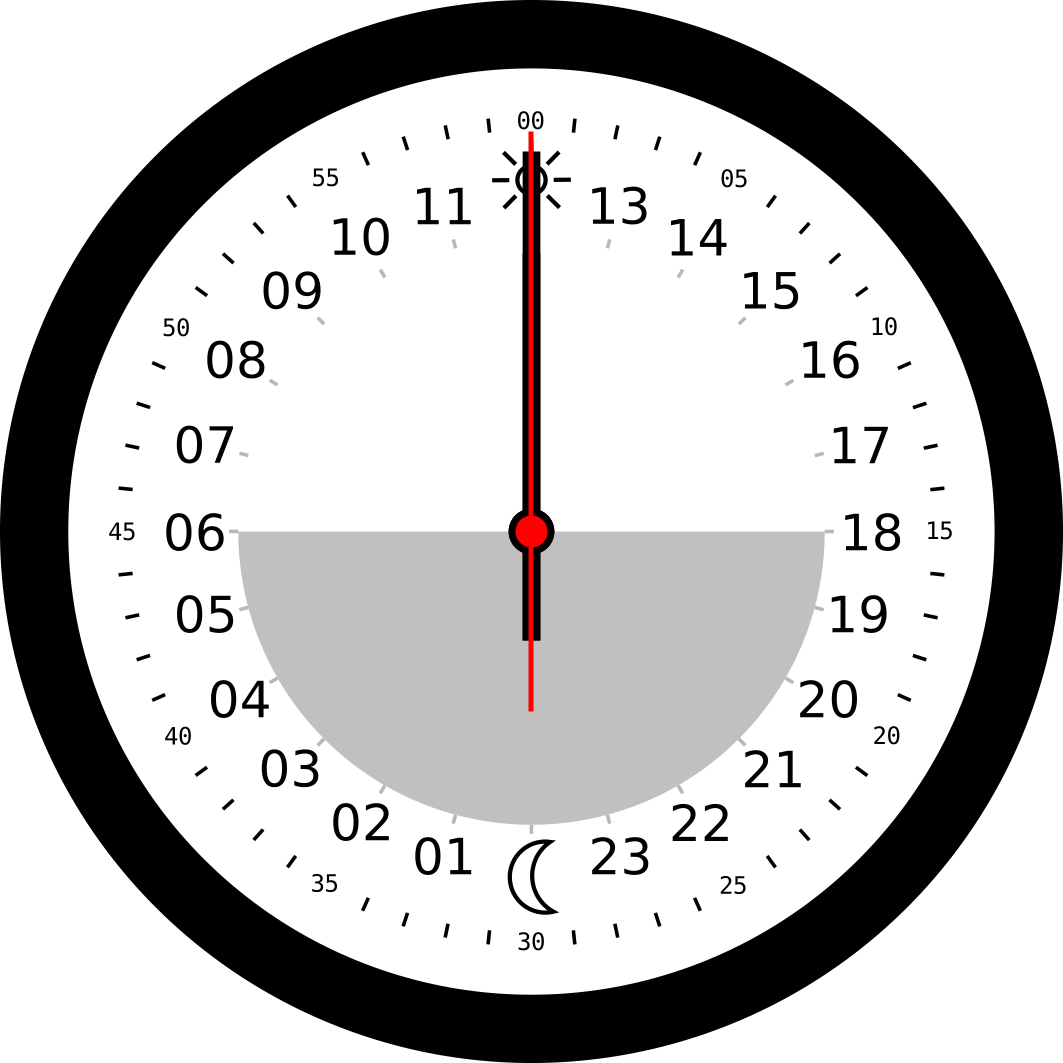
Related, I made a little toy[0] that lets you explore what analog clocks would like with an arbitrary number of hours in the day (since 12/24 is of course arbitrary too).
I've been staying at that click for a solid ten minutes, but I can't figure out why minutes and seconds start on top, but hours on the bottom. Any idea why that particular choice was made?
Adding additional info to my sibling comments. Since the bottom is designed to show night, it would be cool to grab a geolocation and draw the bottom based on sunrise/sunset times.
the 24 hour clocks I've seen usually are set up like this so daytime is the top half and night time the bottom - as though the tip of the hour hand was the sun
This is very nice as it addresses the zero-index nature of time by going 0-23 instead of 1-24. Time would be much more comprehensible if all clock were marked that way.
Ok, it is interesting that the top of 12h clocks in those countries is often a 12 instead of a zero [0]. Maybe the tension of a cardinal zero in an ordinal world (i.e. 1900 is the 20th century) lead the Swiss Railway to de-number the 12h clock [1].
> Are you sure this is not just the amount of exposure to each type of clock?
I have a large analog clock in our living room that I look at every other day or so. I still find that I instantly understood the digital watch, but with the analog watch example I had to actually stop and look carefully at it for a second.
If I had a analog wrist watch I used every day I'm sure I'd be equally good with both. But I really think it takes more time to get used to the analog version. At least in modern society when we have numbers all around us all the time anyway. I'm sure someone who's not literate would feel very differently.
Digital time is inherently superior. Analog time requires the extra cognitive step of translating to the numbers being represented. Digital time skips that process and shows you the numbers directly.
This thread has devolved into what sounds like a bunch of web devs that think that makes them experts on perception and psychophysics.
But on this point there isn’t anything inherently more abstract about Arabic numerals as a representation of numbers than the angles of the hands on a clock face (ie a short hand to the right is 3 and upright is 12, etc is a pretty efficient way to convey a number). As for what can be read quicker probably has overwhelmingly a lot to do what was learned in youth. Similar to stenographic shorthand this can probably be acquired but there just isn’t much incentive to do so.
There isn’t necessarily any extra “cognitive step” in the pattern recognition of a clock face vs that of a numeral.
I don’t know much about research on this particular area but there is some in the related area of written language.
Teaching kids about analog clocks isn't just about telling time. It's teaching them about how gauges work.
If they can understand how the hour hand goes around, they can understand how a fuel gauge goes from Full to Empty. They can tell how a battery gauge on their iPad means they're running out of power.
Neither numerals nor configurations of clock hands are numbers and both require a translation step. For what it's worth, time isn't a number either and you translate from a number to a time.
You make a good argument about people growing up with digital clocks not understanding a clock face.
Maybe if you fill in the area covered you could more easily see it’s relation to pie charts.
A clock face is actually 3 pie charts on top of each other, indicating the ratio between hours, minutes, and seconds left in a sequence.
It might not be intuitive that it only covers half of the hours in a day (12) but then covers all minutes in an hour (60) and seconds in a minute (also 60).
By looking at the long hand (minutes) you can see the fraction of an hour that has elapsed if you color in the area between the “12” at the top, and for example, the “6” at the bottom. That would be half an hour. Or if the hand was in the “3” it would be a quarter hour, and you and see at a glance that a good majority of the hour is still remaining.
Seconds work the same way, with the skinny hand. For minutes and seconds you can just ignore the big numbers (or multiply then by 5 because 12 * 5 is 60).
But because the hours only cover half a day the ratio covers only half of that day, but you can still use the clock to decipher how much time has elapsed (or is left) between midday and midnight.
Having grown up with digital clocks, and only sweated through the difficult lessons of learning to read a clock face and not used them practically, even at school, you may not have realized this ratio (staring at the clock waiting for class to finish does not obviously indicate this property because classes are not evenly divided into hours)
Analogue displays are quicker to read, but less precise. Which is better depends.
On analogue clocks, it doesn't usually matter if I think it's 8:32 when it's really 8:34 unless I'm running for the train. However, I often make the terrible mistake of reading the wrong hour entirely. For that reason (and that I'm frequently running for trains) I do generally prefer digital clocks.
For a rev meter on a car on the other hand, all I care about is if it's getting too far to the bottom or too close to the red. Whether it's 3218RPM vs 3389RPM is entirely irrelevant. So for that, analogue is far better.
For flying, I quite like that electronic flight instrument panels have both analogue and digital displays.
In the cockpit, airspeed and altitude used to be presented on a dial like a watch (one hand in the case of airspeed, two hands or even three in the case of altitude).
In modern cockpits with screens, they could be presented like that, or just as numbers, but they are presented as infinite bands that move up and down. One sees the number on it, but also perceives movement (and how fast it moves) "out of the corner of an eye". Maybe it combines the advantages of both.
Yea I am not sure I get his argument much at all either. While I love my analog watches and wallclocks I also have digital ones. If anything I think the argument should be that the AM PM system is just ridiculous - why do we use it? I am an american but always switch all clocks to 24 hour time (if digital) and while I am completely used to analog clocks being on the standard 12 hour cycle it always also seemed crazy to me that we do not just all use 24 hour analog watchfaces.
seriously, I am a GenXer who grew up with mostly digital clocks and I still have to stop and think to get a time out of a clock dial.
But then again as Adams said elsewhere, Time is an illusion; lunchtime doubly so. That one still rings true, especially if you're a freelancer like me who never needs to get up and go to an office at 9AM.
If I just want a sense of progress of time, especially within an hour, an analog clock works just fine for me. It obviously is more work if I want an exact to the minute time for logging something, and then it must be converted.
On the other hand, analogue might probably slightly easier if I just want to get an to the nearest 15 minutes approximation of the time. If reading from an analogue clock, I'll probably say it is 3:30, but would say it is 3:27 if reading from the digital clock, as reading it exact is faster than rounding it. I have had people seem bemused by my telling them the precise time like that, but like, I'm not going to make more work for myself to make the time less precise to better match tradition.
But unlike some other people I know, I don't have much difficulty understanding the progress of time with a digital clock either. 13:54, and the equivalent clock face both give me equally good impression of how much time is left until until 14:00, and I feel no need to translate either into the other for that purpose.



My kids have known how to understand a digital clock since they were toddlers, but even now, in elementary school, they require entire lesson units in school on telling time from a clock face.
Beyond that, he argues that pie charts tell us more about the relationship between things than tables of numbers, and a clock face is "the world's most perfect pie chart." But a clock face is not really a pie chart. It does not indicate distribution among categories, as a pie chart does. The arms are not delimiters; they merely indicate position.